
Ben Zweibelson, U.S. Space Command, Colorado Springs, Colorado, United States
As of 2026, the NEXUS concept remains experimental and in development across various defense organizations, allies, partners, and agencies. This NEXUS article is theoretical, drawn from open-source content, and intended as a thought piece to stimulate further institutional debate.
Introduction
The U.S. Department of War’s (DoW) reliance on the Joint Planning Process (JPP) as a universal tool for all security challenges may require new thinking beyond existing institutional compliance and doctrinal adherence. The JPP provides a universal decision-making template for regionally fixed, domain-isolated combatant commands and foreign equivalents, based on national-level strategic designs that fracture the world into more manageable geographic and domain-centric “chunks.”[1] For example, Taiwan is within the operational purview of the INDOPACOM Commander, while the EUCOM Commander focuses on the Russia-Ukraine conflict. USSPACECOM handles everything 100 kilometers above our planet, while USSOCOM has unique authorities and capabilities to execute sensitive activities in what is best characterized as irregular and unconventional warfare.[2] Although there are robust liaison cells and collaboration across the U.S. Department of War, what the military instrument of power does (and how doctrine guides it) differs greatly from the U.S. Department of State, as well as the processes and institutional particulars of related international partners and allies.
This creates a specific but often overlooked vulnerability. The JPP is a robust, linear process designed for conventional, well-defined problems, but it is arguably unsuited as an exclusive decision-making tool for the complex, ambiguous, and multi-domain security dilemmas we face today. Cunning adversaries are using new technological abilities to open entirely novel pathways for conflict that were not possible even a few decades ago. It is not that JPP is incapable of orchestrating difficult security activities across multiple regions (or globally, or astro-globally) and through domains that do not readily conform to the geographic confines assigned to military organizations. Rather, JPP was designed for an earlier period of war and conflict conducted at slower speeds, on regional scales, between states and non-state actors operating within largely physical and service-specific domains. Campaigning, along with planning doctrine, now holds a near-ideological grip on military organizations that stifles innovation and prevents new theories from even being considered if they threaten the status quo. It is less a science and more a religion; challenging assumptions within the former defines the discipline, while rigorously defending orthodoxy within the latter expresses the other.
NEXUS, currently employed as a model, represents an emerging strategic approach that provides a unifying yet alternative framework for addressing highly complex, dynamic security problems.[3] These challenges are trans-regional in scale, multi-domain in configuration, and assume alternative organizing logics that dynamically offset or compromise traditional Joint Planning and campaigning activities if pursued in their originally intended, geographically bounded, and domain-prioritizing configuration.[4] NEXUS utilizes a synthesis of space, cyber, and special operations activities (with globally sustained strategic and nuclear deterrence) while integrating complexity science, design thinking, and other disciplines often misunderstood or marginalized within contemporary military doctrine. Lastly, NEXUS requires international networks that prioritize allies and partners, along with relevant industry and academia, in ways that vastly exceed existing military campaigns and plans. This positions most NEXUS frameworks above any singular Combatant Commander and within highly challenging international constellations. NEXUS, if developed in the right design direction, could evolve from its current model status into a broader design framework that utilizes alternative theories, methods, command-and-control (C2) structures, and authorities.
As we will explore below, JPP (along with campaigning and operational design) emerged during an earlier period of modern civilization when the military instrument of state power achieved strategic goals through mastery of the physical domains (air, land, and sea) and geographically bounded campaigns of operational planning and execution. These approaches nest tactical victories across time and space within a world where humanity remained largely tied to the physical, local, and cultural realities of place. The military instrument of state power engages only indirectly and rather awkwardly with other government agencies such as the Department of State or the Department of the Treasury, while international partnerships are further stifled due to classification issues and information-sharing constraints. For functional commands, the distortions between cyberspace, civilian populations, and the space domain produce even more tension, particularly due to how cunning adversaries exploit physical seams and institutional gaps.
Modern security challenges are not only becoming more sophisticated from technological, sociological, and geographic perspectives; the requirements for orchestrating military, interagency, international, commercial, and dynamically scaling activities now exceed even the most organized and well-equipped combatant command headquarters. This is not to declare all military campaigning or operational planning obsolete, as most specific military challenges across the globe are still effectively managed or solved using existing doctrines, organizations, and technologies. Certain security challenges, specifically those requiring national and international integration of multiple instruments of state power, channeled predominantly through the space-SOF-cyber construct, require strategic designs beyond the intended capacities or capabilities of military organizations utilizing JPP alone. This is where a new “NEXUS” of concepts, authorities, information-sharing, and operational harmonization may offer a needed, though disruptive, alternative to legacy military campaign design.[5]
To maintain strategic advantage, the DoW is poised to potentially adopt a dual-system approach through several decades of experimenting with design methodologies, coupled with recent Combatant Command and Service interests in certain NEXUS arrangements involving space, cyberspace, and special operations activities and authorities. NEXUS has the potential to provide international, trans-regional, cross-functional teams—including foreign ministries, space organizations, cyber forces, and SOF elements—a framework to communicate, share information, and execute security actions beyond the authorities and capacities of any single combatant command. Although this is a minority position sustained through military theorization and experimentation, we are likely in a transitional period of technological disruption and social change where deep introspection upon the military pillars of decision-making should be encouraged, not asphyxiated. “Innovation” is on the lips of nearly every senior War Department leader in 2026, yet why does the military institution shudder when certain institutionally sacred cows are considered for slaughter? If so, how might necessary change unfold quickly enough to thwart strategic surprise?
In this article, we will examine NEXUS as an emerging military model that presents several strategic, organizational, and technological tensions with existing military planning methodologies and doctrinal constructions. The term itself is interchangeable and disposable, as NEXUS drew inspiration from the earlier TRIAD concept and, prior to that, other precursors. The fact that multiple Combatant Commands and military organizations around the world are examining the NEXUS construct warrants deeper analysis of existing military decision-making—not only in irregular warfare and strategic deterrence contexts, but across much of contemporary doctrine. First, we must offer a working definition of NEXUS as a point of departure; this is only one of several interpretations, and the emergent properties of how various populations seek to frame NEXUS amplify their deeper-held beliefs on warfighting, military organizational form and function, and likely their understanding of war itself.[6]
Within the NEXUS community of practice, which remains highly experimental at the operational and strategic level, there are three camps holding incommensurate positions. The first group adheres to institutional orthodoxy regarding existing doctrinal concepts and largely characterizes NEXUS as “still just joint planning with some buzzwords for space-SOF-cyber activities.” They advocate a return to the basics of campaign planning and operational design through training and education, particularly across the space-SOF-cyber domains. A second group endorses NEXUS as an emerging security process that fills an important strategic-level, international, and multi-domain “meta-space” that dissolves organizationally imposed boundaries, rules, and policies. The third group, from which this author unabashedly writes, considers existing doctrinal planning methodologies incomplete and increasingly irrelevant outside regionally specific, limited conflicts and crises. This group frames NEXUS as the new way to design conflict in unconventional and irregular warfare contexts that prioritize military designs in ways that, if rendered under traditional military planning methods, would be dismantled, marginalized, or omitted entirely.
Which group is correct? All three hold important and relevant positions regarding twenty-first century conflict and security affairs, yet all three cannot be equally right either. We are at an intellectual crossroads of sorts today, with various camps staking their claims on whether NEXUS is something new for a cross-functional, multi-agency, and international team to develop strategic processes toward; whether it is merely existing joint planning done with new buzzwords; or whether it represents some transformational break with twentieth-century doctrinal and geographically oriented concepts that are increasingly fragile. If we truly require a military construct operating beyond the authorities and capabilities of any individual four-star general and combatant command headquarters, how would such a strategic enterprise operate? How would we better integrate crucial strategic coordination through diplomatic channels using the State Department and foreign equivalents, in conjunction with novel cross-functional teams that extend into multiple allied and partner military instruments of state power, with further linkages into essential commercial and academic networks?
Experimental Phase: NEXUS is Going to Be Whatever the Institution Decides…
Much of the NEXUS work remains at a grassroots and experimental level, lacking, as of 2026, any formal institutional or Joint Staff acknowledgment, with robust skepticism from institutional defenders of the status quo. Tactically and technologically, NEXUS-like activities are occurring across the globe through space, SOF, and cyber practitioners, along with certain industry and academia partners recognizing changes afoot. At higher levels, where NEXUS requires clarification and certain international declarations or policy positions, the movement remains hesitant, with significant tensions between a desire to accelerate change and a fear of increased strategic risk. NEXUS, as a developing concept, is rather vulnerable: potentially a game-changing opportunity, yet also a framework susceptible to hijacking. If the military as an institution prefers to kill the concept, it will likely be moved to the historical trash bin along with the “Gray Zone,” the brief and forgettable “SOCOM Design Way,” and other insufficiently developed concepts.
As an evolving experiment, NEXUS remains open-ended and deserving of serious evaluation, critique, along with robust improvisation and innovation to stimulate iterations of new developments. We will attempt to frame the entire NEXUS debate here and offer detailed commentary on what is working, what requires modification, and where new NEXUS initiatives will likely create disruption within institutions that otherwise rely on doctrinal conformity, hierarchical decision-making, and the habitual “stove-piping” of activities from those considered “outside” the bubble. There are other advocates using NEXUS who likely disagree with some or all of this article, and they are encouraged to articulate those alternative arguments so the military profession may gain greater awareness of where this experimental construct may move next.[7]
This article also makes a case for using strategic design methodology to address the Department of War’s most complex and dynamic security challenges.[8] These are trans-regional, multi-domain, and intentionally configured in ways that exploit twenty-first century technological, societal, and informational developments. The modern battlefield presents problems that defy traditional, linear military planning despite exceptional specialization, analytical optimization, and rigorous professionalization of forces that solve dangerous yet manageable problems. NEXUS represents one way the DoW can adapt when facing “wicked” security challenges that cannot, by their nature, be solved by the existing Joint Planning Process or conventional, regionally aligned campaign designs. NEXUS is outlined as an alternative not to replace JPP or campaign planning, but to operate outside and beyond those institutionalized limits. The DoW needs to become proficient in both pathways for warfighting, which requires significant yet achievable institutional change.
NEXUS represents an emerging strategic design approach that provides a unifying yet alternative framework for addressing highly complex, dynamic security problems. These challenges are trans-regional in scale, multi-domain in configuration, and assume alternative organizing logics to dynamically offset or compromise traditional Joint Planning and campaigning activities. NEXUS utilizes a synthesis of space, cyber, and special operations activities outside and beyond existing joint doctrinal decision-making methodologies while integrating complexity science, design thinking, and other disciplines unavailable in military doctrine currently.[9] Strategic design activities occur outside NEXUS, yet in the contemporary security environment, a synergy between the space domain, the cyber domain, and special operations activities in global irregular warfare contexts suggests a well-defined area for design applications.[10]
Joint Planning and regionally aligned campaign planning efforts may be increasingly insufficient and counter-productive for the complex security challenges emerging today. NEXUS, as an alternative framework drawing from complexity science and design thinking, potentially offers novel strategic management for unique combinations of War Department and other entities/partners in combined activities. However, campaign designs and regionally oriented joint planning methodologies appear highly effective at the numerous military problems routinely encountered by Combatant Commands in non-NEXUS contexts; productive military campaigning remains valid in regionally bound and specific problem sets. Both strategic design thinking and joint planning methods must be retained and sharpened by the War Department. NEXUS represents the necessary way forward for particularly wicked security challenges that otherwise cannot be strategically understood or managed. As of 2026, only a limited number of NEXUS exercises and one NEXUS course exist across the War Department, with few articles and monographs having been published.[11] These concepts are being utilized by a minority of practitioners; the broader organization struggles with defining what NEXUS or strategic design is and how it works.
The Strategic Chest Wound: A Flaw in Our Dominant Warfighting Logic
The Department of War has perfected a highly effective, industrial-age model of planning.[12] The JPP is the embodiment of this logic: a systematic, sequential process that deconstructs a known problem, analyzes courses of action, and produces an executable order. This approach is highly effective for challenges where the problem is clear, the actors are known, and the desired end-state can be simply articulated. We can call these “tame” or “complicated” problems. Examples include planning a conventional force-on-force engagement or organizing a large-scale logistical movement. The JPP solves these problems with engineered precision. However, today’s most pressing threats are not tame. They are “wicked” or “complex” problems. These concepts are explained in detail in the following section. As an introduction to complexity science, organizational confusion between tame and wicked challenges produces serious and deadly consequences.
Applying the JPP to a wicked problem is like using a factory assembly line to raise a child. Raising a child is a complex, non-linear process that involves constant adaptation, learning, and relationship-building; there is no instruction manual or predictable end-state. Often, parents marvel at how far from reality their original thinking was regarding how to raise a child. Similarly, confronting ‘gray zone’ aggression within irregular or unconventional warfare contexts, countering global ideological terror movements, or managing trans-regional security competition in cyberspace between myriad states, proxies, and non-state actors are wicked problems. Forcing them into the rigid, linear framework of the JPP does not lead to a solution; it often exacerbates the situation or creates new, unforeseen crises while the original (and periodically updated) goals become increasingly obsolete.[13] The JPP seeks to find the right answer to a problem, but for wicked challenges, the right question is constantly changing.[14]
Due to this decision-making mismatch, the wrong indoctrinated concepts are applied toward security challenges that naturally resist them. Geographically aligned Combatant Commands (along with allies and partner nations) lack a unifying and strategically centered framework to design and implement strategic-level deliverables tailored for trans-regional, multi-domain contexts outside their directed regional focus areas.[15] This is further frustrated by classifications, restricted access, lack of special skill or domain familiarity, and the contradiction that not all security challenges can be bound within geography, domain, or available organizational authorities. Lastly, our own institution banishes most design concepts from serious and introspective discussion; military “heretics” must develop and implement new, unorthodox concepts from the shadows, largely disconnected from formal processes, schools, training centers, and doctrinal revisions. French critic Jean-Baptiste Alphonse Karr said this best: “The more things change, the more they stay the same.”
Key Definitions, Theories, Doctrinal Processes: “The Strategic Scene Setter”
Military organizations draw from scientific disciplines, yet they are not themselves scientific in military decision-making methodology, doctrinal publication, or the selection and review of emerging and competing theories.[16] Professional military educators might protest such a statement, yet any rigorous defense of contemporary military concepts and processes always reveals pseudo-scientific qualities due to how the military profession, over the last three centuries, sampled extensively from the physical sciences, Industrial Age managerial theories, and clearly stated reform efforts by military theorists attempting to modernize militaries by emulating the natural sciences.[17] J.F.C. Fuller, in his highly influential Interwar Period writings, demonstrates this succinctly:
“If we understand the true reason for any single event, then we shall be able to work out the chain of cause and effect and, if we can do this, we shall foresee events and so be in a position to prepare ourselves to meet them… military power is controlled by similar laws to those which govern [physical laws of nature] force, consequently the aim of the soldier is to harmonize his mind to the workings of these laws.”[18]
Modern militaries develop their doctrines to employ institutionally preferred decision-making methodologies (such as JPP) because these processes are visibly superior to any pre-industrial, Feudal Age, or pre-scientific frameworks used by earlier armies and navies. In the last several centuries, militaries have professionalized by adapting theories and models and arranging them within decision-making methods to solve a wide range of dangerous and deadly battlefield problems. In past conflicts, mastering the ability to identify, diagnose, and employ established (regulated, indoctrinated, standardized) behaviors and techniques at the tactical level could, in aggregate, achieve myriad strategic goals. Operation Overlord, the Allied invasion of the European continent in June 1944, provides a master class in how modern militaries can use some version of contemporary planning methodology to achieve critical battlefield outcomes. Yet today, in a larger and arguably more technologically, sociologically, and physically dynamic world, we face different systems to navigate.
Russell Ackoff (complexity theorist) defined four human strategies for addressing problems.[19] Problem absolution meant ignoring a problem until it no longer was relevant. ‘Problem solution’ involves deterministically and analytically breaking things down to identify the optimal solution, validating and then increasing efficiencies and effectiveness. Problem resolution addresses systemic problems that must be managed across competing and incompatible beliefs, ideas, and perspectives; the act of resolving only provides temporary order in unsolvable system contexts.[20] Problem dissolution, Ackoff’s fourth archetype, requires planners to design a new approach that causes systemic change, ushering in a new system where the ‘problem’ is dissolved in the transformation from legacy to emergent system state. The new system carries different and potentially unfamiliar problems now possible in the new system design.[21] Attempting strategies toward perceived security problems requires a change in thinking (what type of problem is this) coupled with a broad, systemic framing (organizations prefer certain strategies over others and may invent problems while misinterpreting or assuming strategic dominance over alternatives).
In complexity science, theorists generally converge on four basic forms of system behavior: simple, complicated, complex, and chaotic systems.[22] All systems are inherently dangerous and destructive when mishandled, yet these system archetypes exercise distinguishable behaviors. Additionally, these are not static categories; a single security challenge will blur between many system configurations, often with some morphing from one to another, with elaborate networks forming and changing even as strategists try to make sense of different aspects of the challenge. Simple systems are stable, ordered, and, once broken down into essential components, can be ‘solved’ in an analytically rigorous, objectively verifiable, and repeatable process. Complicated systems lack the simple system’s singular and optimized solution yet retain certain order and regularity where a collection of experts can analyze and construct a range of ‘good enough’ options (courses of action) to provide both variety and specialized outputs. Complex systems resist the analytical processes and sequential ordering that achieve results in complicated system contexts. Instead, organizations encountering complexity require innovation, experimentation, and design thinking.[23]
Einstein remarked, “the world as we have created it is a process of our thinking… it cannot be changed without changing our thinking.” Chaotic systems represent contexts where only novelty has a chance of success and all established or institutionalized processes are certain to fail. All existing tools and processes will fail, requiring us to “change our thinking” rapidly and in divergent, creative directions. Although chaotic systems do follow certain “rules” that define chaos, the distinction here by complexity theorists is one of sociological comprehension. People experiencing chaos are in a higher-risk category in that all existing institutional methods, doctrines, and practices carry a higher failure rate due to how chaotic systems behave; literally nothing works in a chaotic system as it might function in other systems. In complex system contexts, some resistant or robust organizational processes may still be successful or provide certain foundations for planning. In Snowden’s Cynefin model, organizations that overinvest in simple system mastery face a unique institutional hazard of collapsing into a chaotic system state in a surprising and highly destructive systemic shift.[24] Examples of this include both sides in the First World War trapped in trench-warfare frontal assault stalemates, the operational failure of the French main forces in 1940 and the ill-conceived Maginot Line, the American Army fixation on tactical, kinetic metrics (largely irrelevant) in the Vietnam Conflict, American and Allied inability to wage coherent counterinsurgency campaigns in Iraq and Afghanistan (2001–2021), and Russian strategic miscalculations in anticipating Ukrainian military and societal resolve (2022), which might be the start of an extensive list.
War contains all four system types in a dynamic and ever-changing configuration where systems sit within other systems and collectively generate new combinations.[25] Organizations that treat all problems using the same decision-making methodology will masterfully handle only those systems that respond to such strategies. Again, this harkens back to a Newtonian, Napoleonic Era of Conflict when states wielded their military instruments of state power, emphasizing uniformity, standardization, and mechanistic reductionism.[26] These military doctrines calcified well before complexity science, as a twentieth-century discipline, emerged. This, in turn, illuminates what is now a twenty-first century technologically equipped military organized along nineteenth century industrial management theory paired with eighteenth-century military decision-making logic. [27] There is one more framework relevant to how human beings define and address what they call “problems.”
In the 1970s, organizational theorists, complexity scientists, and designers divided problems into another bicameral arrangement: tame and wicked problems.[28] In the last several decades, these terms have grown more popular due to how pressing challenges facing societies are increasingly complex, with many now featuring trans-regional, multi-domain, and ill-structured configurations that appear incompatible with existing governmental and organizational structures (including the Napoleonic Staff model). Wicked problems have been extensively studied outside of military doctrinal publications, where such concepts would contradict the Newtonian-styled framework for military planning.[29]
Tame problems still are incredibly deadly in war, but able to be solved (optimized, repeatable), resolved (managed with some order and prediction), or absolved (ignored until they no longer matter). Again, all ‘tame’ security problems, or those best framed within simple or complicated systems, are equally destructive and dangerous as wicked problems and those best framed as complex or chaotic.[30] Tame problems are best dispatched using a rationalistic, deterministic manner of breaking a problem down into smaller components, identifying core principles or governing qualities, composing a range of compatible solution sets, selecting one, and implementing the action with deliberate and directive management processes. Traditional or classically styled wars featured mostly tame problems demanding intensive military specialization, drill, doctrinal instruction, and hierarchical management.[31] Contemporary conflicts in this century appear to be drifting away from the tame majority due to how resilient and effective the modern military machine can rapidly solve them.[32]
Wicked problems have no artificial stopping point.[33] They are incomplete and contradictory, with ever-changing requirements; any action addressing the wicked problem causes new developments that rearrange the problem, often in new and unexpected ways.[34] No level of linear thinking (ends-ways-means, any doctrinal planning process), no matter how much data is collected and how brilliantly it is analyzed, can ever present a workable strategy or plan appropriate to wicked problems. No prescribed, reverse-engineered plan (ends-ways-means logic) will work with a wicked problem due to how the design effort must first begin probing a complex system through sensemaking experiments just to cast light upon deeper systemic issues impossible to grasp at formation.[35] Any original strategic goal or end-state is, from the outset, wrong and likely counter-productive to an organization in a truly wicked problem set.[36]
Attempts to break a complex problem down into manageable parts for specialized experts to apply institutionally standardized (doctrinal) methods and models are a counterproductive and self-defeating strategy for wicked security challenges.[37] Consider how people understand how cakes are designed, baked, marketed, and consumed. If one focuses on the raw ingredients and pairs special teams (Yolk Team, Flour Team) to analyze the cake at the start, such an effort will miss the baking process of transformation, and how decomposition of complexity destroys any chance of understanding it. The essence of the cake is in the interaction throughout the transformation from raw ingredients into a baked cake that is then enjoyed by consumers. Analyzing flour, sugar, and eggs in isolation yields nothing valuable about the flavor, texture, and consumer appeal of the finished cake. “Cakeness” is an emergent property that arises only from the ingredients interacting and transforming into something different from the raw materials.
One cannot “un-bake a cake,” nor can one slice a finished cake up to reverse-engineer back to the raw ingredients. Wicked security problems are like addressing a cake-baking challenge where there are no recipes, and the team needs to create something novel that defeats competitors. Winning one contest opens another, yet in the next challenge, the ideas and process must change again to adapt to the new system. Strategic design through NEXUS is akin to inventing a new form of cooking altogether that generates shockingly good cakes that all previous recipes (planning) could not have provided.[38]
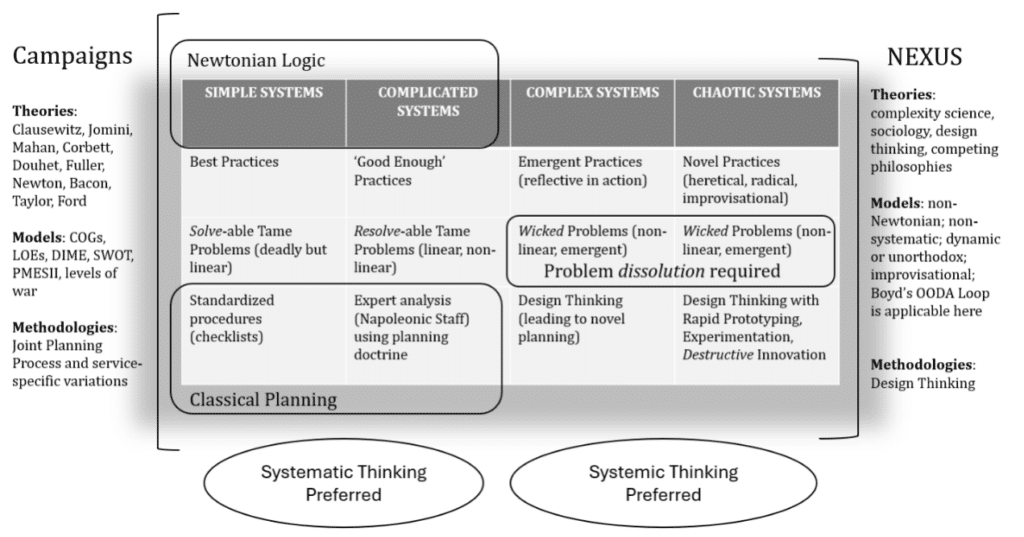
Figure 1. Distinguishing Between Types of Systems and Military Problem Sets
The above figure provides one systemic framing of the primary terms and definitions offered in this section. While contemporary military doctrine assumes all possible conflicts are comprehensively addressed using a single preferred methodology that expresses the theoretical foundations and Newtonian-styled models of systematic thinking, NEXUS becomes the dual-track alternative option for systemic management of wicked security challenges. The theories, models, and methods differ from traditional military campaign planning and operational design through doctrine. Nations today face the legacy threats that are effectively solved or resolved using classical military planning processes, manifesting through regionally aligned, domain-specific configurations. Modern technological, sociological, and ideological developments that distinguish this century from previous ones increasingly require the problem dissolution approaches that strategic design in NEXUS offers for complex and chaotic systems.
Joint Planning and Campaign Design: Domination of Tame, Ignoring the Wicked
All military instruments of state power employ a similar decision-making methodology at strategic, operational, and tactical levels. The Joint Planning Process references multiple U.S. Service methodologies, while the NATO Operational Planning Process (NATO-OPP) shares many concepts, models, and terms with JPP. The Chinese People’s Liberation Army doctrine of Integrated Joint Operations also shares numerous concepts, frameworks, domain specifications, campaign planning processes, and decision-making methods with Western Forces. Nearly all military forces adhere to this core sequence of eight activities: (1) understand the problem, (2) gather information, (3) analyze information collected, (4) conceptualize realistic solutions acceptable to the organization, (5) assess the possible solutions in some isolated, hypothetical simulation or exercise in warfighting, (6) select one course of action over others, (7) implement planned action in the real world, (8) test the consequences of action and as necessary, modify it. This is a classical systems approach and does not merely define all aggregate military decision-making; it represents how most organizations in virtually all fields and disciplines approach problem-solving and strategy-making.[39] Most everyone does this, wittingly or not. We retain the dominant worldview of a Newtonian reality where the Taylorism (Industrial Era) School of Management continues to efficiently analyze and solve known problems.[40] Often, planning is ritualized in many organizations, detached from any legitimate objective ordering.[41]
Security success in non-NEXUS contexts involves the accomplishment of clear, defined military objectives that generate decisive problem solutions or resolutions (state capitulation, enemy defeated/destroyed, threat neutralized, high-value targets eliminated). This comes directly from how modern militaries professionalized over the last several centuries during a phased expansion of scientific thinking that fueled industrialization and the emergence of the modern nation-state system. Planning originated with prioritization of efficiency, drawing first from eighteenth-century natural sciences and inspiring classical economics theory, early organizational management, and a desire to render all decision-making in classical (natural) scientific terms and processes.[42] Militaries entered the First World War drawing exclusively from these classical management and planning processes (Taylorism, Fordism) coupled with Napoleonic war theories such as Clausewitz, Jomini, and similar thinkers.[43] Many professions, including the military, began to mimic the natural sciences in process, language, models, and metaphor.[44]
Today, the Joint Planning Process and modern military campaign design still draw exclusively from Industrial Age decision-making and planning constructs. Designer VanPatter summarizes that, “[because] it was fairly easy to get consensus on the nature of problems during the early industrial period, the task could be assigned to the technically skilled, who in turn could be trusted to accomplish the simplified end-in-view.” Modern military staffs invest in specialization (of domain, technical field, military effect, warfighting technique) where problems are diagnosed scientifically, isolated for analysis, and deconstructed into specialized areas for solution, while the organization simultaneously seeks gains in efficiency and risk reduction to streamline repetition of the process. Previous institutionally popular methods such as Effects Based Operations (EBO) pursued extreme standardization and hierarchical ordering of battlefield problems, imposing systematic logic at a universalized mode of linear-causal sensemaking. By the end of the twenty-first century’s first decade, after significant strategic frustration in two counterinsurgency campaigns, U.S. Joint Forces Command (USJFCOM) Commander General James Mattis formally retired EBO from military doctrinal practice. Whereas EBO represented an ontological lurch toward a highly systematic logical framing focused on categorizing all military challenges into tame and simple/complicated problem sets, leaders like Mattis recognized the need to shift the institution to using complexity theory and design thinking.[45]
Mattis, along with select other senior leaders, had by 2008 become enthralled with military design thinking, which first developed in the late 1990s in the Israeli Defense Forces (IDF) after their frustration with existing IDF planning methods. Shimon Naveh and a small cadre of military intellectuals would present a disruptive, systemic, and interdisciplinary alternative to military decision-making termed ‘design thinking,’ which quickly entered service experimentation in the U.S. Army and U.S. Marine Corps.[46] Israeli ‘systemic operational design’ or SOD proved too intellectually obtuse and disruptive for American military organizations attempting to correct course in Iraq and Afghanistan. Design “purists” battled with institutional defenders of existing doctrine, leading to half-baked compromises such as the U.S. Army Design Methodology, a largely sterilized design framework hammered into doctrinal planning compliance.[47] NEXUS in 2026 faces a similar fate unless sufficient distinction is made between JPP and strategic design using both classical planning terms and concepts with complexity science.
Joint Planning, campaign design, and each service-specific (domain-tailored) form of decision-making remain a reliable, available, and uniform military process to manage tame problems in complicated and simple system settings. Many security challenges are composed of many dangerous yet tame problems that, if improperly solved, result in mission failure. Battlefields are massive constellations of myriad simple and complicated challenges that can quickly destroy a military main effort. Modern military organizations have specialized into spectacularly capable tactical institutions able to obliterate military problems that often are geographically bound, domain-specific, capable of being targeted using analytical optimization, and carry certain localized yet quantifiable qualities (body counts, destroyed systems, successful raids, captured personnel, seized key terrain).[48] Speed, efficiency, risk reduction, and the sequential arrangement of objective military tasks intended to culminate in organizational goals (ends-ways-means logic) become the primary characteristics for military decision-making to solve tame (yet deadly) problems in battle.
Simple, complicated, complex, and chaotic problems co-exist in every field of endeavor (including war). Simple and complicated problems need little identification other than rapid sensing and categorizing so that the Napoleonic staff can field the right problem to the corresponding specialist.[49] Complex problems require substantial definition, engagement, experimentation, and exist across multiple dimensions, domains, and systems. Generalists, not specialists, are better prepared to work on flexible teams of multiple generalists, using different military decision-making methodologies (not Joint Planning, nor campaign design) to make sense of wicked challenges. Mission Command, as a sub-philosophical theme popularized in contemporary military decision-making, refers to earlier Prussian land-based army traditions to decentralize forces and seek individual tactical opportunities that would otherwise be impossible to predict or for a centralized command to analyze and direct from afar.[50] Mission Command is clearly valuable within established command structures (with well-orchestrated higher headquarters plans and intelligence), yet it still suggests strong ontological attachment to tame problems in battle amenable to the commander’s intent and nested objectives. NEXUS instead addresses wicked security challenges where no single commander has the authority or capacity to sufficiently support individual tactical initiatives in the same light. For NEXUS, the Mission Command construction must be realigned not to predetermined mission statements, but toward strategic design deliverables that require different organizational structures for addressing complex systems. This leads to yet another significant tension in contemporary security affairs.
Symmetrical warfare, despite such a term not being officially employed in doctrine, is the conventional orthodox mode of conflict that defaults to ‘war’ in all other cases outside asymmetric engagements. It remains the dominant form of declared warfare between nations adherent to Westphalian and international norms for conflict (policies, treaties, rules, & conventions). [51] In highly symmetrical warfare, conflict unfolds in manageable yet dangerous ways where the existing organizational structure is optimized for battlefield problems to follow preordained, stable, predictable pathways. They rarely cross organizational, functional, or domain-specific lines; a problem set in the maritime domain off the Somali coast is managed effectively by SOCOM and AFRICOM. Narco-cartels operating in Mexico are the purview of NORTHCOM, the DEA, and border agencies. Iraqi armored divisions, both in the First Gulf War (1991) and again in the Iraq War (2003), lined up in doctrinally prescribed formations against American and allied forces obeying their own symmetry to their doctrine and training. Chinese wargames involving an amphibious assault on Taiwan suggest a symmetry with American and allied expected military response to such an act; both sides acknowledge in advance how such a war ought to unfold so that Chinese and American military campaign plans remain relevant to the anticipated battle tasks.[52]
Adversaries engaging in symmetrical conflicts also tend to act within the doctrinal expectations for how the organization is arranged, prepared, and rehearsed to address, even if the enemy is unwittingly doing this. Symmetrical warfare involves two opponents that generally agree on certain rules and norms for conflict (POW camps in 1944 Germany or 1974 Hanoi with American equivalents), adhere to doctrinal standards for performance, and often employ similar (if not technologically equivalent) warfighting forms with recognized, standardized functions (infantry platoons, armor regiment, ADA batteries, naval formation). Opponents converge toward similar form/function in war, even if they employ vastly different strategies, technologies, training, and tactics.[53]
The opposite of symmetric war is asymmetric, or irregular war.[54] This involves conflict between adversaries composed of different capabilities, designs, and strategies. Opponents diverge in military power, orientation, process, and logical progression toward different goals. Often, one adversary carries certain clear advantages in technology, resources, societal interests, or military professionalization. Adversaries in a weaker or inferior position target alternative gaps that play toward the adversary’s vulnerabilities while avoiding their military strengths. Asymmetric warfare focuses on achieving disproportionate strategic effects through unorthodox or unanticipated pathways that otherwise should not function in a symmetrical conflict.[55] If symmetrical war turns out to be the purest form of conflict within the Westphalian state system, then asymmetric war becomes the viable alternative for those unable or unwilling to engage symmetrically.
Irregular warfare (and unconventional warfare) provides several advantages while offering opportunities when confronting a more powerful adversary or attempting to balance conflict escalation and deterrence. Weaker, less professionalized, under-resourced, or technologically inferior forces choose IW because it often offsets a superior opponent, often through exhausting political and societal will through delays, disruption, and strategic frustration. The Taliban’s ability to thwart two global nuclear superpowers between 1979 and 2021 using insurgency and irregular warfare is a prime example, with Viet Cong successes over American forces in the Vietnam War and current Houthi rebel successes in western Yemen despite extensive tactical losses. The Islamic State provides another powerful example of decentralized yet trans-regional irregular warfare and insurgency in action, continuing to reconstitute itself and launch attacks in Syria, Iraq, and parts of Africa through 2026.
Although all military organizations possess operational capabilities to wage counterinsurgency operations, battle irregular warfare opponents, and deter conflict escalation through existing JPP processes, the emergence of new space, cyber, and SOF capabilities in the last few decades provides significant IW opportunity, ideally through NEXUS applications. The space domain is now highly congested and contested, with increased commercial enterprise and technological reach; IW using the space domain is now not only essential but likely unavoidable. Cyber operations in their global yet digital scale and scope are amplified through AI and emerging technologies such as quantum, providing new IW capabilities along with other avenues of disruption, misinformation, confusion, and physical outcomes. SOCOM’s unique authorities and capabilities are essential for wicked security problems, with SOF leadership positioned to use other authorities and abilities otherwise inaccessible or unavailable to General Purpose Forces alone.[56] Unconventional warfare remains exclusively a SOF function, seated within U.S. Army Special Operations Command, and not an easily scaled or transferred skill; proper UW operations require lengthy periods and rarely present linear, kinetic, or traditional military signatures. SOF, able to operate in ambiguous and denied areas, paired with asymmetric cyber effects and trans-regional space effects, form a powerful IW argument within a NEXUS framework.
Again, the primary challenge is not whether existing military decision-making methods and organizational authorities/boundaries are better prepared to wage conventional, asymmetric, or IW conflicts, but how the military institution prefers to understand military problems.[57] JPP was designed for tame and complicated systems comprising dangerous yet bounded, traditional battlefields; NEXUS looks to design thinking to address complex and chaotic systems where wicked security challenges exist. Not only do organizations specialize in specific domains and then tailor their form and function toward types of conventional or irregular warfare, but they also codify the institution to address types of military problems and system configurations dominant in their area of warfighting focus.[58]
This begins to fall apart for large military organizations when they assume that preferred decision-making methodologies that work for certain security challenges will translate effectively to other types of problems. Simply put, the modern military institution preconditionally declares before any conflict that, regardless of the conflict, it must use the doctrinal planning methodology… doctrine prescribes a method regardless of outcome. The military hierarchical structure emphasizes “universal application” in that Joint Doctrine must be the singular, uniform manner for military decision-making across all domains, in all contexts, against all possible military challenges, and becomes problematic if we shift from classical science to complexity science.
Twenty-First Century Conflict Amplifies Wicked Problems in Complex or Chaotic Systems
In 1986, American policymakers enacted the Goldwater-Nichols Act, which was a major military reform designed to shift away from twentieth-century, domain-siloed, and individually focused military services to a Joint framework. This shift acknowledged past strategic failure and shared a pattern of oversimplification toward complex security challenges coupled with a counterproductive orthodoxy of obedience to one’s parent organization.[59] Cunning opponents exploited asymmetry and amplified vulnerabilities caused, largely, by our own institutional predilections. The military failings in the Operation Eagle Claw raid into Iran (1980) and subsequent institutional breakdowns in Grenada in 1983, with lingering issues from the decade in Vietnam, drove political initiative to break the U.S. Department of Defense of service-centric, institutionally biased, and insular behaviors.
Enacted in the late 1980s, Goldwater-Nichols addressed a terrestrially oriented, Industrial Era technology military instrument of state power operating primarily through analog and tangible (explicit) forms of warfare. In this century, conflicts maintain these physical domain manifestations yet extend into the space domain, through cyberspace, and using new technological abilities that directly circumvent governmental powers of the classical nation state.[60] Contemporary adversaries use powerful tools such as crypto, commercial space, decentralized online movements, and digital disinformation to warp and alter the expectations of a traditional and bounded battlefield. NEXUS represents the second shoe dropping, amplifying Goldwater-Nichols and further developing necessary systemic reforms. NEXUS may complete the logic of Goldwater-Nichols by extending ‘jointness’ into the trans-regional, multi-domain, asymmetric realm where wicked security problems now dominate.[61]
Tame security problems exist alongside wicked ones, spanning simple to chaotic systems, often nested within one another. Iran’s recent blockade of the Strait of Hormuz involves sea mines and drones (simple dangerous systems sensitive to deliberate, linear, analytically optimized solutions). CENTCOM and allies are detecting, targeting, and destroying conventional Iranian forces (complicated systems, tame yet deadly) along with regional irregular warfare activities (complex, wicked) and international challenges to the global economy (complex, wicked). Above these challenges, chaotic shifts in the oil market (global, economic, wicked), swirling diplomatic efforts and changing alliances (complex, political, wicked), and shifting public opinions with disinformation and misinformation spreading throughout social media (complex, chaotic, wicked) unfold in emergent, dynamic directions.
Targeting specific units, terrorist cells, or weapon systems is a difficult yet still ‘tame’ security challenge (complex systems minority, simple and complicated systems majority).[62] A military force increasingly effective at solving tame problems through problem-solution methodologies may boost tactical gains while paradoxically causing strategic and system-wide failures. When a wicked problem involving complex and chaotic systems is inappropriately engaged, an organization might tactically succeed against preferred problems and eventually become strategically exhausted (resources, time, political will, societal interest) without ever addressing the conflict outside one’s preferred or doctrinal decision-making methodology. We plan the wrong ways repeatedly, resulting in the organization becoming “more right at planning wrongly.”[63] Bleeding an adversary literally unintentionally bleeds the linear-planning organization figuratively, leading to international or national desire to move toward problem absolution and strategic abandonment.
NEXUS: Best Applied to Wicked Problems, Complex and Chaotic Systems
Once a security problem is identified as wicked instead of tame, a different and entirely distinct form of military decision-making is required. However, due to existing institutional beliefs and the hierarchical arrangement of military doctrines and established planning processes, no legitimate alternative is formally available. The organization instead does the opposite of what Einstein presented. We assume that all battlefield problems can be solved with the same decision-making methodologies we employed that created the problems in the first place.[64] The world remains fixed because the first step in transforming reality requires us to adjust our thinking; indoctrinated processes naturally resist this. If a problem appears trans-regional or global in nature, the institutional preference of the Department of War is to fragment the whole into geographically or domain-specific sub-components, reduced into isolated “chunks” that specific and specialized units can attempt to solve. In complex systems, the movements of a bird flock cannot be understood by capturing individual birds and measuring their wings or attempting to understand how ant colonies find the fastest pathways to food sources by capturing each ant and studying it in isolation. The very nature of JPP’s reductionist ontology violates complex system behavior; militaries attempt to solve problems using a tool that simply cannot accomplish the task of addressing complex security challenges, especially those that ignore geographic boundaries, authorities, or technological limitations.
NEXUS and TRIAD, both introduced as models for augmenting some sort of strategic or operational framework that linked space, cyber, and special operations activities in novel combinations beyond existing campaign design, remain experimental and in iterative developmental phases where they might be adapted outright, rejected, or partially assimilated into contemporary institutional decision-making. As of this writing, TRIAD appears to be losing ground to NEXUS due to the distinct service-specific qualities of TRIAD that NEXUS overcomes. Both of these SOCOM-originated concepts draw from earlier cross-domain, trans-regional efforts, with TRIAD emerging out of U.S. Army Special Operations Command in 2021 as a service-centric ‘space-SOF-cyber’ framework[65] and NEXUS, the combatant command adaptation (between U.S. Special Operations Command, U.S. Cyber Command, U.S. Space Command, and U.S. Strategic Command).[66] Of these, NEXUS in 2026 appears to be gaining traction across the U.S. Department of War, with multiple exercises, experiments, and forums.
Security success in NEXUS contexts is an emergent and dynamic state of managing a complex system while designing and re-designing novel problem dissolutions that prevent adversarial escalation (deterrence) and increase adversary insecurity/uncertainty. Successful NEXUS activities appear insignificant and possibly irrelevant to adversaries that prefer conventional military decision-making methodologies (systematic); the removal of one domino far enough away in a chain is ignored until the dominos suddenly stop in a shocking system-wide calamity of the uninformed. NEXUS is not undisciplined in comparison to JPP methodology. It is disciplined differently, oriented towards complex systems that, despite institutional assurances to the contrary, JPP doctrine does not provide. While NEXUS prioritizes a systemic framing of a wicked security challenge, it does not exclude the use of systematic tools (doctrinal theories, models, methods) within that frame when such context is informative.
In the Joint Planning Process and related methods, problem solution is central at all levels (strategic, operational, tactical), with systemic framing secondary (once mission analysis moves to COA development, the organization assumes sufficient system knowledge and stability to conduct subsequent planning). Yet in designing through NEXUS, problem framing is central, with ‘problem solution’ a secondary and less relevant motive. Immediate, tactical effects are less critical when deeper, systemic processes are understood and targeted. The top-down, problem-solution orientation of campaign planning links strategic goals (specified through national security tasks, responsibilities, focus areas, and authorities) to institutionally recognized ways (bounded, domain-specific, regionalized) and means (service-specialized, domain-specialized, and task-specialized organizations and personnel).[67] These linkages are understood in a linear fashion, where A plus B leads to C.[68] Simple and complicated systems feature linear behaviors, yet nonlinear system phenomena do not have outputs directly proportional to inputs (A plus B does not lead to C). Non-linear systems exhibit disproportionate, atypical, even unpredictable behavior while still achieving the broad outcomes anticipated by linear patterns.[69]
Thus, the problem is known from the outset, along with the dimensions/domains and specialized conditions of the problem in institutionally unsurprising forms. Once the problem can be objectively defined, it is then solved in a linear-causal process (JPP). Yet complex systems cannot be understood or managed using this logic. The strategic design approach of argumentation, a step nonexistent in classical military planning methodologies, requires divergence over convergence. It unfolds with an emphasis on creativity, insight, innovation, and disruption that emerges spontaneously “as the fluorescent by-product of shared understanding,”[70] only achievable through a strategic design methodology. When national leaders view a security challenge as ‘fuzzy’, they also will be largely unable to recognize which design approach might be the one necessary; they won’t know what they want and may default to tame problem-solving descriptors to discuss wicked security challenges.
When addressing wicked security problems, NEXUS designers pursue the following broad activities: (1) acknowledge a strategic concern or tension that often is ill-defined (fuzzy) and confusing (breaks with institutional preferences/norms) for the organization seeking to clarify and categorize it.[71] (2) Assume the initial organizational ‘fuzziness’ and consider both the system that appears to bound the security challenge (legacy frame) and also define the preferences of the organization (us) wanting to solve some perceived problem; the distinct and independent frames of suspected or known adversaries are also framed (other). (3) Assemble a diverse team of generalists, including allies and partners for trans-regional, multi-domain challenges. (4) Compose information divergently, study and experiment with concepts systemically in design teams that argue through productive design actions, such as visual modeling, assumption testing, scenario planning, and the co-development of multiple, contradictory explanations to generate deeper insight. (5) Construct multiple and divergent future systems where various proposed design solutions cause new and nonlinear responses. (6) Select a design dissolution (deliverable) appropriate for complex systems and implement it.[72] (7) Manage and experiment to amplify, dampen, or reframe the security design as the complex system morphs to evolve the wicked problem into new pathways that, ideally, designers anticipated through problem dissolution.[73] Assessment is performed not through a convergent framing of “did predetermined ends get achieved”, but through an analysis of “is the emergent system a consequence of this strategic design and does the adversary now face diminished awareness, access, flexibility, or drive?[74]
NEXUS capitalizes on military design thinking, which draws from civilian design processes (along with more exotic elements) and is intentionally configured to address wicked instead of tame problems.[75] There are several core principles within nearly all design methodologies:
- Design pursues systemic framing over systematic framing. Systematic logic seeks to isolate a perceived problem, freeze it in time and space, break it down into smaller, more manageable pieces, determine fundamental principles or rules governing the pieces, solve the problem at a micro-level in simulation/wargame, and consequently re-assemble the pieces into the whole and scale the micro-level solution toward the entirety. Systemic logic takes the opposite approach in denying that complex systems can be decomposed and reassembled without the system adapting and changing along with participants themselves being part of the systemic change. Designers consider broader systemic relationships by acknowledging critical phenomena within the system that only manifest at higher levels of organization (strategic effects that emerge indirectly or independently of localized or tactical actions).[76] Systematic and systemic are not binary or oppositional; systemic frames hold systematic configurations as complementary within a system.[77]
- The implementation phase of the strategic design methodology is unlike how JPP executes a plan and measures outcomes. Complex systems do not respond to clear, specific, and easily understood solutions,[78] meaning that any comprehensive design deliverable addressing a wicked problem will also require time, creativity, and intellectual flexibility for receivers (outside the design team) to understand it. Nor will the subsequent plan be easily and clearly executed as informed by the strategic design, but the planners will work in novel pathways unrealized prior to the design.[79] This means that any strategic design implemented must be done using the same iterative, argumentative, divergent, and improvisational frames to appreciate how a complex system will respond and adapt to the design.
- Complex systems are susceptible not to specialists (best for complicated and simple systems) but to generalists with creativity and critical thinking skills. Additionally, the emergent expertise needed in managing a wicked problem set within complexity or chaos is distributed over multiple designers and manifests in nonlinear and surprising ways. Directorates and staff configured into the Napoleonic and Prussian organizational specialization are optimized for complicated problems and are therefore not configured for the exploratory, systemic work required by wicked problems. The best military planners are usually terrible designers.
- Cross-functional teams involving a divergent, diverse, and creative mix of talent are superior for design team configurations. Each wicked security problem requires a custom, one-time-use, non-repeatable cross-functional team empowered to design beyond institutional norms and set processes. These are NEXUS constellations of a network of generalists that are reconfigured in different arrangements for each wicked security challenge. No two constellations are the same.
- Most military decision-making activities (doctrines, processes, structures, beliefs, language, identities, sense of purpose) are not based in scientific expertise, but rather “political and general moral and ethical attitudes” professionalized within the organization.[80] However, the institution encourages pseudo-scientific confidence that military theory, models, and doctrinal methods are objectively truthful facts instead of socially constructed assumptions.[81] Classical planners posit all essential problems in war must be identifiable and malleable to the linear-causal planning methodology, where the organization understands the observed conditions (legacy system) and can visualize a desired future condition (end-state, goal, objective). Ritualization of the process often becomes justification to protect and sustain said activities.[82]
- Designers working with wicked problems acknowledge that such complexity denies any participant the ability to remove themselves into some neutral, objective observer perspective, and that complex systems transform in highly emergent (and nonlinear) ways impossible to predict or control. Indeed, the first strategic grasping of a fuzzy security challenge will lead to a series of often paradoxical, disruptive, and surprising design journeys where argumentation and innovation lead to deeper problems impossible to realize at the start. Predetermined ends are as unproductive in addressing complex systems as systemic thinking is to problems that are best addressed systematically and analytically.
- Designers insist upon objective transparency in not only articulating one’s military logic but also clarity on the foundations of such logical expression (thinking about thinking or ‘reflective practice’).[83] It is insufficient to claim “we are following doctrine here” in that one must explain why one thinks one design option is better than another. Designers will disagree with one another on specific judgments, but they must always understand the foundations of why each designer understands reality as such.
- War contains many scientific processes with certain qualities best understood using scientific methodologies. However, designers addressing wicked problems (inherently sociological, societal, technological) acknowledge the societal/sociological construction of reality over that of mimicking scientific processes inappropriately. Physics validates the theory of gravity through repeatable, measured experimentation. Military ‘centers of gravity’ are metaphoric devices taken from science to serve as approximations for patterns in war that have no similar theoretical stability.[84]
- NEXUS addresses “unsolvable problems” because the JPP methodology is not designed to address such complexity, nor do national policymakers have tolerance for the War Department to construct strategies, campaigns, and plans that do not clearly solve security problems in recognizable, institutionally relevant ways. NEXUS instead operates beyond the JPP decision-making framework, augmenting it while using strategic design methods that “manage the unmanageable.” Most trans-regional, multi-domain, dynamically adaptive security problems cannot be solved, yet many can be influenced and shaped if addressed creatively and comprehensively beyond the socially constructed barriers imposed institutionally (geography, domain, authority, specialized task, select or localized component).
- Lastly, yet likely most important for design processes, the organizational emphasis flips from how classical military decision-making prioritizes convergence toward shared doctrinal forms and functions to that of divergence and argumentation. These are oppositional intentionally, where classical planning fails without each element adhering to the doctrinal methodology and all activities converging (all COAs orient toward a shared end-state) in the overarching ‘ends-ways-means’ logic. Designers approach wicked problems by seeking the widest range of perspectives and positions, in that innovation and creativity function exclusively in methodologies that prioritize divergence with refined iterations of novel convergence.[85]
Solution Through Dissolution: NEXUS and Strategic Design Methods
NEXUS, as presented in this article, is not a replacement for the JPP. It is a necessary, complementary framework for sense-making and strategic design when faced with wicked problems. Where the JPP seeks problem-solving, NEXUS aims for problem-dissolution. It recognizes that some challenges cannot be “solved” but must be continuously managed, influenced, and guided toward a more advantageous state.The core of the NEXUS methodology involves a continuous, iterative cycle of four key activities:
- Framing: Deeply exploring the context of the complex situation to develop a shared understanding of the system, its actors, and its underlying tensions. This goes beyond the JPP’s “mission analysis” to question the very nature of the problem itself.
- Reframing: Continuously challenging and updating the initial frame as new information emerges and the situation evolves; learning is key. Reframing isn’t executed within a doctrinal framework without discarding (certain) doctrines despite institutional resistance.
- Posturing: Devising and implementing a series of strategic “postures” or actions designed to influence the system, not to achieve a final objective. These are adaptive moves, not fixed plans.
- Action: Seeking novel initiatives based on the current posture, while simultaneously observing the system’s response to inform the next cycle of framing and reframing. ‘We’ plus ‘opposition’ both are part of the system; the fastest learner gains maximum flexibility to adjust/adapt.
NEXUS in practice has evolved rapidly, with strategically disruptive vignettes available in recent conflicts. Recent operations already demonstrate what NEXUS constructs using strategic design methodologies could achieve in practice, even when not formally labeled as such or comprised of planners attempting to force NEXUS into existing doctrinal formats.[86] While not directly termed in a Space-SOF-Cyber construct, these examples demonstrate the NEXUS way of thinking in war that produces strategic disruption through asymmetric pathways. In ‘Operation Spiderweb’, an elaborate and covert drone attack, Ukrainians executed strategic surprise against Russian strategic bombing fleets deep inside Russian sovereign territory on 01 June 2025. Meticulously planned over 18 months, operators smuggled drones into Russia and used unwitting Russian drivers; remote-controlled roofs unveiled the payloads, and operators used open-source software to dead-reckon navigate. AI was incorporated due to the time delay between the operator and the drone, with data sent over local mobile phone networks.
‘Operation Grim Beeper’, the aptly nicknamed Israeli covert attack using electronic devices against Hezbollah in September 2024, is another compelling example. Mossad, Israel’s national intelligence agency, created shell corporations and infiltrated supply chains to insert explosive batteries into pagers and similar communication instruments. Mossad manipulated the market by discouraging non-Hezbollah customers through high cost, while delivering the deadly pagers to insurgents at special low pricing. Israel claimed it sold Hezbollah over 16,000 walkie-talkies and pagers. They detonated these in devastating attacks designed to injure and psychologically traumatize the terror network across the entire organization (foot soldiers to senior leadership). Strategically shocked and now distrustful of any modern technology, Hezbollah and Iranian handlers (the Islamic Revolutionary Guard Corps) suspended communications and examined all their technology in the aftermath. In both examples, Russian and Iranian forces are unlikely to fall for a similar strategic exploitation carried out exactly as these were. The system adapts.
NEXUS requires robust national-level synthesis beyond individual instruments of state power because nations struggle to synchronize military, diplomatic, economic, and informational activities across trans-regional challenges that ignore organizational and geographic boundaries. If a Four-Star level General is directed to lead a NEXUS enterprise, that leader should be partnered in a strategic manner with an equivalent state agency leader (diplomatic, informational, other) and in a clear international relationship that links other national powers and their critical instruments. This works well beyond any existing geographic or functional combatant command enterprise and exceeds the scope and scale of any military decision-making methodology (JPP, NATO OPP, MDMP, MCPP) due to how non-military instruments of state power, academia, and industry use nothing remotely like campaign plans, OPLANs, or military doctrine.
NEXUS activities are strategically disruptive, not just the tangible battlefield effects they generate, but also how the broader system must subsequently adapt to a redesigned environment where an adversary is uncertain, confused, and unwilling to return to past processes without significant introspection and examination. This goal of systemic transformation stands in contrast to classical campaign planning, which typically follows a more linear-causal logic aimed at achieving a predetermined end-state through tested, well-demonstrated activities and technologies. One assumes the battlefield effects will restore a system to some predetermined, stable, and known status; the other accelerates systemic change to usher in an entirely novel competitive space with the adversary in disarray. The following table illustrates the fundamental differences in logic between the two systems:
| Attribute | Joint Planning Process & Campaigning | Strategic Design with NEXUS Construct |
| Primary Logic: | Systematic (sequential, checklists) | Systemic (holistic, pattern-seeking) |
| Problem Framing: | Tame/Complicated | Wicked/Complex & Chaotic |
| Guiding Metaphor: | Engineering (ordered, reversible, analytically optimized, stable) | Gardening (cultivating an ecosystem) |
| Core Task: | Problem solution | Problem Dissolution (Reframing) |
| Desired End-State: | A defined, predictable solution with clear (linear) actions (ways & means) leading to the predetermined end-state | Experimentation & Innovation: designing toward a transformed, more favorable reality that diverges in emergent ways from the present (legacy) state |
| Process Type: | Linear, sequential phases (reversible, repeatable, uniform), requiring standardized training | Iterative, emergent, disruptive, requiring continuous learning |
| Organizational Model: | Centralized hierarchy using Napoleonic/Prussian military staff specialization (categorization-oriented, analytical, positivistic) | Constellation in flux (adaptive, cross-functional teams in various networks capable of new formations mid-journey) |
| Core Institutional Demand: | “Find the problem, solve it, achieve a desired end-state as clearly envisioned before starting, and accomplish it through institutionally regulated processes” | “Why do we see such a phenomenon as problematic? How do adversaries frame this? Can we design novel and unexpected pathways to systemically transform the system to an emerging advantage we imagine, and others lack the creativity to realize (for now)?” |
Table 1.
Adopting a dual-system approach is not an academic exercise; it is a strategic necessity. By continuing to misapply the JPP to wicked problems, we risk:
- Strategic Stagnation: Generating detailed plans for the wrong problem. “The righter we do the wrong thing, the wronger we become.”[87]
- Wasted Resources: Committing forces and funds to actions that fail to achieve meaningful strategic outcomes. Thousands of tactical victories may never lead to strategic success.
- Loss of Initiative: Ceding the advantage to adversaries who operate with a more fluid, adaptive, and holistic understanding of the competitive landscape.
By integrating NEXUS, the DoW (and more importantly, USG and allies, partners) will gain the ability to:
- Act Intelligently in Ambiguity: Make more effective decisions that disrupt the current system when faced with incomplete information and evolving threats.
- Develop Adaptive Leaders: Cultivate a cadre of strategists who can think systemically and are not constrained by rigid, process-driven thinking. Clever beats predictable.
- Gain Strategic Advantage: Out-think and out-maneuver adversaries by moving beyond a reactive, problem-solving posture to one of continuous, proactive system influence.
The future of warfare is not about having the best plan; it is about having the best learning system. The JPP remains our tool for winning known battles. NEXUS is our framework for navigating unknown wars. We need both and must distinguish between the two for military activities.
Conclusion: Strategic Design for Wicked Problems Requires New Thinking
NEXUS will likely fail if designed without sufficient international partners, allied nations, and necessary divergent perspectives to achieve certain minimum creative, critical, and comprehensive thresholds; at best, it may become another categorization trope within military doctrine for anything featuring ‘space-SOF-cyber’. This would be unfortunate. Without NEXUS or some similar strategic design effort to synthesize various Combatant Commands, Services, and international security partners uniquely and comprehensively, the military institution may only continue to apply a single, doctrinal decision-making methodology to all security challenges, coupled with fiercely geographic and military identity-based tensions.[88] While the singular, universal planning approach offers relatively effective global management of recurring, stable, and ‘tame’ battlefield challenges, it often guarantees strategic vulnerability for wicked security problems emerging from complex or chaotic systems. NEXUS is purpose-built for the Space-SOF-Cyber community (organizations directed to operate in these domains, carry specific authorities that others lack, or specialize in strategic effects that take on novel and disruptive qualities through the NEXUS) because of the trans-regional, multi-domain, and asymmetric qualities of wicked security challenges. Space and cyber are truly twenty-first-century domains, unlike their twentieth-century terrestrial counterparts in myriad regards; forcing square pegs into round holes rarely works. Classical planning activities can effectively address or solve the tame security problems found within such frameworks and should be undertaken by the responsible military force, yet only a NEXUS constellation may have better chances of managing the wicked problems that remain.[89] To do this, it will require change at the highest national security levels of not just the United States, but all potential NEXUS contributing nations and groups.
Our adversaries have a low tolerance for military efficiencies and lethality gained by institutional specialization into linear-causal planning and campaign design; who wants to fight anyone by the rules that benefit the opponent greatly? They simply will not battle us conventionally when possible. The twenty-first century features far more alternative pathways in cyber, space, and trans-regional options that previously were impossible or nonexistent. Cunning adversaries will prefer asymmetrical, irregular, and unorthodox pathways to victory. They will continue to seek trans-regional, multi-domain, and highly dynamic modes for organizing, disrupting, and denying our traditional attempts to make sense of the battlefield. Doing anything else becomes self-defeating. The critical challenge for the Department of War is not to plan better, but to think differently and create novel war-fighting solutions that defy adversarial comprehension. NEXUS offers the only institutional escape from an overarching and singular decision-making methodology designed for earlier conflicts. Although many existing security challenges remain highly solvable using the classical military planning approach, those that are wickedly complex must be dealt with differently.
Consider the following fictitious scenario:
In August 2028, a range of seemingly unrelated activities worldwide unfolds. Outside Chicago, a fast-moving logistical pod that rocketed to LEO from international waters de-orbits and parachutes through the atmosphere, clandestinely carrying 500 kilos of Mexican Cartel cocaine toward a drop point. A seemingly unrelated local shooting occurs in Sydney, where a person armed with a 3D-printed pistol opens fire on a gang’s drug house, the seventh in a month in the greater Sydney area. When apprehended, the individual admitted they were paid in cryptocurrency and retrieved the job through an anonymous online handyman jobs platform; the last IP address located was linked to Turkey. In Northeastern Nigeria, Islamic terror cells capture thousands of vulnerable children and young women, moving to traffic them into slavery and the sex trade in high-demand locations in South American and European cities. In the beautiful ski resort town of Aspen, Colorado, a decentralized group of environmental extremists commits arson at new multi-million-dollar housing projects under construction, synchronizing using Starlink and encrypted smartphone apps. In an online gaming chatroom, operatives from a major Mexican drug cartel coordinate with Cuban intelligence officers on how to smuggle Russian military caches of restricted technology through the Caribbean. In Caracas, Venezuela, a group of cartel members, Socialist revolutionaries, and Russian hackers collaborate to conduct a cryptocurrency market distortion to cause financial instability and steal millions using satellites and AI to mask their locations.
Meanwhile, a NEXUS multinational, interagency team begins to identify linkages between Boko Haram, Russian hacker activists, the Earth Liberation Front (ELF) ecoterrorism network, and the Sinaloa Drug Cartel, along with suspected Cuban and Russian state overlaps. The U.S. Department of State, USSOCOM, USSPACECOM, USCYBERCOM, and multiple allies and partner nations begin to consolidate a NEXUS enterprise at the direction of the U.S. National Security Council and through diplomatic channels. Based on senior national security leadership direction, a NEXUS constellation with USCYBERCOM in overall C2 authority orchestrates a SOCOM, SPACECOM, and U.S. Department of State (with other organizations) structure, partnered with Australian, German, Israeli, Nigerian, Mexican, and Canadian Space-SOF-Cyber organizations. The international NEXUS enterprise operates trans-regionally, linking gaps along various geographic and political boundaries, connecting military and diplomatic effects across domains. In some contexts, one nation or entity achieves NEXUS effects through irregular warfare, while simultaneously in multiple locations across the globe, other NEXUS participants generate different space, cyber, or SOF effects that otherwise appear isolated and unrelated.
In a 3-year period, this NEXUS enterprise operates in the shadows, globally, with a multi-domain, trans-regional signature nearly impossible to detect or make sense of. One moment, an organization from one nation executes a limited effect, while across multiple time zones, other agencies and actors harmonize activities that unfold in multiple continents, through cyberspace and space, into terrestrial locations, and influence adversarial decision-making. One moment, a nation signals certain military or diplomatic actions openly; in the next moment, a surge of unconventional and unattributed activities unfolds across three continents through unorthodox and unexpected means. Russian hacker groups become paranoid about certain technological vulnerabilities and their own security, while Boko Haram members revert to low-technology communication means that slow and fragment their operations. Cuban intelligence members begin to second-guess assumptions due to misinformation and lack of trust; several cartel-on-cartel assassinations occur amidst the disruption. Multiple Mexican law enforcement raids on the Sinaloa Cartel shock and degrade their command structures, while international commercial and diplomatic efforts halt the illegal movement of space-based payloads at the launch sites. Online job platforms employ new AI-enabled software to track suspected illicit activities, while multiple special operations forces worldwide engage in unconventional and irregular warfare campaigns that are nested within these established NEXUS strategic priorities.
The above scenario features new or emergent technologies, yet these alone do not warrant a new strategic process for enabling security actions different from legacy frameworks. Instead, readers might ponder “how could existing JPP and geographically arranged, regionally bounded organizations attempt to manage such a scenario only through existing policies, structures, doctrines, and relationships? Tactically and in regional or domain-specific isolation, one might argue that every instance in the above scenario could be addressed by select organizations using specific tools, responsibilities, and capabilities. This might be technically correct, but one cannot help but wonder how much more cost, risk, and likelihood of institutional fratricide or counterproductive disarray might result if such strategic designs were compartmentalized into separate national, service-specific, and regional elements. For these wicked security challenges, the twenty-first-century world demands a far more dynamic, nimble, and creative enterprise. This is the second shoe dropping for Goldwater-Nichols, where national-level strategic design operates beyond any single military or government agency’s purview.
NEXUS thus becomes a ‘specialty shop’ for strategic surprises within dynamic, complex systems, not a direct competitor to JPP. NEXUS is the high-end, bespoke workshop where strategic planners across multiple Combatant Commands develop novel, tailored, and “one-time only” approaches to wicked security challenges. These NEXUS ‘constellations’ are intended to be directed by one authorized commander, with subsequent NEXUS challenges requiring entirely new and customized constellations with different command designations. Otherwise, the military profession risks defaulting to a form of rain dancing. When ritualized planning is followed by success, the process becomes scientifically “proven” to work. When it fails to produce results, the blame shifts to unwise policymakers, ignorant citizenry, or the wrong dance for the wrong atmospheric effect.[90] Campaign planning toward wicked security challenges may occasionally connect a rain dance to actual precipitation, but such coincidence has no strategic value. Assigning wicked security challenges to a tame-problem specialized planning methodology results in similar outcomes. The following key elements are foundational to forming a NEXUS design constellation:
- Senior leader strategic direction/authorities: NEXUS requires a delegated authority (strategic sponsor) and articulation of a wicked problem statement that includes the essential commands, agencies, partners, and some command structure. This likely must occur at a national security level above existing Four-Star Commands, combining State Department (and foreign equivalents) with other organizations including select industry and academia, depending on the security challenge.
- Frame the NEXUS Constellation: Team composition, classification challenges, information sharing, and design process with proposed timeline. A group of generalists (including allies, deep experts, unorthodox partners, often outside standard Napoleonic staff configurations) will work in asymmetric pathways, often lacking classical planning milestones or linear sequences. Classification must be flattened within the NEXUS.
- Strategic design deliverable: The team brings novel, disruptive, and often experimental constructs for senior leader consideration. Instead of singular desired end-states, designers use NEXUS and articulate a divergence of future states with opportunities, risks, and consequences distinct in each of them.
- Executing Disruption: The NEXUS deliverable carries safeguards to amplify, dampen, and assess the system transformation imposed by the team’s activities. This includes essential information management, models, metaphors, and risks for planning team hand-over. NEXUS concepts likely require additional security constraints, with some planning elements gaining greater awareness over the entire concept than others due to security and the need for strategic surprise.
The three camps on NEXUS may take different concluding directions concerning this article. The “orthodoxy” camp will dismiss further NEXUS experimentation as unnecessary, irrelevant, and counter-productive to existing command structures and existing regionally focused campaign designs. Anticipated defensive arguments will recycle traditional arguments, including “demonstrate NEXUS working as superior to JPP” and “prove design does more than current military planning can,” which are straw-man quarrels built not upon scientific logic and curiosity, but upon institutionalized dogma and doctrinal preservation.[91] NEXUS as an experimental construct requires further iterations of testing, improvisation, creative application, and critical reflection. The future can have this dual-track security apparatus where NEXUS addresses complex, trans-regional security challenges through strategic design thinking above and beyond JPP confines, while rigorous campaign planning at regional, geographic, and domain-specified focuses will still be the most effective security management tool for tame and complicated (yet deadly) challenges.
The “meta-process” camp (NEXUS is the ways and means toward similar ends shared by combatant commands collectively) may advocate for a strategic-level Joint Planning Group that operates within existing JPP methodology and relies upon combining various campaign plans with additional inter-agency and international coordination to fill in the gaps. The “transformative” camp (designing above and beyond any existing campaign, breaking existing doctrinal “rules” to create new spaces requiring new rules) takes the more radical approach, advocating the full extent of this concept paper by pairing military design thinking with dynamic, complex system management that otherwise cannot be accomplished using traditional military methodologies, models, and theories. Thus, depending on which camp successfully articulates a NEXUS pathway in the next several years, the concept may remain a limited model paired with select military decision-making methods, a rejected concept that fails to translate beyond select space, cyber, and SOF professionals that operate behind inaccessible classification and information-sharing channels, or NEXUS could become the second Goldwater-Nichols shoe dropping, producing institution-wide transformation. Of these, NEXUS, if done at the right strategic level of harmonization across multiple states and their instruments of power, industry, and academia, could become the alternative framework for wicked military challenges in the twenty-first century.
NEXUS replaces the pursuit of finite, isolated, and bound security solutions with the continuous management and design of innovative security deliverables appropriate within complex system architecture. This requires an institutional pivot from specialists arranged in a Napoleonic staff arrangement in a rigid hierarchy bounded by Service identity and geographic lines to that of cross-functional teams of generalists. Such design teams value innovation as highly as planners value efficiency. Senior leaders must now champion this dual-capacity approach to render a new conceptual space for both military planning and design to coexist. Failure to do so is to cede the strategic initiative to those who have already mastered the trans-regional, multi-domain, and asymmetric nature of twenty-first-century warfare.
Endnotes
[1] Although recent revisions in Joint and Service-related planning publications encourage multidomain operations and discuss transregional planning beyond a Combatant Command’s borders, these become largely bilateral or regional-specific while still centering on the organizing or requesting authority’s command priorities. Example: INDOPACOM might opt for transregional planning and multidomain ops between SOCOM, STRATCOM, and SOUTHCOM for a PRC concern involving the Panama Canal and water routes across the Pacific, but this would remain transregional/multidomain in the spirit of enacting one CCMD’s mission focus in traditional supported-supporting, hierarchical frames. The core JPP and regional reductionist logic is prioritized over all other constructs.
[2] Doctrinal proponents may offer that coordinating authorities already exist for addressing such concerns. This is another Straw Man argument where conceptually speaking, these authorities should accomplish certain trans-regional tensions. However, in practice, coordinating authorities are nothing beyond a collaboration relationship. INDOPACOM is the coordinating authority for certain PRC security concerns, but that does not translate into INDOPACOM being the expert in assessing PRC activities in South America, SOUTHCOM’s area of responsibility. This tension exacerbates with space, cyber, and SOF contexts where existing coordinating authority policies and practices are optional and often underwhelming.
[3] Models relate to methods in specific ways, despite many PME programs failing to distinguish the two. Models can be replaced to support a methodology, while a methodology can be retired yet the model retained in the replacement method. John Boyd’s OODA Loop, used in multiple military decision-making methodologies, is another example of a model. Boyd drew from specific theories (general systems theory, chaos theory, advanced mathematics, psychology, war theories) and military doctrine today pairs the OODA as a useful model within JPP and service-specific decision-making methods. Doctrine draws from ‘center of gravity’ (COG) models in a similar capacity. See: Ben Zweibelson, Beyond the Pale: Designing Military Decision-Making Anew (Maxwell AFB, AL: Air University Press, 2023), https://www.airuniversity.af.edu/Portals/10/AUPress/Books/B_181_Zweibelson_Beyond_the_Pale.3.pdf.
[4] Each geographic combatant command carries authorities and responsibilities bounded within clear geographic limits, while many functional commands orient toward specific function that prioritizes certain domain(s) over others. USCENTCOM is concerned with the Iranian Conflict, but not China and Taiwan; NORTHCOM defends the homeland and must address dangerous narco-cartels operating in their region, but not violent narco-cartels operating exclusively in Asia. No single Combatant Commander has designated authorities or command that spans multiple geographic regions or across all domains, and many cunning adversaries now exploit gaps and blind spots across the Department of War’s physical division of civilization on this planet.
[5] Again, the three NEXUS groups in 2026 will differ on this point. The first group seeks strict JPP adherence with renewed focus on space-SOF-cyber focus areas utilizing existing policy, authorities, and practices. The second group elevates JPP to some new strategic or national-level orchestration and authorities arrangement, while the third group (this author) press for a design approach to untether NEXUS activities from the incomplete and insufficient JPP frameworks that otherwise constrain NEXUS success. For CCMDs, authorities do not always equal capabilities or capacities. Sometimes one has authorities but must collaborate and integrate other organizations or agencies to achieve authorized strategic effects.
[6] Emergence is an important concept in complexity theory and not to be confused with linear or nonlinear phenomena. Linear systems have outputs directly proportional to inputs (A plus B leads to C) and are stable, ordered, and predictable. Nonlinear system behavior is disproportionate, unpredictable, yet still achieve the desired output (getting to C) in ways that on the onset would not be considered. Emergence is where entirely new behaviors arise that transform the entire system, yet before such changes occur, the emergent pattern cannot be anticipated. In retrospect, emergent properties can be linked to some novel interaction of components in the legacy system, while emergence itself generates systemic disruption to change how those components now interact in the new (emergent) system.
[7] Critical push-back requires clear ontological and epistemological declaration for what NEXUS is and is not. If advocates declare NEXUS should remain an optional model within current JPP framework, they need to define such a doctrinal arrangement. NEXUS advocates wanting a Joint Planning Group (JPG) process held at some strategic level beyond or adjacent to campaigning need to render similar logic and clarity. Those skeptics of the military design movement should openly declare their criticisms and why they feel existing doctrinal planning methodologies and models are sufficiently robust for what designers critique.
[8] This term avoids service-branded design labels such as ‘Army Design Methodology’ or ‘Systemic Operational Design’ and instead emphasizes the scale and scope of such innovative military ventures. Strategic-level innovation is the appropriate starting point for trans-regional, multi-domain, dynamic security challenges that violate, exceed, or otherwise incapacitate classical military planning methodologies. These indoctrinated military design formats frequently miss most of the core concepts in design so that existing doctrinal planning constructs remain unmolested.
[9] Ben Zweibelson, Understanding the Military Design Movement: War, Change and Innovation, first (Routledge, 2023); Aaron Jackson, “Design Thinking in Commerce and War: Contrasting Civilian and Military Innovation Methodologies,” Air University Lemay Center for Doctrine Development and Education LeMay Paper No. 7 (December 2020): 1–78. Although some design methodologies do exist in military doctrine, they are often a compromise between design theorists and institutional defenders; the doctrine converts design into subordinate and complimentary constructs, removing the design and rendering it into planning.
[10] Importantly, the presence of space, SOF, and cyber in a military operation does not mean it is NEXUS relevant or utilizing strategic design methods. NEXUS is a Combatant Command centered focal point for strategic design to occur, with the warfighting deliverable possessing some constellation involving space, cyberspace, and special operations activities/authorities for trans-regional, multi-domain applications.
[11] Brian Hamel, “Reframing the Special Operations Forces-Cyber-Space Triad: Special Operations’ Contributions to Space Warfare,” Military Review, March 2024, https://www.armyupress.army.mil/Journals/Military-Review/English-Edition-Archives/March-2024/Cyber-Space-Triad/. Hamel’s published research on the TRIAD, a related service-specific model to the NEXUS, is one of the few primary sources published thus far. The USSPACECOM ‘Space-SOF-Cyber Innovation’ design course is the only Professional Continuing Education (PCE) program currently offering NEXUS education through the National Security Space Institute (NSSI). See: https://nssi.spaceforce.mil/?directlink&nav-home/courses/allcourses&&&&&&&&.
[12] Aaron Jackson, The Roots of Military Doctrine: Change and Continuity in Understanding the Practice of Warfare (Combat Studies Institute Press, 2013); Christopher Paparone, The Sociology of Military Science: Prospects for Postinstitutional Military Design (Bloomsbury, 2013); Zweibelson, Beyond the Pale: Designing Military Decision-Making Anew.
[13] Often the tactical win creates a new development that leads to far bigger challenges and strategic setbacks. This frustrates policymakers, military organizations, and societies in general. Over time, such as counterinsurgency operations in Iraq and Afghanistan became overburdened by myriad and competing goals from the multiple organizations involved. The tactical accomplishments coupled with costly sacrifices and sunk costs became themselves a barrier for goal adjustment.
[14] Jeffrey Meiser, “Ends + Ways + Means = (Bad) Strategy,” Parameters 46, no. 4 (2016): 81–91; Christopher Paparone, “Beyond Ends-Based Rationality: A Quad-Conceptual View of Strategic Reasoning for Professional Military Education,” ResearchGate, May 16, 2016, 309–47; Ben Zweibelson, “One Piece at a Time: Why Linear Planning and Institutionalisms Promote Military Campaign Failures,” Defence Studies Journal 15, no. 4 (2015): 360–75; Ben Zweibelson, “Linear and Nonlinear Thinking: Beyond Reverse-Engineering,” The Canadian Military Journal 16, no. 2 (2016): 27–35.
[15] Jeffrey Meiser, “Ends + Ways + Means = (Bad) Strategy,” Parameters 46, no. 4 (2016): 81–91; Christopher Paparone, “Beyond Ends-Based Rationality: A Quad-Conceptual View of Strategic Reasoning for Professional Military Education,” Research Gate, May 16, 2016, 309–47; Ben Zweibelson, “One Piece at a Time: Why Linear Planning and Institutionalisms Promote Military Campaign Failures,” Defence Studies Journal 15, no. 4 (2015): 360–75; Ben Zweibelson, “Linear and Nonlinear Thinking: Beyond Reverse-Engineering,” The Canadian Military Journal 16, no. 2 (2016): 27–35.
[16] Christopher Paparone, “How We Fight: A Critical Exploration of US Military Doctrine,” Organization 24, no. 4 (2017): 516–33, https://doi.org/10.1177/1350508417693853; Christopher Paparone, “On Metaphors We Are Led By,” Military Review 88, no. 6 (2008): 55–64; Zweibelson, Beyond the Pale: Designing Military Decision-Making Anew. Paparone effectively showcases the pseudo-scientific orientation of the military profession. Doctrine becomes dogma, not generated or debated in a scientific manner and enforced through rigid, hierarchical ways akin to a religious order.
[17] Christopher Paparone, Alex Ryan, Shimon Naveh, Ofra Graicer, Aaron Jackson, and numerous other military theorists make this argument that military decision-making is largely pseudo-scientific. These theorists provide variations on Karl Popper’s falsification criterion: “a theory that cannot be proven wrong is not scientific.” Since doctrinal planning methods are unprovable (failures are externalized to policymakers or other reasons) and no challengers to doctrine are permitted to demonstrate superior performance in conflict, planning defenders can rightly claim “there is no proof this works” while never presenting any scientific evidence that traditional military planning works in a scientifically valid or reasoned manner. Military doctrine is treated not in any scientific sense, but that of a religious orientation, complete with strict rules of compliance, edition currency, hierarchical authority, lack of transparent composition or theoretical debate, and obvious pseudo-scientific embellishment (centers of gravity are unscientific metaphoric devices). We stick to ideological devotion of doctrinal methodologies and insist on scientific evidence to change this position, while never actually permitting such scientific process to any challenger. It becomes a self-fulfilling functionalist planning prophesy.
[18] J. F. C. Fuller, The Foundations of the Science of War (London: Hutchinson & Company, 1925; repr., Books Express Publishing, 2012), 94–95.
[19] Russell Ackoff, “On the Use of Models in Corporate Planning,” Strategic Management Journal 2, no. 4 (1981): 353–59.
[20] Law enforcement addressing vandalism and graffiti in parts of a large city represents a resolvable but not solvable problem. Systemic challenges for civilization such as poverty, domestic violence, mental health issues, homelessness, drug abuse, and criminal activities are all problems to be perpetually resolved, never solved.
[21] Cities previously plagued with horse droppings faced emergent challenges in the transition to combustion engines; the pre-2007 world used cellular phones differently before the first smartphone; war after the invention of radar, aircraft carriers, weapons of mass destruction, and satellite imagery are all examples of problem dissolution.
[22] Eric Dent, “Complexity Science: A Worldview Shift,” Emergence 1, no. 4 (1999): 5–19; John Holland, “Complex Adaptive Systems,” Daedalus 121, no. 1 (1992): 17–30; Jamshid Gharajedaghi, Systems Thinking: Managing Chaos and Complexity, A Platform for Designing Business Architecture, Third (Elsevier, 2011), http://pishvaee.com/wp-content/uploads/downloads/2013/07/Jamshid_Gharajedaghi_Systems_Thinking_Third_EdiBookFi.org_.pdf; David Snowden, “A Leader’s Framework for Decision Making,” Harvard Business Review, November 2007, 1–14. Snowden’s ‘Cynefin Framework’ is a popular model for articulating how simple, complicated, complex, and chaotic systems behave and interrelate.
[23] Gharajedaghi, Systems Thinking: Managing Chaos and Complexity, A Platform for Designing Business Architecture; Russell Ackoff, “Why Few Organizations Adopt Systems Thinking,” Systems Research and Behavioral Science 23 (2006): 705–8; Antoine Bousquet and Simon Curtis, “Beyond Models and Metaphors: Complexity Theory, Systems Thinking and International Relations,” Cambridge Review of International Affairs 24, no. 1 (2011): 43–62.
[24] Dent, “Complexity Science: A Worldview Shift”; Holland, “Complex Adaptive Systems”; Gharajedaghi, Systems Thinking: Managing Chaos and Complexity, A Platform for Designing Business Architecture; Snowden, “A Leader’s Framework for Decision Making.” Snowden uses a “cliff” or a “wave” metaphor to denote this phenomenon where an organization falls from simple system mastery into the destructive environment of chaotic system contexts.
[25] Zweibelson, Beyond the Pale: Designing Military Decision-Making Anew; Dent, “Complexity Science: A Worldview Shift”; Gharajedaghi, Systems Thinking: Managing Chaos and Complexity, A Platform for Designing Business Architecture; Haridimos Tsoukas and Mary Jo Hatch, “Complex Thinking, Complex Practice: The Case for a Narrative Approach to Organizational Complexity,” Human Relations 54, no. 8 (2001): 979–1013.
[26] Newtonian styled processes feature a mechanistic, linear, and predictable framework (ends-ways-means; center of gravity, line of effort, spectrum of war, levels of war) where the physical and classical sciences show significant influence on military methods, models, and beliefs about war itself. Warfare is considered orderly and rational, like classical physics (war’s enduring nature… Newtonian laws), where cause and effect may be difficult to observe in “fog and friction”, yet sufficient scientifically inspired logic and analysis can, for the superior military professional, result in battlefield victory. Jominian logic, reinforced by Fuller and established in doctrinal principles of operational art, declare that all conflicts must contain some arrangement of principles. Winning a battle means the victors used the right principles, while the defeated side clearly (retrospectively) did not. Every conflict must have these, yet only rigorous analysis can reveal the correct combination.
[27] Ben Zweibelson, Reconceptualizing War, 1st edition (Helion & Company, 2025), https://www.helion.co.uk/military-history-books/reconceptualizing-war-.php; Stephen Waring, Taylorism Transformed: Scientific Management Theory since 1945 (The University of North Carolina Press, 1991); Stephen Waring, Taylorism Transformed: Scientific Management Theory since 1945 (Chapel Hill: University of North Carolina Press, 1991). Taylorism and Fordism, both early and influential industrial management theories, were readily incorporated into militaries professionalizing and adapting in preparation for the First World War. These theories remain deeply ingrained in modern military training, education, doctrine, and organizational structuring.
[28] Horst Rittel and Melvin Webber, “Dilemmas in a General Theory of Planning,” Policy Sciences 4 (1973): 155–69.
[29] Paparone, “How We Fight: A Critical Exploration of US Military Doctrine.”
[30] All are deadly; all require specific identification and pairing with appropriate military decision-making methodology.
[31] The Iran-Iraq War (1980-1988), The First Gulf War (1990-1991), and the current Russo-Ukraine War (2022-present) provide strong examples of traditional warfare between opponents using similar methods, tactics, and technologies. Although the Russo-Ukraine conflict has many new and unorthodox characteristics, it remains largely defined by fixed and entrenched positions, heavy use of artillery bombardment, front-line assaults and orientation on terrestrial conquest or defense.
[32] Consider the difference between major conflicts in the 20th century versus the 21st century. Last century included the 1919 Treaty of Versailles, the 1951 Treaty of San Francisco, the Potsdam Agreement in 1945, and the First Persian Gulf War, terminated by UN resolutions. In this century, major conflicts such as the War in Afghanistan, the Iraq War, and the Syrian Conflict terminated without any traditional peace treaty. Instead of resolution, most conflicts in this century appear to result in some measured decline in organized violence with adversaries declaring to their own population some definitive victory or resolution.
[33] Richard Buchanan, “Wicked Problems in Design Thinking,” Design Issues 8, no. 2 (1992): 5–21; Jeff Conklin, “Wicked Problems and Social Complexity,” in Dialogue Mapping: Building Shared Understanding of Wicked Problems (CogNexus Institute, 2008), http://www.cognexus.org; John Camillus, “Strategy as a Wicked Problem,” Harvard Business Review, May 2008, 99–106.
[34] Rittel and Webber, “Dilemmas in a General Theory of Planning.” Rittel and Webber state that wicked problems that planners (governmental, military, commercial, academic) deal with are societal problems and these differ with the problems that scientists and some classes of engineers deal with. The classical paradigm of science and engineering is not applicable to these wicked problems of open societal systems, where conflict and war unfold.
[35] Haridimos Tsoukas, Complex Knowledge: Studies in Organizational Epistemology (Oxford University Press, 2005); Haridimos Tsoukas, “Introduction: Chaos, Complexity and Organization Theory,” Organization 5, no. 3 (1998): 291–313.
[36] Meiser, “Ends + Ways + Means = (Bad) Strategy”; Paparone, “Beyond Ends-Based Rationality: A Quad-Conceptual View of Strategic Reasoning for Professional Military Education.”
[37] Christopher Paparone and George Topic, Jr., “From the ‘Swamp’ to the ‘High-Ground’ and Back- Educating Logisticians to Operate in Complexity: Part One,” Logistics in War: Military Logistics and Its Impact on Modern Warfare, May 13, 2017, https://logisticsinwar.com/2017/05/13/from-the-swamp-to-the-high-ground-and-back-educating-logisticians-to-operate-in-complexity-part-one/; Jackson, “Design Thinking in Commerce and War: Contrasting Civilian and Military Innovation Methodologies”; Buchanan, “Wicked Problems in Design Thinking.”
[38] Additionally, the NEXUS process extends into the way that consumers enjoy this new cake, causing a societal shift in general cake enjoyment. Strategic design engages with the entire cake phenomenon, from selecting ingredients through baking and into contextually unique cake consumption. The process is irreversible, dynamic (new cake changes the cake game), and using one recipe to win now prevents that same recipe from winning again… originality and adaptation become central in the cake-learning experience over memorizing how to make a single type of cake in a factory mass-production process.
[39] Jeff Conklin et al., “Rethinking Wicked Problems: Unpacking Paradigms, Bridging Universes (Part 1 of 2),” “Conversation 28,” NextD Journal: Rethinking Design, 2007, 9. Conklin simplifies the eight-step model with the acronym GAFI: Gather the data; Analyze the data; Formulate a solution; Implement the solution.
[40] Fuller, The Foundations of the Science of War; Paparone, “Beyond Ends-Based Rationality: A Quad-Conceptual View of Strategic Reasoning for Professional Military Education”; Paparone, “How We Fight: A Critical Exploration of US Military Doctrine”; Jeremiah Monk, “End State: The Fallacy of Modern Military Planning,” Research Report, Air War College, Maxwell Air Force Base, Alabama, April 6, 2017; Grant Martin, “Of Garbage Cans and Paradox: Reflexively Reviewing Design. Mission Command, and the Gray Zone,” Journal of Military and Strategic Studies 17, no. 4 (2017): 194–208.
[41] Russell Ackoff, “The Corporate Rain Dance,” The Wharton Magazine (Pennsylvania), Winter 1977; Henry Mintzberg, “The Fall and Rise of Strategic Planning,” Harvard Business Review, February 1994, 107–14; Haridimos Tsoukas, “Refining Common Sense: Types of Knowledge in Management Studies,” Journal of Management Studies 31, no. 6 (1994): 761–80.
[42] Jackson, The Roots of Military Doctrine: Change and Continuity in Understanding the Practice of Warfare; Paparone, The Sociology of Military Science: Prospects for Postinstitutional Military Design; Zweibelson, Beyond the Pale: Designing Military Decision-Making Anew.
[43] Stephen Waring, “Management by the Numbers: Operations Research and Management Science,” in Taylorism Transformed: Scientific Management Theory since 1945 (The University of North Carolina Press, 1991); Fuller, The Foundations of the Science of War; Michael Welch, “The Science of War: A Discussion of J.F.C. Fuller’s Shattering of British Continuity,” Journal of the Society for Army Historical Research 79, no. 320 (2001): 320–34; Zweibelson, Reconceptualizing War. Fuller, in the Interwar Period, was highly influential in assimilating Clausewitz and Jomini using Taylorism and natural science concepts for a “military science of war”. His work would deeply influence modern doctrine in lasting ways still visible in 2026.
[44] Conklin et al., “Rethinking Wicked Problems: Unpacking Paradigms, Bridging Universes (Part 1 of 2),” 17. VanPatter explains: “[The] social professions were misled somewhere along the line into assuming they could be applied scientists- that they could solve problems in ways scientists can solve their sorts of problems. The error has been a serious one.”
[45] Zweibelson, Understanding the Military Design Movement: War, Change and Innovation; James Mattis, “USJFCOM Commander’s Guidance for Effects-Based Operations,” Joint Forces Quarterly 4th Quarter, 2008, no. 51 (2008): 106–8; James Mattis, “Memorandum for U.S. Joint Forces Command,” U.S. Joint Forces Command, August 14, 2008, https://smallwarsjournal.com/blog/assessment-of-effects-based-operations-updated.
[46] Zweibelson, Understanding the Military Design Movement: War, Change and Innovation; Ofra Graicer, “Beware of the Power of the Dark Side: The Inevitable Coupling of Doctrine and Design,” Experticia Militar, October 2017, 30–37; Ofra Graicer, “Self Disruption: Seizing the High Ground of Systemic Operational Design (SOD),” Journal of Military and Strategic Studies 17, no. 4 (2017): 21–37.
[47] Alex Ryan, “A Personal Reflection on Introducing Design to the U.S. Army,” The Medium, November 4, 2016, https://medium.com/the-overlap/a-personal-reflection-on-introducing-design-to-the-u-s-army-3f8bd76adcb2.
[48] James Gibson, The Perfect War: Technowar in Vietnam, First Edition (The Atlantic Monthly Press, 1986), 12–18.
[49] Paparone, “How We Fight: A Critical Exploration of US Military Doctrine.”
[50] Mission Command is specified not as a military philosophy, but as an augmenting philosophical maxim that sits within the modern military sociological paradigm and emphasizes common understanding of a broader mission coupled with seizing individual opportunities rapidly with decisiveness. If American Baseball and American Football operate under different sports philosophies, they share a sports competition maxim of the coaches trusting the pitcher and the quarterback to make game-changing decisions on their own initiative.
[51] Politically, many nations no longer issue formal declarations of war, yet the activities of states engaged in warfare are internationally recognized as distinct from non-war conditions. Once a nation organizes violence to a detectable level that causes a reciprocal war action from an adversary, war is acknowledged in some collective or international process.
[52] China’s People’s Liberation Army (PLA) conducted ‘Justice Mission 2025’ on December 29-30th, 2025 with a large-scale joint military exercise surrounding Taiwan. This full-scale, multi-service simulation adhered to Chinese military doctrine and training manuals, with clear symmetrical relationships in how the PLA and U.S. forces organize and prepare for war.
[53] One historic example is found in the 1879 Anglo-Zulu War between the African Zulu Army and technologically advanced British forces at the Battle of Isandlwana. Zulu warriors used the iklwa (short spear) and ishilunga (cow-hide shield) and attempted to rush British positions for close-quarters fighting. British forces used the Martini-Henry breech-loading rifle and artillery to repel the Zulu, causing huge casualties. However, the Zulu ‘buffalo horn’ rushing formations and mass numbers overwhelmed the British, leading to a tactical defeat. Despite major differences in technology, tactics, and training, both forces followed a symmetrical framework for waging battle.
[54] Coincidently, just as asymmetric lacks a formal ‘symmetric’ equivalent in military doctrine, ‘irregular warfare’ has no ‘regular warfare’ corresponding to it in military lexicon. There is war, and then irregular warfare, along with unconventional warfare that are compartmentalized into service-specific organizations that specialize types of warfighting in each context.
[55] Numerous insurgencies use time and the accumulation of political, social, and military costs to force an occupying or counterinsurgency force to withdraw. The Taliban, Viet Cong, the Algerian National Liberation Front (FLN), and United Irish Republican Army (IRA) are all examples of long-term guerrilla or insurgency campaigns where frequent tactical defeats or stalemates still cumulated in overarching strategic victory.
[56] While Theater Special Operations Commands (TSOCs) operate within each geographic combatant command and exist to extend SOF-unique capabilities to the GPC organization, this structure remains regionally bounded and often domain-specific, losing the strategic qualities advocated in the NEXUS construct. At the NEXUS level, SOCOM itself would ideally provide the required strategic SOF leadership and authorities to execute coordinated activities addressing wicked challenges versus complicated and tame ones.
[57] This distinction weighs ontology over epistemology. Epistemologically, the military believes JPP works because the institution cites selective evidence of planning success, while mitigating or discounting serious planning failure by shifting blame to policymakers, society, or others outside the planning process. Ontologically, militaries believe in JPP or service-equivalent methods because it defines what military decision-making is (and can only be) at an identity-based level that is unfalsifiable. One cannot ever prove military planning does not work, and one cannot ever establish evidence of an alternative to planning due to institutional denial of such a real-world opportunity. In a nod to the famous old woman in the tale about how the universe is made, “you cannot fool me… it is military planning all the way down.”
[58] Carl Builder, The Masks of War: American Military Styles in Strategy and Analysis (John Hopkins University Press, 1989).
[59] Builder, The Masks of War: American Military Styles in Strategy and Analysis.
[60] Cyber hackers today can accomplish what previously might require a governmental level of technology, talent, and resource. Criminals can use 3D printers today to create weapons, while groups desiring access to Low Earth Orbit can turn to commercial entities. Advancements in robotics, AI, and soon quantum technology will put exceptionally volatile tools in the hands of more dynamic and untraceable adversaries.
[61] This “jointness” exceeds the classical planning confines manifesting in geographic command configurations utilizing Newtonian, reductionist planning methods exclusively centered upon select physical domains (prioritization, with other domains marginalized and arranged in isolation versus systemically).
[62] Managing global terrorist and antagonistic state actor instruments of military power for enduring US national interests is a wicked, unsolvable security problem involving complex systems majority versus simple or complicated.
[63] Russell Ackoff, Redesigning the Future (New York: John Wiley & Sons, 1974), 9. The author paraphrases Ackoff’s original statement of “doing the wrong things right only lead to the organization being more wrong.”
[64] Gibson, The Perfect War: Technowar in Vietnam, 23.
[65] Hamel, “Reframing the Special Operations Forces-Cyber-Space Triad: Special Operations’ Contributions to Space Warfare.”
[66] The Watch Staff, “Space Force Sets up Special Forces Component within SOCOM,” The Watch, June 5, 2025, https://thewatch-journal.com/2025/06/05/space-force-sets-up-special-forces-component-within-socom/. General Fenton used the phrase “critical nexus… to advance the convergence of SOF, space, and cyber effects” between SOCOM, CYBERCOM, SPACECOM, and STRATCOM.
[67] Matthew Lauder, “Systemic Operational Design: Freeing Operational Planning From the Shackles of Linearity,” Canadian Military Journal, Operational Planning, vol. 9, no. 4 (2009): 41–49; Zweibelson, “Linear and Nonlinear Thinking: Beyond Reverse-Engineering”; Christopher Paparone and George Reed, “The Reflective Military Practitioner: How Military Professionals Think in Action,” Military Review, April 2008, 66–76.
[68] Meiser, “Ends + Ways + Means = (Bad) Strategy”; Paparone, “Beyond Ends-Based Rationality: A Quad-Conceptual View of Strategic Reasoning for Professional Military Education”; Zweibelson, “Linear and Nonlinear Thinking: Beyond Reverse-Engineering.”
[69] Linear patterns work in expected, predicted ways, such as when someone drives to work and uses the same daily roads to navigate. In a nonlinear example, there is a massive car accident closing the highway, and the driver now must navigate alternative routes to get to their destination. The driver did not set out planning to take this new route, but conditions on the roadway forced them from a linear path to a nonlinear one that they made sense of as they went.
[70] Conklin et al., “Rethinking Wicked Problems: Unpacking Paradigms, Bridging Universes (Part 1 of 2),” 9.
[71] Herbert Simon, The Sciences of the Artificial, Third Edition (The MIT Press, 1996). Fuzzy’ is used by Herbert Simon to define emergent challenges that have not been encountered previously and are organized in ambiguous, ill-structured, and unpredictable arrangements that make an institution uncomfortable. Simon termed simple and complicated problems as belonging to some ‘programmed’ nature where the organization puts the round peg into the round hole.
[72] The shift from conceptualizing divergent design options and then implementing the chosen one is different than how classical military decision-making methods operate. There is abductive reasoning that occurs here (differing from deductive and inductive) where designers think normatively and through iterative prototypes that include patterns of design divergence and convergence. Instead of an ‘ends-ways-means’ guiding star metaphor demonstrated in JPP methodologies, designers abductively explore systemically as if in a fog on a difficult mountain, where the straightest path may be the worst option and an undiscovered, longer one is eventually found to reach the top.
[73] Unlike in classical planning where ‘ends-ways-means’ logic necessitates the outcomes visualized prior to executing the plan, designers move into problem dissolution acknowledging that iterations of sensemaking need to occur as they engage with the complex, dynamic system. Put another way, instead of mapping directions like a merchant ship in the 16th century Mediterranean Sea, strategic designers are exploring beyond the edges of the known maps, into uncharted waters to discover new continents.
[74] Design assessments are done differently than campaign planning or military classical decision-making activities in that JPP or campaign metrics are composed a priori to the plan’s implementation. Strategic designers acknowledge that emergence in complex systems features both downward causation (one must have certain precursors that cannot indicate their normative linkages from within the legacy system perspectives) and systemic consequences only realized in the future state; these will require new ways of thinking that is stimulated not in legacy metric formation, but emergent design dissolution and consequences.
[75] Paparone, The Sociology of Military Science: Prospects for Postinstitutional Military Design; Zweibelson, Understanding the Military Design Movement: War, Change and Innovation; Jackson, “Design Thinking in Commerce and War: Contrasting Civilian and Military Innovation Methodologies”; Philippe Beaulieu-Brossard and Philippe Dufort, “The Archipelago of Design: Researching Reflexive Military Practices,” The Archipelago of Design: Researching Reflexive Military Practices, 2017, www.militaryepistemology.com; Graicer, “Beware of the Power of the Dark Side: The Inevitable Coupling of Doctrine and Design.”
[76] Ocean currents are a useful metaphoric device for consideration here. Systematic thinking would scoop some of the ocean water into a fish tank for isolated analysis; yet the ocean current is only experienced systemically and cannot be broken down into a smaller, manageable part.
[77] In Joint Planning methodologies, the systematic approach is the core epistemological stance for how doctrine approaches security problems. Every doctrinal model, metaphoric device, and logical process works through reductionism, categorization, convergence, and objective analysis. This bias of systematic perspective is not a feature in high-performing design teams that form hybrids between both forms.
[78] Again, a complex system will contain countless arrangements of other systems including many simple systems within it. One might solve ten thousand tame problems within a complex, dynamic system, yet never address at the systemic level anything wicked.
[79] Shimon Naveh, “The Australian SOD Expedition: A Report on Operational Learning,” Unpublished manuscript, December 2010; Shimon Naveh, “Between the Striated and the Smooth: Urban Enclaves and Fractal Maneuver,” PowerPoint Presentation, December 2005; Gal Hirsch, Defensive Shield: An Israeli Special Forces Commander on the Front Line of Counterterrorism, the Inspirational Story of Brigadier General Gal Hirsch (Gefen Publishing House, Ltd, 2016).
[80] Conklin et al., “Rethinking Wicked Problems: Unpacking Paradigms, Bridging Universes (Part 1 of 2),” 7. Conklin terms this ‘Deontic premise’: the problem solver holds personal beliefs of an “ought-to-be” nature which philosophically involves the concepts of ontology and epistemology as developed within societies and groups. An example of this is found in Marines doctrinally adhere to tactical centers of gravity while other service planners deny COGs below the operational level of war.
[81] Paparone, “On Metaphors We Are Led By”; Siniša Malešević, The Sociology of War and Violence (Cambridge University Press, 2010); Linda Putnam, “The Interpretive Perspective: An Alternative to Functionalism,” in Communication and Organizations: An Interpretive Approach, ed. Linda Putnam and Michael Pacanowsky (Sage Publications, 1983); Ben Zweibelson, “Breaking the Newtonian Fetish: Conceptualizing War Differently for a Changing World,” Journal of Advanced Military Studies 15, no. 1 (2024): 153–201. Paparone first defined the ‘pseudo-science’ framework underpinning military doctrine using sociology and systems thinking.
[82] Ackoff, “The Corporate Rain Dance”; Monk, “End State: The Fallacy of Modern Military Planning.”
[83] Joanne Martin, “Meta-Theoretical Controversies in Studying Organizational Culture,” in The Oxford Handbook of Organization Theory: Meta-Theoretical Perspectives, ed. Haridimos Tsoukas and Christinan Knudsen (Oxford University Press, 2003); Donald Schön, The Reflective Practitioner: How Professionals Think in Action, 1st Edition (Basic Books, 1984); Paparone and Reed, “The Reflective Military Practitioner: How Military Professionals Think in Action”; Tsoukas and Hatch, “Complex Thinking, Complex Practice: The Case for a Narrative Approach to Organizational Complexity.” Reflective practice forms the ontological and epistemological basis for military design praxis. This differentiates sense-making from ‘making sense’, where designers think about their thinking as they design instead of constructing a plan and then following it through toward the predetermined outcomes using pre-planned metrics and assessment protocols.
[84] In other words, any astrophysicist can take a current NASA experiment on micro-gravity with astronauts and verify the results by repeating the experiment under similar conditions using the same scientific theory of gravity. No military planners can ever validate one operational or strategic COG in any campaign plan over alternatives suggested during the campaign design process other than through organizational (not scientific) selection. Annually, an organization might swap one COG out for another, again done not in scientifically verifiable processes but in sociological ones reflecting the organization at that moment.
[85] Designing starts with divergent activities to foster innovation and experimentation. Should a design deliverable demonstrate value for addressing a wicked problem, the organization can then converge toward planning in new ways (novel convergence) that were impossible to access or realize prior to the divergent activities being conducted. “One changes the world by first changing one’s thinking about the world.”
[86] In both real-world examples and many others, a hybrid of planning and design likely occurred. Operational planners may have incorporated design concepts unwittingly or through informal processes and techniques, such as how many Israeli Defense Force leaders in 2026 graduated the IDF General Officer School program instructed by Brigadier General (ret) Dr. Shimon Naveh and Dr. Ofra Graicer, both design advocates. Naveh and Graicer have since 2013 experimented with strategic design methods extensively using IDF real-world applications through student teams. These leaders routinely would adapt planning terminology and modify planning frameworks to transfer design contents into the organization, often clandestinely. The author hypothesizes that certain IDF activities undoubtably emerged from design praxis.
[87] Russell Ackoff, “Transforming the Systems Movement,” acasa.upenn.edu, May 26, 2004, 2, http://www.acasa.upenn.edu/RLAConfPaper.pdf. Ackoff paraphrases Peter Drucker.
[88] Here, ‘identity based’ carries a specific meaning for the military profession unlike contemporary political debates. Marines identify not as naval amphibious infantry, but through a separate Marine Corps mindset that also differs from the Army. Space Force distinguishes itself from its parent service, the U.S. Air Force, while Special Operations professionals consider themselves quite different from General Purpose Forces. The modern military profession is fiercely tribal along service, geographic, mission-specific, and cultural fault lines. Carl Builder’s monumental study of the Army, Navy, and Air Force is a foundational area for research in these tensions. See: Builder, The Masks of War: American Military Styles in Strategy and Analysis.
[89] If each geographic and regionally-focused Combatant Command continues to solve tame military problems within their areas of purview using the classical campaigning methods, each organization will become busier and feel more successful in stacking up tactical successes that cannot culminate in collapsing or transforming the system. The wicked challenges are not only resistant to such activities, but they also likely drive systemic adaptation where the wicked problem grows stronger as select tame problems are managed.
[90] Ackoff, “The Corporate Rain Dance.”
[91] Modern militaries regularly make a Fochian fallacy argument when facing criticism on military campaign failures. Ferdinand Foch, in the First World War Period, argued that complete control of a nation must be ceded to the military instrument so that all obstacles might be removed. Defense of planning from Vietnam in 1975 through Afghanistan in 2021 routinely imply “if we had only the freedom to execute our campaigns without political disruption, resource limitations, and the strategic goal shifts, JPP would work perfectly.” Fochian logic in contemporary doctrinal debates is used to deflect any ontological or epistemological inquiry into the foundations of planning itself, and whether the military as an institution is capable of even realizing what it does, why it does it, or whether it might ever change its ways.
CONTACT Ben Zweibelson | ben.zweibelson.1@usspacecom.mil
The views expressed in this article are solely those of the author(s) and do not necessarily reflect the views, policy, or position of the U.S. War Department, U.S. Space Command, or any organization.
© 2026 Arizona Board of Regents / Arizona State University