Holger Lindhardtsen, Royal Danish Defence College, Copenhagen, Denmark
William L. Mitchell, Norwegian Defence University, Oslo, Norway
Introduction
“A year ago, I personally openly said that all Russian war criminals who fought, are fighting, or plan to fight against Ukraine will be punished anywhere in the world. As for confirming or denying the information in CNN reports, I have nothing to say here, without comment. Let everyone find answers on their own.” So said Kyrylo Budanov, Chief of the Main Intelligence Directorate (HUR) of Ukraine, in September 2023, when addressing recent rumors about Ukrainian Special Operations Forces (SOF) conducting military actions in Sudan.”[1]Since then, multiple news outlets—from Ukrainian, Western, and Russian sources alike—have reported on Ukrainian forces aiding in strikes against Russian assets in Mali, Sudan, and Syria.
Despite facing a full-scale invasion from a stronger adversary in Russia, Ukraine continues to target Russian military interests beyond its borders. These actions diverge from traditional proxy wars, which typically involve local proxies in third-party states. Instead, it appears that Ukrainian operators are directly involved, creating what resembles a proxy battlespace rather than a proxy war.
Since the full-scale invasion began in February 2022, Ukraine has lost a significant number of soldiers and expended a great deal of materiel, once again highlighting the importance of mass in modern warfare.[2] With this in mind, why does Ukraine deploy its specialized troops for combat outside the main battlespace instead of focusing on targets directly within it? Indeed, it seems paradoxical that a state fighting an existential war against its neighbor would dedicate valuable resources to distant theatres. This article resolves this apparent paradox by providing a novel theoretical perspective on the unexpected benefits of creating proxy battlespaces (i.e., expanding a theatre of operations to a non-contiguous space outside the sovereign territory of the primary combatants).
The war in Ukraine is of broad interest to military thinkers around the world, both scholars and practitioners alike, largely because it showcases the evolution of large-scale warfare.[3] Notably, the Ukrainian conflict challenges current Western doctrine in multiple areas, necessitating not only increased sustainability and mass, but also flexibility and adaptability to new battlefield challenges.[4]
Perhaps most significantly, the deployment of Ukrainian SOF in Sudan, Syria, and Mali demonstrates an approach to the use of special forces that is not aligned with standard Western operations planning doctrine or special forces doctrine, as will be demonstrated in this paper. In current operations planning doctrine, planning occurs within the main theatre, designated as the “Joint Operations Area” (JOA), and the battlespace geometry is defined through an Area of Intelligence Interest (AII) for areas connected to the main theatre of operations.[5] In the case of the ongoing war, this would be limited to the territories of Ukraine and Russia. Over the past decade, there has been a shift in what is tolerated under the label of hybrid warfare and covert activities. The international security environment has become more permissive of such hybrid activities. While illegal under international law, conducting operations outside the primary theatre should still be accounted for for various reasons. While some would argue that feasibility should weigh more heavily than legality when designing such operations—as could be argued in a war of survival, such as Ukraine’s—even NATO countries within a powerful alliance will have to assess these developments in warfare and adapt for future survival. While NATO states may not be willing to violate international law, they can nonetheless be transparent about planning processes and acknowledge that certain intelligence interests exist beyond legally defined battlespaces. As such, Western doctrine will need to reflect these developments so that it can serve as a tool for already occurring practices rather than remaining confined to legal debate. We do not seek to pass judgment on the legality of these activities, nor to prove their military effectiveness, but rather to highlight their newly identified existence in order to address potential doctrinal complications and shortcomings in modern operational planning processes.
By attempting to answer these questions, the paper makes two key contributions. First, it builds upon existing literature by developing a new concept—proxy battlespaces—drawing on previous academic work, initial reporting, and the identified rationale behind documented strikes. We then apply this concept to three case studies, namely Ukrainian special operations in Syria, Mali, and Sudan, linking these operations to the overall war effort in Ukraine’s primary theatre of conflict. Notably, it is not our intention to develop a concept solely for Ukrainian SOF. While we recognize cultural differences between SOF units across countries, the concept is intended to be applicable to broader and more generalizable tenets of special operations akin to those demonstrated in the cases examined.
The second contribution is to the military literature, as the concept and analysis highlight the absence of an appropriate doctrinal term in current NATO doctrine, particularly within operational planning, to fully capture the phenomenon observed in these cases. As such, the paper advocates for the adoption of a new doctrinal term, Out-of-Theatre Operations (OTO), within operations planning doctrine, in order to help NATO planners more effectively navigate the complexities of modern military operations.
Literature Review
This section first examines the literature on theories of proxy and hybrid warfare to demonstrate how existing theoretical frameworks fail to fully explain the unique cases of Ukraine’s actions in Sudan, Mali, and Syria. It then reviews the limited literature currently available on these cases.
Multiple opinion pieces and news articles have described these events as a form of “proxy warfare.”[6] Proxy warfare as an academic field appears under a variety of guises. As Tyrone Groh notes, the literature is “overused and unspecified, and lacks a sharp definition of what it is, as well as when and how it works.”[7] However, synthesizing some of the most influential theories on the topic allows shared characteristics to emerge. Groh defines proxy wars as “directing the use of force by a politically motivated, local actor to influence political affairs in the target state indirectly.”[8] This resembles the definition offered by Andrew Mumford, who defines proxy wars as “conflicts in which a third party intervenes indirectly to influence the strategic outcome in favor of its preferred faction.” [9] Mumford further explains that proxy wars are used because they are “the logical replacement for states seeking to further their own strategic goals yet at the same time avoid engaging in direct, costly, and bloody warfare.”[10]
Both definitions of proxy warfare rely on the use of a local third party as a proxy, enabling plausible deniability and conflict management without direct engagement. However, these definitions do not adequately apply to the Ukraine–Russia context for two reasons. First, Ukraine and Russia are already engaged in direct conflict, rendering escalation management through deniability largely irrelevant. Second, Ukraine is reportedly targeting locations using its own operators rather than relying solely on local proxies.
Another definition comes from Karl Deutsch, who described proxy wars as “an international conflict between two foreign powers, fought out on the soil of a third country, disguised as a conflict over an internal issue of that country; and using some of that country’s manpower, resources, and territory as a means for achieving preponderantly foreign goals and foreign strategies.”[11] While Deutsch’s definition aligns more closely with the surface dynamics of the situations in Syria, Sudan, and Mali, it still fails to fully capture their complexity, as Ukraine is reportedly conducting operations with its own personnel and without extensive concealment.
In parallel, the literature on hybrid warfare has expanded significantly over the past decade, reflecting its growing relevance to international security. Hybrid warfare is characterized by an asymmetrical approach in which aggressors employ a combination of unconventional tactics to exploit the vulnerabilities of stronger opponents.[12] It combines military and non-military means—including cyberattacks, disinformation campaigns, and economic pressure—to achieve strategic objectives without direct military confrontation.[13] Hybrid warfare seeks to degrade an adversary by undermining social cohesion, employing soft power, and strategic organization to shape public perception. Operating within the cognitive domain, this form of social engineering can produce long-term destabilization by reshaping values and meanings within the target population.[14]
The concept of hybrid warfare has received particular attention in relation to Russian military doctrine and strategy. Since 2008, it has functioned as both a theoretical and practical framework shaping Russian academic, political, and military thinking.[15] Russia’s annexation of Crimea and its actions in eastern Ukraine exemplify this approach, combining military force with political manipulation and information operations to achieve objectives while limiting international military responses. This model has since informed other malign actors seeking to pursue strategic goals without directly confronting Western military power.[16]
The international community’s failure to respond decisively to Russia’s annexation—driven largely by fears of escalation—ultimately benefited Russia. Russia committed a clear act of war by invading a sovereign state, in violation of international law and established norms, yet faced no meaningful consequences. This outcome illustrates how hybrid warfare has helped normalize the conventional use of military force within an increasingly permissive international system. In summary, hybrid warfare theory helps explain how this permissive environment emerged, beginning with information and cyber operations that went unpunished under the logic of de-escalation and culminating in overt military action that similarly avoided retaliation. However, hybrid warfare theory has limitations and does not adequately address challenges related to campaign-level doctrine. This paper introduces the concept of proxy battlespaces, recognizing the role of hybrid warfare in creating conditions that necessitate new approaches to operational and campaign planning.
Due to the recency of the cases, the available literature remains limited. Most reporting on the emergence of proxy battlespaces comes from popular media sources—Western, Ukrainian, and Russian alike—which often lack analytical depth. One exception is a March 2024 article by Lovett, Nikolaienko, and Bariyo in The Wall Street Journal, which includes interviews with alleged Ukrainian special operators. While not grounded in a specific theoretical framework, the article provides insight into the operators’ stated motivations and strategic logic.
In November 2024, Andrew McGregor published an online piece examining targeting in the Sahel, with references to Syria and Sudan. In March 2025, Robert Kremzner wrote in Small Wars Journal on the utility of Ukrainian SOF, briefly suggesting that deployments in Mali and Syria should be reduced or eliminated due to perceived ineffectiveness.
On July 2, 2025, David Kirichenko published an article in Lawfare analyzing Ukraine’s diplomatic and military approaches to challenging Russian influence in Africa and the Middle East through the lens of strategic gain.
James Horncastle has addressed Ukrainian SOF operations on two occasions. In an August 2024 article for The Conversation, he highlighted their role in the broader war against Russia and the morale effects of operations in Africa. This analysis was expanded in his July 3, 2025 article, “Seeking Advantages Abroad: Ukrainian SOF in Africa,” published in Comparative Strategy, where he argues that Ukraine’s use of SOF in Africa is intended to generate strategic effects aligned with political objectives, particularly in Mali and Sudan, though not Syria.
The growing number of publications reflects increasing scholarly and policy interest in this topic, particularly the work of Kirichenko and Horncastle, which offers valuable insights into legal frameworks and the unique historical contexts of these cases. However, much of the existing literature lacks comprehensive case coverage and does not fully articulate the distinct operational value of special operations conducted outside primary theaters of conflict. This gap creates space for a new perspective that explains the commonalities across cases and clarifies the strategic utility of Ukrainian special operations in Africa and the Middle East.
Proxy Battlespaces: A Conceptual Framework
Since the initial observations of Ukrainian military activities in Mali, Sudan, and Syria do not fit existing theoretical frameworks, this section develops a new conceptual framework termed “proxy battlespaces.” From the initial observations, at least two common factors emerge across all cases. First, these activities take place outside the main battlespace in Ukraine. Second, both academic literature and popular media characterize them as “special operations.” While the first factor may appear self-explanatory—given that the fighting is occurring in Africa and the Middle East rather than Eastern Ukraine—understanding how military operations are shaped and constrained by spatial distinctions requires clarification of what constitutes a “battlespace.” Similarly, there must be an understanding of what defines a special operation. Finally, it is necessary to examine a third factor: the shared relationship between these special operations conducted in foreign theaters and the broader war campaign.
Beginning with the term “battlespace,” NATO defines it as “the part of the operating environment where actions and activities are planned and conducted” (see Table 2). Within military doctrine, the concept of battlespace encompasses all physical and non-physical domains within the Joint Operations Area (JOA). The JOA is a defined region in which a commander directs military operations and activities to achieve specified missions. For non-military readers, the JOA represents where conventional military operations occur—the main theater of war—where the most intense fighting typically takes place across land, air, and maritime domains. In the case of Ukraine, the JOA encompasses Ukrainian territory and parts of Russia (see Table 2).
Doctrinally, the JOA in a conflict of this nature would not include Africa or Syria; therefore, these regions cannot be considered part of the main battlespace within either the JOA or the Area of Operations (AoO). Nor would they be classified as the “deep area,” as they are not geographically proximate to the JOA. Even the operational or extended deep area remains linked to the primary JOA and its associated area of interest (see Table 2).
Understanding the distinction between what constitutes the main battlespace and what does not is critical, as it directly influences the types of operations conducted. Conventional military operations are typically confined to the main battlespace, whereas the deep or extended deep areas are more commonly associated with special operations.
The second factor concerns special operations. According to the U.S. Department of Defense (DoD), special operations are “operations requiring unique modes of employment, tactics, techniques, procedures, and equipment. These operations are often conducted in hostile, denied, or politically and diplomatically sensitive environments. They are characterized by one or more of the following: time sensitivity; a clandestine or covert nature; low visibility; collaboration with or support from indigenous forces; a greater need for regional knowledge and cultural expertise; and a higher degree of risk.”[17]
While this doctrinal definition clarifies what constitutes a special operation, Tom Searle provides an additional conceptual explanation in his 2017 paper “Outside the Box.” Searle conceptualizes military activity as a circle encompassing a box: the circle represents all military activity, while the box represents conventional operations. Activities outside the box are therefore considered “unconventional” and categorized as special operations.[18] Searle’s framework is useful for defining special operations, but it is limited in explaining why a state under pressure—such as Ukraine—would employ special operations outside the main battlespace. This limitation is expected, as the framework was not designed to address this question.
To understand the “why,” it is necessary to examine the third factor: the relationship between special operations and the broader military campaign. One way to conceptualize this relationship is through the lens of attritional warfare. During World War II, special operations were generally viewed as supporting the primary campaign. Although these operations often occurred deep within the Joint Operations Area, their purpose was to reinforce the main efforts of conventional forces. Attritional warfare seeks to defeat an adversary by gradually degrading its capabilities and morale through sustained losses, ultimately forcing capitulation or collapse. This framework has been widely used to analyze the evolution of the ongoing war between Russia and Ukraine.[19]
Special operations can significantly support conventional forces in prolonged campaigns by contributing to attritional effects. Their primary purpose is to enhance overall strategic performance, either directly or indirectly supporting conventional forces. As James Kiras argues, special operations are particularly effective in attritional warfare for several reasons.[20] First, they can increase friction for adversaries by disrupting critical supplies or communications. Second, they can induce shock and moral degradation among enemy forces by creating persistent uncertainty, destroying resources, or fostering fear through raids and targeted actions. Third, they can create strategic freedom of maneuver—and temporary operational breathing space—by disrupting the enemy’s initiative and slowing its operational tempo. Ultimately, the use of special operations is intended to support the main campaign by amplifying attrition and friction. In this role, special operations function as a force multiplier for conventional military forces.
Proposed Principles of Proxy Battlespaces
Distilling this down allows us to identify the defining characteristics of a proxy battlespace through three key tenets:
- A proxy battlespace is a transnational area of operations located outside the main theater of operations.
- It possesses the characteristics of a special operation.
- It supports the campaign in the main theater.
First, a proxy battlespace exists in a transnational area of operations that is physically disconnected from the primary theater of operations. Second, it must exhibit the defining characteristics of special operations. For the purposes of later analysis, this article relies on doctrinal definitions to determine whether an activity qualifies as a special operation, including a higher degree of risk, unique modes of employment or tactics, and execution in hostile, denied, and/or politically sensitive environments. Third, a proxy battlespace must support the primary campaign through military activities that either impose attrition or contribute to achieving the actor’s broader military objectives. The underlying motivation is to generate effects and create dilemmas, for example, by inflicting attrition and friction on an adversary or by striking key sources of power, such as economic, diplomatic, or military resources.
The concept of proxy battlespaces is distinct from the literature on proxy wars for two primary reasons. First, it is not a tool of escalation management, nor is attribution ambiguous. In the cases of Ukrainian special operations in Africa and the Middle East, Russia is well aware of who is conducting the strikes, as will be demonstrated in the subsequent analysis. Second, unlike proxy warfare, proxy battlespaces do not rely on proxy actors to generate effects. As the cases discussed later illustrate, Ukraine has employed its own operators to deliver the required capabilities.
At the same time, the concept does not compete with hybrid warfare theory but can instead be understood as an evolution of hybrid modalities. As noted earlier, hybrid warfare theory has well-documented limitations, particularly due to the proliferation of definitions and the expansive literature offering divergent interpretations of what constitutes hybrid warfare.[21] Nevertheless, given the international environments in which these operations occur, proxy battlespaces may be viewed as an evolution of hybrid tools—or even as counter-hybrid measures, particularly in the context of Ukrainian targeting—used to weaken an adversary, potentially in combination with other instruments commonly associated with hybrid campaigns.
The addition of the proxy battlespace concept, therefore, provides analytical value by explaining a distinct set of contemporary special operations. It clearly differentiates this phenomenon from existing bodies of literature that do not fully capture the logic or mechanics underlying these activities. By integrating insights from special operations theory, hybrid warfare scholarship, and broader military literature, this article introduces a novel concept that addresses a specific area of overlap among special operations, hybrid warfare, proxy warfare, and related frameworks. Importantly, this is intended as a generalizable concept and does not focus on the unique historical, cultural, or organizational characteristics of Ukrainian special operations or their personnel.
Finally, the development of the proxy battlespace concept offers practical value by enabling the introduction of a proposed doctrinal term, “Out-of-Theater Operations.” This term is intended to support future military planners and analysts by providing a shared vocabulary and conceptual clarity for understanding these types of operations. The need for such a term arises because the cases examined represent a departure from prevailing Western doctrinal assumptions about where and how military operations are conducted.
Doctrinal literature concerning proxy battlespaces
While academic literature on proxy and hybrid warfare cannot fully explain these cases, Western military literature is similarly insufficient. Examining military doctrinal documents directly, the relevant doctrine can be divided into three categories:
- Campaign Planning Doctrine: This includes guidance such as the Comprehensive Operational Planning Directive (COPD) and Allied Joint Publication 5.0. (AJP 5.0).[22]
- Targeting Doctrine: This refers to frameworks such as NATO’s Allied Joint Targeting (AJP 3.9) and the U.S. Joint Targeting doctrine (JP 3-60).[23]
- Operational Depth: This encompasses discussions of destroying, suppressing, or disorganizing enemy forces not only at the line of contact but throughout the depth of the theater of operations.[24]
Within campaign planning doctrine, there are no established frameworks for out-of-theater operational planning. Instead, planning is primarily constrained by existing international laws of armed conflict and a generally non-permissive approach to conducting military operations across the borders of sovereign states outside the designated theater of operations. Targeting doctrine operates within the boundaries established by campaign planning doctrine. The primary exceptions are doctrines addressing transnational non-state actors, including transnational violent extremist organizations (VEOs) and terrorist groups, such as the U.S. Attack the Network (AtN) doctrine.[25] Even in these cases, transnational operations are expected to comply with international law and respect state sovereignty through cooperation, although this expectation is not always met in practice. Similarly, discussions of operational depth remain constrained by planning doctrine, as they are tied to a defined theater of war.
Taken together, existing doctrine on campaign planning, targeting, and operational depth fails to account for changes in the international security environment that have enabled out-of-theater operations intended to support the main effort within the primary theater. This doctrinal gap is central to this paper, which seeks not only to identify the problem but also to propose a doctrinal solution.
These doctrinal limitations also help explain the uniqueness of the Ukrainian cases from a NATO perspective. Under Western doctrine, these operations cannot be characterized as occurring within “secondary” theaters of war. NATO defines a theater of operations as a “designated area, which may include one or more JOAs,” implying geographic adjacency to the primary Joint Operations Area (see Table 2). Historically, secondary theaters—such as Africa, Europe, and the Pacific during World War II—comprised multiple battles and locations that were geographically connected within a broader theater.
If Ukraine had attempted to open a conventional front in another country using large-scale forces, an argument could be made for the existence of a secondary theater. However, available evidence does not suggest this is the case. Instead, the use of special operations forces in non-permissive environments—combined with Ukraine’s reluctance to officially acknowledge involvement—indicates that these activities do not constitute a secondary theater. A secondary theater would not require denial of involvement, as it would already be an acknowledged and designated battlespace within the conflict. As such, the concept of secondary theaters is insufficient for describing these cases and necessitates a different conceptual and doctrinal classification.
Methodology
As a reminder to the reader, this study is divided into three distinct sections. The preceding section proposed a concept defining the principles of a proxy battlespace. The following section applies these principles to three case studies of Ukraine’s out-of-theater operations—namely, Mali, Sudan, and Syria. The final section concludes the paper by assessing the added value of the proxy battlespace concept for understanding the planning requirements of covert out-of-theater operations, evaluating the findings for their implications for policy and practice, primarily within the context of existing operational planning doctrine.
This study employs a two-phase qualitative methodology to develop and assess a conceptual framework. The first phase consists of a comprehensive qualitative analysis of secondary-source literature focused on distinguishing the proposed concept of proxy battlespaces from existing theories of proxy warfare. To accomplish this, we systematically reviewed relevant studies, articles, and theoretical frameworks. This phase culminated in the development of a preliminary conceptual framework capturing the core tenets of the proposed proxy battlespace concept.
The second phase tests this conceptual framework through three in-depth case studies examining Ukrainian hybrid-kinetic activity conducted outside the main theater of operations in Mali, Sudan, and Syria. This phase relies exclusively on qualitative analysis of primary-source materials. Each case study was selected for its relevance to the proposed concept and draws on archival documents and observational data to provide a contextualized understanding of the operations examined.
Upon completion of the two-phase qualitative analysis, findings from each case study are synthesized to strengthen the validity of the identified tenets, refine the definition of proxy battlespaces, and assess the concept’s added value using doctrinal metrics related to battlespace geometry. This dual-phase approach enables both conceptual development and empirical assessment within a qualitative framework.
Regarding research limitations, all three cases are directly connected to the ongoing Russia–Ukraine war, which limits the generalizability of the findings to other conflict contexts. To address this limitation, claims regarding the universality of the proxy battlespace concept are deliberately constrained. Broader applicability should only be asserted once similar operational planning behaviors are observed in other conflicts involving different actors, or once official adaptations appear in operational planning doctrine.
A further self-imposed limitation is the study’s focus on lessons relevant to Western militaries. This paper does not provide a comprehensive analysis of Ukrainian military doctrine. While such an examination might yield valuable insights, it falls outside the scope of this research. The primary focus is on how proxy battlespace operations affect NATO planning and how Western military literature should account for this evolution in special operations warfare. Likewise, while recognizing differences between Ukrainian SOF and Western SOF, the paper does not offer a detailed assessment of the unique characteristics of Ukrainian special operations or their influence on these cases; for such analysis, the reader is referred to Horncastle (2025). The aim is not to analyze a specific national SOF culture, but rather to make two broader contributions: first, to identify generalizable characteristics of a novel operational phenomenon through a new conceptual framework; and second, to translate these insights into NATO military literature through proposed updates to doctrinal terminology.
Finally, an additional limitation of the research design stems from the scarcity of reliable information on the operations themselves. Such is the nature of special operations that information in popular media is often put forward by actors seeking to influence public opinion in one way or another. As a consequence, we cannot offer in-depth case studies of each case, but instead assemble snippets of information from different sources to describe the phenomenon, which we encapsulate in a concept to aid understanding. This is a trade-off when studying special operations: one can either rely on historical case studies, which may be based on declassified information but offer only overarching insights into contemporary operations, or study contemporary cases that may help explain current changes in warfare but are necessarily predicated on incomplete evidence. As such, we are limited to developing a concept based on alleged operations and the fragments of information put forward by the involved parties, each of whom has its own agenda.
Cases of Proxy Battlespaces in the Ukraine-Russia War
At the time of writing, the main theater of operations for Russia and Ukraine includes the territories of both countries, excluding Kaliningrad. The forward line of contact runs approximately from the border of Ukraine’s Luhansk Oblast in the north to the southern border of Kherson Oblast, including Crimea.

Map 1. Main Theatre and UKR Area of Operations
However, there are indications that Ukraine is incorporating out-of-theater operations into its overall campaign plans. This requires a military and decision-making process to support each out-of-theater operational line, effectively creating a de facto proxy battlespace linked to the main theater of operations. Three such examples have been identified since 2022: Mali, Sudan, and Syria.
Mali
In the summer of 2024, news reports began to circulate about a skirmish near Tinzawaten that resulted in the deaths of several Africa Corps personnel (formerly Wagner Group members) and Malian government troops following clashes with local Tuareg rebels. While the incident itself, given the ongoing civil war, may not be surprising, reports emerged indicating that the rebels had received assistance from the Ukrainian military.
Ukrainian news outlet Suspilne reported on the story, including excerpts from an interview with a representative of the Main Intelligence Directorate (HUR) under Ukraine’s Ministry of Defense.[26] The representative stated that Ukraine was assisting the rebels, “not only by providing information,” implying support of additional forms. Russian news outlets reacted swiftly. On July 30, TASS reported that Ukrainian personnel were present at the scene and claimed that “terrorists” had employed FPV drones and heavy quadcopters. According to the report, Ukrainian specialists had assisted by teaching the rebels how to operate these systems.[27]
Shortly thereafter, the Malian government responded. On August 4, Mali severed diplomatic ties with Ukraine, reportedly in reaction to comments made by the Ukrainian spokesperson, which Malian authorities interpreted as an admission of Ukrainian involvement in supporting rebel groups.[28] In response, the Ukrainian government issued an official statement through its Ministry of Foreign Affairs. Notably, the statement did not deny involvement but instead criticized the Malian government’s decision while asserting that Russia is directly responsible for numerous war crimes.[29]
Further developments followed in October 2024, when the French newspaper Le Monde published an article comparing the drone attacks at the Battle of Tinzawaten with subsequent rebel attacks, arguing that they mirrored Ukrainian operational methods observed in the ongoing war.[30] Le Monde had previously reported on the incident, citing statements from Suspilne and including claims from a rebel commander that “exchanges” had taken place with Ukrainian intelligence services.[31] This issue was also addressed in an article published by Contre-Poison, in which a rebel leader asserted that Ukrainian forces did not assist directly during the Battle of Tinzawaten and that the drones used were procured elsewhere. However, the leader acknowledged cooperation with Ukrainian forces more broadly, citing a shared adversary in Russian mercenary forces.[32]
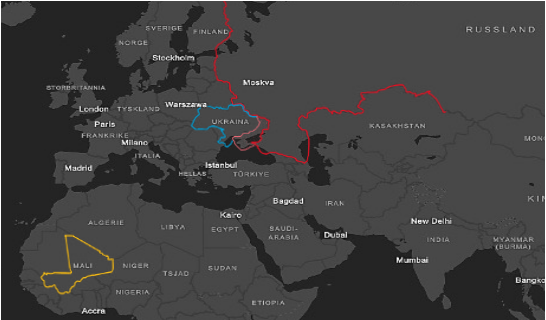
Map 2. Proxy Battlespace in Mali
To understand why Ukrainian special operations would target Wagner PMC in Mali, it is necessary to consider Russia’s interests in the country. First, Russia benefits from Mali’s natural resources, particularly gold, as Mali is one of Africa’s leading gold producers.[33] While Ukrainian forces are not targeting gold mines directly, they are reportedly targeting mercenaries who are compensated in gold for their services.[34]
Gold has emerged as a strategic resource for Russia since the invasion of Ukraine, as it allows Moscow to circumvent international sanctions and sustain wartime trade relationships, particularly with countries such as China, Turkey, Iran, and the UAE.[35] It has also been revealed that gold-related schemes finance Wagner operations in Africa. In practice, billions of dollars’ worth of African gold are laundered through mercenary companies, supporting Russia’s broader war effort. This, in turn, increases pressure on Ukraine within the main theater of operations.[36] Reports further indicate that Russian mercenary forces have funneled weapons through Mali—procured via third-party suppliers—to support the main battlefront as well.[37]
Does the concept of proxy battlespaces apply to the case of Mali? Initial indicators suggest either the presence of proxy warfare or the emergence of a proxy battlespace. The proxy battlespace framework identifies three necessary indicators to distinguish this phenomenon from related concepts such as hybrid attacks or proxy wars. First, the operations must take place outside the main theater of war. In the case of Mali, this condition is clearly met. Second, the operations must exhibit characteristics typical of special operations. Based on the U.S. Department of Defense definition discussed earlier, this appears plausible, as the activity occurred in a hostile and politically sensitive environment. This is evident from the diplomatic backlash Ukraine faced following the incident and, if Ukrainian personnel were present, from their reported collaboration with Tuareg rebel forces. Third, a proxy battlespace must support the primary campaign through actions conducted abroad. In this context, targeting mercenary forces and disrupting Russian operations in Mali—where gold revenues contribute to funding the war effort—would support Ukraine’s broader campaign. In a war characterized by attrition, Russia would be forced either to reinforce its presence in Mali or to reduce its activities there, both of which could constrain its ability to sustain the main campaign, whether through material resources or income derived from gold.
Overall, the concept of proxy battlespaces appears broadly consistent with the situation in Mali. However, one critical factor remains unresolved. For an area to qualify as a proxy battlespace rather than a proxy war, Ukraine would need to have employed its own personnel directly. On this point, available reporting remains ambiguous. Initial statements from a representative of the Main Intelligence Directorate (HUR) suggested that Ukraine provided more than informational support but did not specify the nature of that assistance, while later statements appeared to deny direct involvement. As a result, the available evidence is insufficient to conclusively classify Mali as a proxy battlespace, although the majority of the concept’s defining tenets appear to be present.
Sudan
While the incident in Mali has received the most academic attention, indicators in Sudan represent the earliest reported cases of Ukrainian activity abroad. In August 2023, the Russian outlet Gazeta claimed that MI6 was assisting Ukrainian operators from the Main Intelligence Directorate (HUR) and the Security Service of Ukraine (SBU) in missions aimed at sabotaging infrastructure and disrupting Russian assets in Africa, identifying Sudan as a key target.[38] Shortly thereafter, CNN reported that Ukrainian special services were likely responsible for strikes against units of the Wagner-backed Rapid Support Forces (RSF), noting that the attacks occurred just two days after Wagner had helped facilitate a large arms convoy to an RSF garrison.[39] Ukrainian officials neither confirmed nor denied the attacks; however, Kyrylo Budanov, chief of the HUR, reiterated that “Russian war criminals” would be “punished anywhere in the world.”[40]
Subsequent reporting strengthened claims of Ukrainian involvement. In October 2023, Babel published videos allegedly showing Ukrainian operators employing drones and sniper rifles to strike targets, citing a source within the intelligence community who confirmed the footage’s authenticity.[41] These claims were further supported by an open-source intelligence (OSINT) analysis conducted by Bellingcat, which geolocated the events to Sudan.[42]
Kyiv Post reported multiple related incidents, beginning in November 2023 with the publication of exclusive video footage depicting operators fighting Wagner personnel in Sudan. The outlet quoted a source stating that these engagements had taken place within two weeks of the article’s release.[43] Le Monde echoed these accounts, citing its own sources who similarly confirmed the events.[44] In 2024, Kyiv Post published two additional exclusives describing a month-long campaign against Russian mercenaries, including video footage showing Ukrainian SOF interrogating Wagner captives.[45]
The most detailed account emerged in March 2024, when The Wall Street Journal published an article providing extensive context for the strikes in Sudan (Lovett et al. 2024). Drawing on video evidence and interviews with operators reportedly deployed in Sudan, the article outlines the relationship between Lt. Gen. Abdel Fattah al-Burhan and President Volodymyr Zelensky and frames Ukraine’s deployment to Africa as part of a broader strategy to disrupt Russian economic activity and influence in the region. The reporting describes the scope of the missions, including an initial infiltration in mid-August 2023 involving approximately 100 HUR operators and an early operation to evacuate Burhan from Khartoum, followed by support to government forces in efforts to regain control of the capital. According to the operators interviewed, the primary objective of the Ukrainian mission was to undermine Russian interests in Sudan rather than to target individual Wagner personnel.
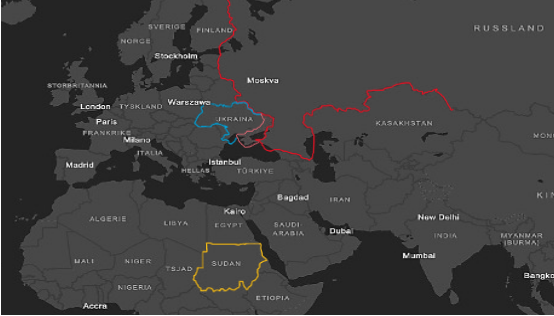
Map 3. Proxy Battlespace in Sudan
To understand why these strikes may have an effect on the overall war effort, it is necessary to examine Russian interests in Sudan. Russia has several interests in the country, including economic, military, and diplomatic ones. As in the case of Russian involvement in Mali, Sudan likewise possesses substantial gold resources, ranking among the top five gold producers in Africa.[46] As discussed earlier, gold is a conflict commodity used to finance Russian mercenary operations and to bypass international sanctions, thereby supporting Russia’s war effort.[47]
Russia’s role in Sudan has been described by Götz and Kaas as “curious,” as Russian interests appear to have supported both sides of the conflict. Both Russian Deputy Foreign Minister Mikhail Bogdanov and the late Yevgeny Prigozhin reportedly offered to mediate between rival factions.[48] While Russia previously supported the Rapid Support Forces (RSF), recent reporting suggests that Moscow has shifted its support to government forces, which control much of the country’s gold production as well as access to the Red Sea via Port Sudan.[49] Earlier this year, an agreement was reportedly reached allowing Russia to establish a naval base in Port Sudan, potentially serving as an important replacement for its recently lost base in Tartus, Syria.[50]
When analyzed through the lens of proxy battlespaces, Ukrainian actions in Sudan exhibit several indicators consistent with the concept. The first indicator is that operations occur outside the main theater of conflict. Given the significant geographic distance between Ukraine and Sudan, this condition is clearly met. Second, the operations must display characteristics of special operations. Based on the definition outlined earlier in this article, these activities take place in a hostile and politically sensitive environment. They occur in a foreign country involving multiple external actors, over which Ukraine has no official jurisdiction, and within the context of an ongoing civil war. The political sensitivity is further heightened by the position of Ukraine’s primary supporter, the United States, which has actively urged foreign states not to intervene militarily in Sudan, warning that such involvement risks exacerbating atrocities and complicating the conflict.[51]
A further important distinction from the Mali case is that multiple reports from Western, Russian, and Ukrainian media indicate that Ukrainian SOF have been present on the ground in Sudan. According to these accounts, Ukrainian operators collaborated with elements of the Sudanese Armed Forces (SAF) while also conducting independent direct-action missions.
Finally, the proxy battlespace concept requires that actions undertaken abroad support the primary campaign. As in Mali, disruptions to Russian operations in Sudan would affect Russia’s potential gold revenues derived from mercenary activity and other illicit practices, including arms trafficking. Given Sudan’s status as one of Africa’s largest gold producers, the financial stakes for Russia are considerable, amplifying the impact of Ukrainian actions. By targeting Russian mercenary forces and affiliated rebel groups, Ukraine places Russia in a strategic dilemma similar to that observed in Mali: Moscow must either accept reduced activity—resulting in lower income and diminished support for its war effort—or reinforce its presence in Sudan by diverting additional troops and resources from the primary theater. In either case, the trade-off imposes costs on Russia’s main campaign.
These actions can therefore be understood as directly supporting Ukraine’s primary war effort by contributing to attrition in Russian capabilities. Moreover, reporting by The Wall Street Journal suggests a degree of cooperation between Ukraine and Sudan regarding weapons transfers. According to the article and its sources, Ukraine supplied FPV drones, Bayraktar drones, and small arms to the SAF, which in turn may have supported Ukraine’s efforts through economic means. Unlike the case of Mali, the situation in Sudan appears to satisfy all tenets of the proxy battlespace concept. While Ukraine has not officially confirmed the conduct of special operations, multiple independent media reports place Ukrainian operators on the ground engaging in direct-action missions.
Syria
One of the earliest reports of Ukraine’s planned operations outside the main battlespace emerged in April 2023, when The Washington Post published an article detailing alleged Ukrainian plans to target Russian forces in Syria.[52] The reporting was based on the so-called “Pentagon Leaks” and featured a photographed one-page document dated January 2023 outlining purported Ukrainian planning. The document included a targeting priority list, potential operational and political constraints, logistical challenges, political risks, a possible modus operandi, and an explanation of why Ukraine might conduct operations abroad. Notably, it suggested that operating in foreign territories could provide deniability, as Ukraine could attribute attacks to non-state groups opposing the Syrian government.
Following this report, mainstream media coverage was largely quiet for some time, with no major outlets reporting confirmed Ukrainian special operations in Syria. This changed in early summer 2024, when Kyiv Post published several articles in June, July, and September featuring exclusive videos allegedly showing Ukrainian SOF from the Main Intelligence Directorate (HUR) targeting Russian and Syrian facilities.
The first article, published on June 3, included video footage reportedly showing HUR operators collaborating with Syrian rebel forces to attack Russian mercenaries and Assad-aligned forces in the Golan Heights.[53] The article further cited a source within HUR who stated that Russian facilities in the region had been targeted since early 2024. Shortly thereafter, Kyiv Post released another exclusive on July 31, accompanied by video footage and additional reporting. This article claimed that Ukrainian forces conducted strikes against the Kuweires Air Base east of Aleppo, which Russian forces reportedly used for military purposes, including training and transporting foreign mercenaries to support operations in Ukraine.[54]
On September 16, Kyiv Post published a third exclusive, detailing an alleged operation in which HUR SOF targeted a Russian drone base in Syria. The accompanying video purportedly showed Ukrainian operators causing an explosion inside a building displaying Russian flags.[55] Russian media also reported on these incidents. Articles published by Gazeta and Izvestia in September 2024 alleged a partnership between HUR and Hay’at Tahrir al-Sham (HTS), claiming that militants were exchanged for drone supplies. [56]These reports were later reinforced by statements from Russian officials asserting that Ukrainian forces were operating in Syria.[57]
Alleged collaboration with HTS gained broader Western media attention when the group participated in the coalition that ultimately toppled the Syrian government. Beginning in late November 2024 and continuing through December 8, rebel forces advanced rapidly across Syria, culminating in an offensive on Damascus that led to the collapse of the Assad regime. During this period, Kyiv Post reported that HUR operators may have assisted some of the rebel groups involved in the assault on Aleppo, though the outlet explicitly noted that it lacked independent verification or sourcing for these claims.[58] By contrast, The Washington Post published an article citing unnamed “knowledgeable sources” who claimed that Ukrainian intelligence had sent approximately 20 experienced drone operators and around 150 FPV drones to HTS headquarters in Idlib roughly four weeks prior to the offensive in order to support the rebellion.[59]
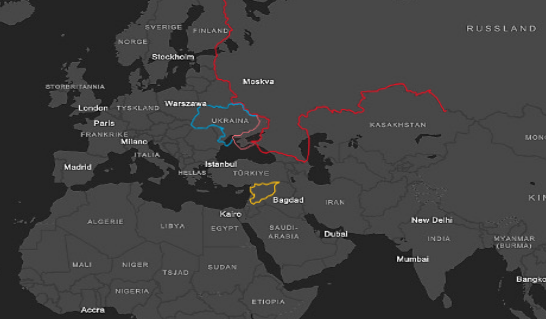
Map 4. Proxy Battlespace in Syria
When considering why Ukraine would target Russia in Syria, it is important to note that Russia has long-standing and substantial interests in the country, as well as a well-documented relationship with the former Syrian leader, Bashar al-Assad. This relationship was underscored by Russia’s intervention in the Syrian civil war in 2015, during which Moscow deployed fighter jets, helicopters, air-defense systems, and mercenary forces to support government troops against rebel groups.[60] In return, Syria became Russia’s primary foothold in the Middle East, underpinned by agreements involving weapons transfers, military training, energy trade, and diplomatic support.[61] Moreover, Russia maintained control over multiple military installations, including airfields near Kuweires and, most notably, the naval base at Tartus—the only Russian naval facility of strategic significance in the Mediterranean. Before the fall of the Assad regime, these bases were slated for expansion and intended for both military and economic use.[62]
Russia’s war effort in Ukraine has also benefited from Syrian support. Multiple reports indicate that both volunteers and government forces from Syria were recruited to reinforce Russian ranks in Ukraine, with some estimates suggesting as many as 16,000 volunteers in the early stages of the war in March 2022. Other reporting indicates that training for these recruits took place at bases near Aleppo.[63] In this context, alleged Ukrainian strikes near Kuweires Air Base and other locations around Aleppo, as well as reports that rebel groups were assisted during the takeover of the city, may suggest that Ukrainian targets were deliberately selected to disrupt Russian recruitment efforts in the region. Notably, even while under significant pressure in the primary battlespace, Russia reportedly pledged to send reinforcements to Syria during the rebel offensive in late November 2024 to support the Assad regime, further underscoring Syria’s importance to Russian strategic interests.[64]
As in the Sudan case, there are clear indicators supporting the use of the proxy battlespace concept to describe Ukrainian actions in Syria. The first tenet—operations conducted outside the main area of operations—is clearly met. Second, the actions attributed to HUR in Syria display characteristics consistent with special operations. These activities occurred in a hostile and politically sensitive environment, taking place in a foreign country and targeting foreign actors while undermining an established government amid an ongoing civil war. As suggested by the Pentagon leaks, additional political sensitivities were involved, particularly with respect to Turkey and the United States, both of which had to consider potential Russian retaliation against key regional assets, adding further complexity to the operational environment. Similar to the situation in Sudan, reporting suggests that Ukrainian operators were present on the ground conducting strikes against Russian assets. Given the volume of reporting, including video evidence of raids and drone strikes and indications of coordination with local forces, it is reasonable to characterize these activities as special operations.
The third tenet of a proxy battlespace is support for the primary campaign. The former Syrian regime maintained a long-standing relationship with Russia that encompassed trade in oil and gas, security cooperation, and military equipment. Strikes against Russian facilities would therefore disrupt economic activity and place Russia in a strategic dilemma: either address these challenges directly or accept a reduction in services and influence, with corresponding financial consequences. In addition, Russia’s recruitment of Syrian personnel for the war in Ukraine represents another vulnerability, one that Ukraine may have sought to exploit by targeting training camps and logistical routes linked to Kuweires Air Base.
The fall of the Assad regime is likely to have significant consequences for Russia. This is reflected in Moscow’s willingness to deploy forces on short notice despite ongoing pressure in Ukraine. Russia’s diplomatic position in the region has weakened, while the new Syrian government appears more receptive to Ukraine. Ukrainian officials met with representatives of the new Syrian government in late December 2024, stating that the two countries shared similar views regarding Russian military presence in Syria.[65] As a result, Russia has lost access to the naval base at Tartus, a development of strategic importance that will limit Russia’s ability to project power in the Middle East and Africa until a comparable port facility can be secured elsewhere.[66]
As in the Sudan case, Ukraine’s actions in Syria do not fully align with classical definitions of proxy warfare or hybrid warfare. However, the key characteristics of a proxy battlespace are present, with the important caveat that Ukraine has not officially confirmed its involvement in these operations.
Summary of Cases
In Mali, Sudan, and Syria, Ukraine appears to have targeted Russian interests and mercenary forces. Although each case has unique characteristics, they share notable commonalities in both the actions undertaken by Ukraine and the potential reasoning behind them, suggesting a coherent pattern. Ukrainian forces from the Main Intelligence Directorate (HUR) appear to have struck Russian assets as part of a broader strategy to support the primary war effort in Ukraine. When comparing the cases, a consistent pattern emerges that lends support to the concept of proxy battlespaces.
| Proxy Battlespace: | Out of Theatre | Special Operation | Supporting Main Campaign |
| Mali | Yes | N/A | Yes |
| Sudan | Yes | Yes | Yes |
| Syria | Yes | Yes | Yes |
Table 1. Proxy Battlespaces applied to the cases
First, all cases occurred outside the main theater of war, thereby meeting the first criterion of the proxy battlespace concept. Second, at least two of the cases can be clearly characterized as special operations. All operations took place in hostile and politically or diplomatically sensitive environments. Reporting from Western, Ukrainian, and Russian media indicates that Ukrainian operators were present on the ground in both Syria and Sudan, conducting military actions. Mali serves as an outlier, as available accounts and reporting are contradictory, and therefore, sufficient information is lacking to conclusively assess this criterion. Third, in all three cases, Russia maintained interests that directly supported its war effort in Ukraine. In Mali and Sudan, gold extraction plays a central role. Russia exploits gold reserves to bypass Western sanctions and sustain its war economy, primarily through the use of mercenary forces. In Syria, Russian interests were rooted in long-standing ties to the Assad regime, which granted favorable economic arrangements, military basing rights, and access to the Mediterranean. Russian air bases and naval facilities in Syria functioned as key logistical hubs and recruitment centers for fighters deployed to Ukraine, making the fall of the Assad regime a significant setback to Russian influence in the region and to its broader war effort.
Across all three cases, Ukrainian targeting focused on degrading Russian military and economic assets abroad that were linked to the war in Ukraine. In Mali and Sudan, strikes against mercenary forces and support to rebel groups undermined Russian operations, limiting both influence and revenue derived from gold. In Syria, operations sought to constrain Russian presence in the country and disrupt facilities used for recruiting personnel for deployment to Ukraine. In each case, Russia was confronted with a strategic dilemma: either reallocate scarce resources to defend overseas interests—resources that could otherwise support operations in Ukraine—or accept a reduction in services rendered abroad, resulting in diminished income and influence.
Unlike traditional theories of proxy warfare or hybrid warfare, the concept of proxy battlespaces accounts for special operations conducted in foreign theaters that are intended to support the main theater of war. As such, the proxy battlespace framework offers a compelling lens for understanding the logic behind Ukraine’s special operations abroad. More importantly, the cases examined strongly suggest that Ukraine has, in all likelihood, conducted military actions in Syria, Sudan, and Mali in pursuit of this broader strategic objective.
Implications for Policy and Doctrine
As demonstrated by the case studies, proxy battlespaces provide a comprehensive understanding of how transnational operations are related to a main theatre of operations. To integrate the conceptual aspects of proxy battlespaces into existing doctrinal frameworks, we construct a representative term: Out-of-Theatre Operations (OTO). This term can be compared to existing terminology related to battlespace geometry, as indicated by the tables below.
| Doctrinal Term | Doctrine | Sources | |
| — | Battlespace | The part of the operating environment where actions and activities are planned and conducted. | AAP-06; AAP-39 |
| — | Sequel | A future operation that anticipates the possible outcome – success, failure, or stalemate – of the current operation. | AAP-3 |
| AOO | Area of Operations | An operational area defined by a joint commander for land or maritime forces to conduct military activities. Normally, an area of operations does not encompass the entire joint operations area of the joint commander, but is sufficient in size for the joint force component commander to accomplish assigned missions and protect forces | AAP-06; AAP-15; AAP-39; ISRI WG Glossary (AEDP-2, Vol. 4) |
| AOI | Area of Operational Interest | In air defense, an area in which automatic cross-telling of tracks of interest is provided to an adjacent site based on established criteria, such as identity and location. | AAP-06; AAP-39 |
| AOR | Area of Responsibility | In naval operations, a predefined area of enemy terrain for which supporting ships are responsible for covering by fire on known targets or targets of opportunity, and by observation | AAP-06; AAP-15; AAP-39; ISRI WG Glossary (AEDP-2, Vol. 4) |
| AII | Area of Intelligence Interest | A geographical area for which commanders require intelligence on the factors and developments that may affect the outcome of operations. | AAP-06; AAP-15; AAP-39 |
| AIR | Area of Intelligence Responsibility | A geographical area allocated to a commander, in which the commander is responsible for the provision of intelligence | AAP-06; AAP-15; AAP-39 |
| JIPOE | Joint Intelligence Preparation of The Operating Environment | The analytical process used to produce intelligence estimates and other intelligence products in support of the commanders’ decision-making and operations planning. | AAP-06; AAP-15 |
| JOA | Joint Operations Area | A temporary area defined by the Supreme Allied Commander Europe, in which a designated joint commander plans and executes a specific mission at the operational level of war. A joint operations area and its defining parameters, such as time, scope of the mission and geographical area, are contingency- or mission specific and are normally associated with combined joint task force operations | AAP-06; AAP-15; AAP-39 |
| LoO | Line of Operation | A path linking decisive conditions to achieve an objective. | AAP-06; AAP-15; AAP-39 |
| NAI | Named Area of Interest | A defined geographical area where data and information are gathered to satisfy specific intelligence requirements. | AAP-06; AAP-15 |
| TAI | Target Area of Interest | The geographical area where high-value targets can be acquired and engaged by friendly forces. | AAP-15; AJP-2;JP2-01.3 |
| TOO | Theatre of Operations | A designated area, which may include one or more joint operations areas. A theatre of operations may include land, air, space, and sea outside a joint operations area. | AAP-06; AAP-15 |
| OTO | Out-of-Theatre Operation | A designated area, separated transnationally from the Theatre of Operations, where special operations are conducted to support the campaign plan of the Theatre of Operations. | Proposed |
Table 2. Doctrinal Baseline
| Metrics | Assessment Statement |
| OTO vs. Battlespace | Complementary. An OTO can be considered a battlespace and vice versa for planning purposes. |
| OTO vs. Sequel | Complementary. An OTO can be planned as a sequel. |
| OTO vs. AOO | Complementary. An OTO can be considered an AOO that belongs to the Theatre Commander. AOOs are not doctrinally restricted geographically to the Theatre but to the Command of the Theatre. |
| OTO vs. AOI | Complementary. An OTO can start as an AOI or include AOIs within the geographical area of the OTO. |
| OTO vs. AOR | Complementary. An OTO can have specific AORs designated within its geographical boundaries for planning purposes. |
| OTO vs. AII | Complementary. For planning purposes, an OTO can begin as an AII or have AIIs associated with it outside its geographical designation. |
| OTO vs. AIR | Complementary. An OTO can have its own AIRs for planning purposes. |
| OTO vs. JIPOE | Complementary. An OTO geographic designation can be part of the Theatre JIPOE. |
| OTO vs. JOA | Complementary. An OTO already belongs to a designated JOA or Theatre. |
| OTO vs. LoO | Complementary. An OTO can be represented by a LoO in a Theatre OPLAN and can have its own LoOs in the operational planning for its designated geographical area. |
| OTO vs. NAI | Complementary. An OTO can designate its own NAIs as part of the operational planning for its geographical area. |
| OTO vs. TAI | Complementary. An OTO can designate its own TAIs as part of the operational planning for its geographical area. |
| OTO vs. TOO | Complementary. OTO identifies transnational AOOs that are essential for planning purposes within the main theatre. |
Table 3. Doctrinal Assessment
The significant implications for policy and doctrine can be summarized in two main points. First, policymakers must acknowledge that the international environment has become noticeably more conducive to conducting transnational hybrid operations. This recognition should be incorporated into a broader security policy. In addition, the military implications of this shift must be taken into account. It is essential to include critical requirements for military operational planning that reflect this new reality, as well as the need for armed forces capable of contributing to the transnational aspects of hybrid warfare where appropriate. This study does not seek to prove the effectiveness of proxy battlespaces, but rather to demonstrate their existence, even when states themselves deny such activities. This has important ramifications: as the cases suggest, the phenomenon exists, and doctrine should reflect this reality. Even if Western nations are unwilling to engage in such activities due to legal constraints, doctrine should at a minimum account for adversary capabilities so that militaries possess doctrinal tools to address the threat posed by proxy battlespaces.
Second, as a direct consequence of this more permissive environment for hybrid operations, the use of hybrid warfare between belligerents in more open wars or conflicts is likely to increase where capabilities allow. From a defense policy perspective, this requires military organizations to prepare for the integration of hybrid warfare into their broader warfighting strategies. Doing so, in turn, necessitates a planning doctrine that accounts for both kinetic and non-kinetic hybrid operations. A less visible implication for both policy and doctrine concerns the concept of “plausible deniability,” which may need to be assessed on a case-by-case basis. Such assessments depend on the capabilities of the actors involved and their perceptions of escalation management and international law. Put simply, the more powerful a state is, the lower the threshold for what constitutes “plausible deniability” may become.
Conclusion
In the quote presented at the beginning of this article, Kyrylo Budanov stated that people should “find the answers on their own” when asked whether Ukrainian SOF had conducted military operations in foreign countries. These actions present a paradox: in the midst of a full-scale invasion by Russian forces, Ukraine appears to have committed troops outside its own borders to conduct military operations in Syria, Sudan, and Mali.
This article addresses that paradox, contributing to an emerging but still nascent body of academic literature. As argued here, existing theories of hybrid warfare, proxy wars, and military operations fail to fully capture and explain the contemporary phenomenon of employing SOF to strike targets in foreign theaters while under severe pressure in the main battlespace, as is the case for Ukraine. To address this gap, the article proposes a new conceptual framework—proxy battlespaces—alongside a corresponding doctrinal term, Out-of-Theater Operations.
Building on existing literature, the article identifies three defining factors of a proxy battlespace. First, such operations occur during an ongoing conflict and take place in transnational locations outside the main theater of battle. Second, they must exhibit the characteristics of special operations. Third, they must support the primary campaign being fought in the main battlespace.
When applying this concept to Ukraine’s use of SOF in Mali, Sudan, and Syria, a clear pattern emerges. First, all cases involved operations conducted outside Ukraine. Second, the cases of Sudan and Syria clearly exhibited the characteristics of special operations, particularly due to their execution in hostile and politically sensitive environments and their conduct by specialized units from Ukraine’s Main Intelligence Directorate. Third, in all three cases, the actions appear to support Ukraine’s primary campaign against Russian forces by targeting key enablers of Russia’s war effort—such as recruitment networks in Syria and mercenary forces linked to illicit gold transactions in Mali and Sudan. Moreover, these operations impose a strategic dilemma on Russia: either accept losses among deployed forces, with corresponding reductions in income and services rendered, or redirect additional resources away from the main battlespace, thereby weakening its core war effort.
The article concludes by advocating, on descriptive rather than prescriptive grounds, for the formal recognition of the proxy battlespace concept within military doctrine. Existing terminology does not adequately capture the logic or operational dynamics of these activities, despite their apparent occurrence. As hybrid warfare becomes more prevalent during phases of competition and crisis, operations conducted in proxy battlespaces are likely to feature more prominently in contemporary conflict. Ukraine’s approach to employing special operations forces in foreign theaters, therefore, warrants closer study and recognition in both military planning and broader security policy.
As a final note, this article closes by highlighting the significant legal and ethical questions raised by the exploitation of Out-of-Theater Operations. While a full examination of these issues lies beyond the scope of this study, scholars and practitioners alike should consider how existing interpretations of the Law of Armed Conflict and International Humanitarian Law, including the Geneva Conventions, may be strained by the increasing use of OTO in future conflicts.
Endnotes
[1] Ostap Yarysh, “Budanov Commented on Media Reports about Ukraine’s Possible Involvement in Drone Strikes in Sudan,” Voice of America, September 23, 2023, https://www.holosameryky.com/a/budanov-prokomentuvav-povidomlennia-pro-udary-droniv-u-sudani/7281150.html.
[2] International Institute for Strategic Studies (IISS), “Combat Losses and Manpower Challenges Underscore the Importance of ‘Mass’ in Ukraine,” February 10, 2025, https://www.iiss.org/online-analysis/military-balance/2025/02/combat-losses-and-manpower-challenges-underscore-the-importance-of-mass-in-ukraine/.
[3] John A. Nagl and Katie Crombe, A Call to Action: Lessons from Ukraine for the Future Force (Carlisle, PA: U.S. Army War College Press, 2024), https://press.armywarcollege.edu/monographs/968/; Tim Sweijs and Jeffrey H. Michaels, eds., Beyond Ukraine: Debating the Future of War (London: Hurst, 2024), https://www.hurstpublishers.com/book/beyond-ukraine/.
[4] James Black et al., “Russia’s War in Ukraine: Emerging Insights for UK and NATO Joint Doctrine,” RAND Europe, November 18, 2024, https://www.rand.org/content/dam/rand/pubs/research_reports/RRA3400/RRA3400-1/RAND_RRA3400-1.pdf; Jack Watling, Oleksandr Danylyuk, and Nick Reynolds, “Preliminary Lessons from Ukraine’s Offensive Operations, 2022–23,” Royal United Services Institute (RUSI), July 2024, https://static.rusi.org/lessons-learned-ukraine-offensive-2022-23.pdf.
[5] United Kingdom Ministry of Defence, Joint Doctrine Publication 2-00, August 2023, 110, https://assets.publishing.service.gov.uk/media/653a4b0780884d0013f71bb0/JDP_2_00_Ed_4_web.pdf.
[6] Andrew Maher, “Negotiations Can’t End the War in Ukraine; It Would Just Evolve,” The Strategist, February 24, 2025, https://www.aspistrategist.org.au/negotiations-cant-end-the-war-in-ukraine-it-would-just-evolve/; Olayinka Ajala, “Russia–Ukraine War Spills into West Africa: Mali Attacks Signal Dangerous Times Ahead,” The Conversation, August 16, 2024, https://doi.org/10.64628/AAJ.gj9ge63tu; Shola Lawal, “Mali’s Spat with Kyiv: Is the Russia–Ukraine War Spilling over into Africa?” Al Jazeera, August 8, 2024, https://www.aljazeera.com/news/2024/8/8/malis-spat-with-kyiv-is-the-russia-ukraine-war-spilling-over-into-africa.
[7] Tyrone Groh, Proxy War: The Least Bad Option, 1st ed. (Stanford University Press, 2019), 27, JSTOR, https://doi.org/10.2307/j.ctvqsdq0k.
[8] Groh, Proxy War, 29.
[9] Andrew Mumford, “Proxy Warfare and the Future of Conflict,” RUSI Journal 158, no. 2 (2013): 40–46, https://doi.org/10.1080/03071847.2013.787733.
[10] Mumford, “Proxy Warfare”
[11] Karl Deutsch, “External Involvement in Internal War,” in Internal War: Problems and Approaches, ed. Harry Eckstein (Glencoe, NY, 1964).
[12] Mirosław Banasik, “Russia’s Hybrid War in Theory and Practice,” Journal of Baltic Studies 2, no. 1 (2016): 157–82, https://doi.org/10.1515/JOBS-2016-0035.
[13] Stephen M. Dayspring, “Toward a Theory of Hybrid Warfare: The Russian Conduct of War during Peace,” Defense Technical Information Center, 2015, https://apps.dtic.mil/sti/pdfs/ADA632188.pdf; Maxim A. Suchkov, “Whose Hybrid Warfare? How the Concept Shapes Russian Discourse,” Small Wars & Insurgencies 32, no. 3 (2021): 415–40, https://doi.org/10.1080/09592318.2021.1887434.
[14] Oleksandr Panfilov and Ol’ga Savchenko, “Sociological Aspect in the Content of the Modern Hybrid Warfare,” Visnik Nacional’noï Úridičnoj Akademii Ukraïni İmeni Ároslava Mudrogo 1, no. 52 (2022), https://doi.org/10.21564/2663-5704.52.249948.
[15] Mark Galeotti, “Controlling Chaos: How Russia Manages Its Political War in Europe,” European Council on Foreign Relations, 2017.
[16] Dayspring, “Toward a Theory of Hybrid Warfare.”
[17] Joint Chiefs of Staff, Joint Publication (JP) 3-05, Special Operations, 16 July 2014. https://edocs.nps.edu/2014/July/jp3_05.pdf
[18] Tom Searle, Outside the Box: A New General Theory of Special Operations, JSOU Report 16-4 (2017), https://jsouapplicationstorage.blob.core.windows.net/press/112/17-4.pdf.
[19] Christopher Tuck, Understanding Land Warfare (Routledge, 2022); Franz-Stefan Gady, “Making Attrition Work: A Viable Theory of Victory for Ukraine,” IISS, February 9, 2024, https://www.iiss.org/online-analysis/survival-online/2024/01/making-attrition-work-a-viable-theory-of-victory-for-ukraine/; Alex Vershinin, “The Attritional Art of War,” RUSI, March 18, 2024, https://www.rusi.org/explore-our-research/publications/commentary/attritional-art-war-lessons-russian-war-ukraine.
[20] James D. Kiras, Special Operations and Strategy: From World War II to the War on Terrorism (Routledge, 2006), (e.g. 73-74), https://doi.org/10.4324/9780203969649.
[21] Tarik Solmaz, “‘Hybrid Warfare’: One Term, Many Meanings,” Small Wars Journal 25 (2022); Donald Stoker and Craig Whiteside, “Blurred Lines,” Naval War College Review 73, no. 1 (2020): 12-48.
[22] NATO, “Allied Joint Doctrine for the Conduct of Operations” (NATO Standardization Office, February 2019); NSO, “AJP-5 Allied Joint Doctrine for the Planning Operations,” Edition A, Version 1 (NATO, February 2018).
[23] NSO, “AJP-3.9 Allied Joint Doctrine for Joint Targeting” (NATO, November 2021).
[24] David M. Glantz, Soviet Military Operational Art: In Pursuit of Deep Battle (Frank Cass, 1991).
[25] JWC, “Commander’s Handbook for Attack the Network” (Joint Doctrine Support Division, May 20, 2011).
[26] Yulia Kuzmenko, “The Largest Losses of the Wagner PMC in Africa in 6 Years: What Is Known about the Battles in Northern Mali with Tuareg Rebels,” Suspilne, July 29, 2024, https://suspilne.media/801575-najbilsi-vtrati-pvk-vagner-v-africi-za-6-rokiv-so-vidomo-pro-boi-na-pivnoci-mali-z-povstancami-tuaregami/; Reuters, “Mali Says Cutting Ties with Ukraine over Alleged Involvement in Rebel Attack,” August 5, 2024, https://www.reuters.com/world/mali-says-cutting-ties-with-ukraine-over-alleged-involvement-rebel-attack-2024-08-04/.
[27] TASS, “Ukrainian Special Services on Ground in Mali, Aiding Terrorists,” July 30, 2024, https://tass.com/politics/1823121.
[28] Mimi Mefo Newuh, Wendy Bashi, and Igor Burdyga, “Mali Breaks Diplomatic Ties with Ukraine,” Deutsche Welle, August 5, 2024, https://www.dw.com/en/mali-ends-diplomatic-ties-with-ukraine-over-attack-claims/a-69860100.
[29] Ministry of Foreign Affairs of Ukraine, “Statement of the Ministry of Foreign Affairs of Ukraine on the Decision of the Transitional Government of the Republic of Mali to Break off Diplomatic Relations with Ukraine,” August 5, 2024, https://mfa.gov.ua/en/news/zayava-mzs-ukrayini-shchodo-rishennya-perehidnogo-uryadu-respubliki-mali-rozirvati-diplomatichni-vidnosini-z-ukrayinoyu.
[30] Benjamin Roger and Emmanuel Grynszpan, “Ukrainian Drones Provide Support for Northern Mali’s Rebels,” Le Monde, October 13, 2024, https://www.lemonde.fr/en/le-monde-africa/article/2024/10/13/ukrainian-drones-provide-support-for-northern-mali-s-rebels_6729231_124.html.
[31] Benjamin Roger, “In Mali, the Shadow of Ukraine behind Rebels at War with Wagner’s Russian Mercenaries,” Le Monde, August 2, 2024, https://www.lemonde.fr/en/le-monde-africa/article/2024/08/02/in-mali-ukraine-s-shadow-behind-rebels-at-war-with-wagner-s-russian-mercenaries_6707255_124.html.
[32] Contre-Poison, “La coopération entre le CSP-DPA et les Ukrainiens en est à sa première phase: Interview avec Mohamed Elmaouloud Ramadane, porte-parole du CSP-DPA,” September 11, 2024, https://web.archive.org/web/20240911143049/https://contre-poison.fr/azawad-2-2-la-cooperation-entre-le-csp-dpa-et-les-ukrainiens-en-est-a-sa-premiere-phase-interview-avec-mohamed-elmaouloud-ramadane-porte-parole-du-csp-dpa/.
[33] U.S. Geological Survey, Mineral Commodity Summaries, 2023.
[34] U.S. Department of the Treasury, “Treasury Sanctions Illicit Gold Companies Funding Wagner Forces and Wagner Group Facilitator,” June 27, 2023, https://home.treasury.gov/news/press-releases/jy1581.
[35] John Kennedy et al., Gold Rush: How Russia Is Using Gold in Wartime (RAND Corporation, 2024), https://www.rand.org/pubs/research_reports/RRA3230-1.html.
[36] U.S. Department of the Treasury, “Treasury Sanctions;” Kennedy et al., Gold Rush.
[37] Humeyra Pamuk, Katharine Jackson, and Daphne Psaledakis, “US Says Russia’s Wagner Group Seeking to Transit Military Equipment through Mali,” Reuters, May 24, 2023, https://www.reuters.com/world/us-says-russias-wagner-group-seeking-transit-material-acquisitions-through-mali-2023-05-22/.
[38] Pavel Zubov, “It Became Known about Britain’s Training of Ukrainian Saboteurs to be Sent to Africa,” Gazeta, August 16, 2023, https://www.gazeta.ru/army/news/2023/08/16/21081080.shtml.
[39] Victoria Butenko et al., “Exclusive: Ukraine’s Special Services ‘Likely’ behind Strikes on Wagner-Backed Forces in Sudan, a Ukranian Military Source Says,” CNN, September 20, 2023, https://edition.cnn.com/2023/09/19/africa/ukraine-military-sudan-wagner-cmd-intl; Nima Elbagir et al., “Exclusive: Evidence Emerges of Russia’s Wagner Arming Militia Leader Battling Sudan’s Army,” CNN, April 20, 2023, https://www.cnn.com/2023/04/20/africa/wagner-sudan-russia-libya-intl.
[40] Abbey Fenbert, “Budanov Responds to CNN Reports about Ukrainian Drone Strikes in Sudan,” The Kyiv Independent, September 24, 2023, https://kyivindependent.com/budanov-responds-to-cnn-reports-about-ukrainian-drone-strikes-in-sudan/.
[41] Kostya Andreykovets, “Babel Sources: Ukrainian Special Forces Conducted Operations in Sudan against Wagner PMC,” Babel, October 6, 2023, https://babel.ua/news/99274-dzherela-babel-ukrajinski-specpriznachinci-provodili-operaciji-v-sudani-proti-pvk-vagnera.
[42] Youri van der Weide and Glib Dreger, “Examining Videos of Suspected Ukrainian Riflemen in Sudan,” Bellingcat, October 7, 2023, https://www.bellingcat.com/news/2023/10/07/examining-videos-of-suspected-ukrainian-riflemen-in-sudan/.
[43] Kateryna Zakharchenko, “EXCLUSIVE: Videos Show Ukrainian Special Forces ‘Cleaning Up’ Wagner Fighters in Sudan,” Kyiv Post, November 6, 2023, https://www.kyivpost.com/post/23722.
[44] Thomas Eydoux, Laureline Savoye, and Sinead McCausland, “Why Are Ukranian Special Forces Fighting Russia’s Wagner Mercenaries in Sudan?” Le Monde, November 26, 2023, https://www.lemonde.fr/en/videos/video/2023/11/26/why-are-ukrainian-special-forces-fighting-russia-s-wagner-mercenaries-in-sudan_6290288_108.html.
[45] Chris York and Kateryna Zakharchenko, “Ukrainian Drones ‘Destroy Russian Mercenaries’ in Sudan,” Kyiv Post, January 30, 2024, https://www.kyivpost.com/post/27383; Alisa Orlova and Kateryna Zakharchenko, “EXCLUSIVE: Ukrainian Special Forces Interrogate Wagner Mercenaries in Sudan,” Kyiv Post, February 5, 2024, https://www.kyivpost.com/post/27637.
[46] Ahmed Soliman and Suliman Baldo, “Gold and the War in Sudan,” Chatham House, March 26, 2025, https://www.chathamhouse.org/2025/03/gold-and-war-sudan/03-gold-production-and-trade-during-war; U.S. Geological Survey, Mineral Commodity Summaries.
[47] Soliman and Baldo, “Gold and the War,” 16; John Kennedy et al., “Gold Rush: How Russia Is Using Gold in Wartime;” RAND, September 9, 2024, https://www.rand.org/pubs/research_reports/RRA3230-1.html.
[48] Elias Götz and Jonas Gejl Kaas, “Why Russia Seeks to Expand Its Influence in Africa – and What It Means for the West,” DIIS Report, February 28, 2024, https://www.diis.dk/en/research/why-russia-seeks-to-expand-its-influence-in-africa-and-what-it-means-the-west.
[49] Andrew McGregor, “Russia Switches Sides in Sudan War,” The Jamestown Foundation, July 8, 2024, https://jamestown.org/program/russia-switches-sides-in-sudan-war/.
[50] Basillioh Rukanga, “‘No Obstacles’ to Russian Red Sea Base – Sudan,” February 13, 2025, https://www.bbc.com/news/articles/c30del8dz5lo.
[51] Anthony J. Blinken, “War Crimes, Crimes Against Humanity, and Ethnic Cleansing Determination in Sudan,” U.S. Department of State, December 6, 2023, https://web.archive.org/web/20240226024734/https://www.state.gov/war-crimes-crimes-against-humanity-and-ethnic-cleansing-determination-in-sudan/; Anthony J. Blinken, “Secretary Antony J. Blinken at a UN Security Council Meeting on Sudan,” United States Department of State, December 19, 2024, https://2021-2025.state.gov/secretary-antony-j-blinken-at-a-un-security-council-meeting-on-sudan/.
[52] Evan Hill and Alex Horton, “Ukraine Planned Attacks on Russian Forces in Syria, Leaked Document Shows,” The Washington Post, April 20, 2023, https://www.washingtonpost.com/national-security/2023/04/20/russia-ukraine-war-syria-attacks/.
[53] Kateryna Zakharchenko, “Ukrainian Special Forces and Syrian Rebels Decimate Russian Mercenaries in Syria,” Kyiv Post, June 3, 2024, https://www.kyivpost.com/post/33695.
[54] Kateryna Zakharchenko, “Ukrainian HUR Special Forces Deliver Devastating Strike on Russian Base in Syria,” Kyiv Post, July 31, 2024, https://www.kyivpost.com/post/36646.
[55] Kateryna Zakharchenko, “Ukraine’s HUR Special Forces Target Russian Drone Base in Syria,” Kyiv Post, September 16, 2024, https://www.kyivpost.com/post/39074.
[56] Dmitry Arkhipov, “РИА: сирийские террористы получили от ВСУ беспилотники в обмен на боевиков,” Gazeta, 2024, https://www.gazeta.ru/army/news/2024/09/16/23934403.shtml; Andrey Kuzmak, “Вассальная воинственность: Киев договорился с террористами в Африке и на Ближнем Востоке,” Izvestia, September 20, 2024, https://iz.ru/1761849/andrei-kuzmak/vassalnaia-voinstvennost-kiev-dogovorilsia-s-terroristami-v-afrike-i-na-blizhnem-vostoke.
[57] RBC, “Спецпредставитель Путина заявил, что Киев вооружает террористов в Идлибе,” November 14, 2024, https://www.rbc.ru/rbcfreenews/67357ebe9a79477661fb40de; TASS, “Escalation in Syria Clearly Involves Ukrainians Foreign Ministry,” December 4, 2024, https://tass.com/politics/1881827.
[58] Kyiv Post, “Ukrainian Trained, Turkish Sponsored Syrian Rebels Lead Assault on Aleppo,” December 1, 2024, https://www.kyivpost.com/post/43117.
[59] David Ignatius, “Opinion: Syrian Rebels Had Help from Ukraine in Humiliating Russia,” The Washington Post, December 11, 2024, https://www.washingtonpost.com/opinions/2024/12/10/ukraine-syria-russia-war/.
[60] Aron Lund, “From Cold War to Civil War: 75 Years of Russian-Syrian Relations” (The Swedish Institute of International Affairs, 2019), https://www.ui.se/globalassets/ui.se-eng/publications/ui-publications/2019/ui-paper-no.-7-2019.pdf.
[61] Lund, “From Cold War to Civil War.”
[62] Lund, “From Cold War to Civil War.”
[63] Martin Chulov, “Syria Recruiting Troops from Its Military to Fight with Russian Forces in Ukraine,” The Guardian, March 11, 2022, https://www.theguardian.com/world/2022/mar/11/putin-approves-russian-use-of-middle-east-fighters-against-ukraine; Elsa Court, “Military Intelligence Publishes List of Syrians Recruited by Russia to Fight in Ukraine,” The Kyiv Independent, February 14, 2024, https://kyivindependent.com/military-intelligence-publishes-list-syrians/.
[64] Dylan Malyasov, “Russia to Send Extra Military Aid to Syria,” Defence Blog, November 30, 2024, https://defence-blog.com/russia-to-send-extra-military-aid-to-syria/; Abbey Fenbert, “Syrian Rebels Take over Aleppo as Russia Pledges to Assist Assad Regime,” The Kyiv Independent, November 30, 2024, https://kyivindependent.com/syrian-rebels-take-over-aleppo-as-russia-pledges-to-assist-assad-regime/.
[65] Daria Shulzhenko, “Ukraine’s Foreign Minister Meets with Syrian Leadership in Damascus,” The Kyiv Independent, December 30, 2024, https://kyivindependent.com/ukraines-foreign-minister-meets-with-syrian-leadership-in-damascus/.
[66] H. I. Sutton, “After Loss of Tartus, Russia Now Has No Submarines in the Mediterranean,” Naval News, January 5, 2025, https://www.navalnews.com/naval-news/2025/01/after-loss-of-tartus-russia-now-has-no-submarines-in-the-mediterranean/.
CONTACT Holger Lindhardsten | holg@fak.dk
The views expressed in this paper are those of the author and do not reflect the official policy or position of the Royal Danish Defence College or the Norwegian Defence University College.© 2026 Arizona Board of Regents/Arizona State University