Ian Murphy, SecuriFense Inc., Norfolk, Virginia, USA
Introduction
Kinmen’s modern history is marked by a dramatic transformation. Taiwanese scholars identify four distinct periods in its evolution from a heavily fortified battleground to a focal point in cross-strait relations. Once a site of armed confrontation, Kinmen’s identity and priorities have been reshaped by economic development and cross-strait management. This paper argues that Chinese media’s application of securitization theory to the so-called “Kinmen Model” signals the emergence of a distinct fifth period in Kinmen’s modern history.
While existing discourse largely concentrates on a potential full-scale invasion of Taiwan, this study shifts attention to the strategic significance of the outlying islands—particularly Kinmen—and the use of securitization to exert indirect control. It examines the evolving dynamics of cross-strait relations through the lens of securitization theory, focusing on China’s strategic deployment of the Kinmen Model and its implications for regional security. Utilizing Vuori’s 2008 framework for analyzing securitization in non-democratic contexts, this study conducts a discourse analysis of nineteen Chinese-language media sources that reference the Kinmen Model. The analysis aims to dissect the speech acts employed by Chinese media, identifying specific strands of securitization—raising an issue, legitimizing future actions, deterrence, justifying past actions, and control—and their intended political functions.
The paper reviews Kinmen’s historical trajectory, highlighting the shift from military confrontation to economic integration and, more recently, intensified gray zone activities. It identifies a gap in the literature regarding the “Fourth Period” of Kinmen’s history, characterized by a transition from border infiltration through legitimate interaction to a more aggressive securitization strategy. This research contributes to understanding China’s gray zone tactics and the securitization of territorial claims. By analyzing the Kinmen Model, it provides insights into China’s strategic goals, the nature of its securitization efforts, and whether these actions warrant recognition of a distinct historical period. Ultimately, the paper aims to bridge the gap in U.S. understanding of the actors, domestic political dynamics, and strategic objectives underlying China’s evolving approach to Kinmen and Taiwan.
Kinmen’s Modern History
Taiwanese scholars have categorized Kinmen’s history into four distinct periods, each marking a significant shift in the island’s role and relationship with mainland China: the initial era of intense military confrontation (1949–1958); a period of defensive military posture (1959–1979); a phase of easing cross-strait tensions and economic restrictions (1980–2000); and a more recent stage defined by increased cross-border interaction (2001–2014). Initially a symbol of armed confrontation, Kinmen has undergone gradual economic development and increasing cross-strait management, reshaping its identity and priorities. The following paragraphs examine these four historical periods, highlighting the key events, policies, and socio-economic changes that have driven Kinmen’s transformation. This section also introduces how the application of securitization theory to Chinese media coverage of the Kinmen Model signals the emergence of a distinct fifth period in the island’s modern history.
In 1949, following a series of defeats in the Chinese Civil War, Chiang Kai-shek’s Nationalist government retreated to Taiwan with two million troops. This pivotal year also marked a turning point in Kinmen’s history, as the island came under the control of the relocated Nationalist regime. Situated just six miles (10 km) off the coast of Xiamen in Fujian Province, Kinmen’s strategic position at the mouth of Xiamen Bay made it a crucial military stronghold against the Communist People’s Liberation Army (PLA).[i] The PLA’s failed attempt to seize Kinmen in the Battle of Guningtou in October 1949 underscored the island’s importance, solidifying its role as a symbol of cross-strait tensions. In the years that followed, Kinmen endured intense artillery bombardments from the mainland during the First and Second Taiwan Strait Crises in 1954–55 and 1958.

Figure 1. Geographic map depicting the proximity of Kinmen Island (金门岛) and Little Kinmen Island (小金门岛) to Xiamen City (厦门岛) in Fujian Province. This map includes Chinese Coast Guard inspection routes (solid blue and solid red lines), Chinese dredging operations around the Liuwudian Channel (red box and red dot), and the paths of the Xiamen Port Main Channel and the Xiamen Harbor South Channel (dotted red lines).[ii]
During the First Taiwan Strait Crisis, Kinmen—along with Matsu—became a primary target of PRC artillery bombardments due to its proximity to the mainland and its role as a Nationalist military outpost. The crisis underscored Kinmen’s strategic significance in the cross-strait conflict, prompting increased U.S. involvement and the signing of the U.S.-ROC Mutual Defense Treaty.[iii] With the PLA aiming to sever Nationalist resupply lines to the islands, Kinmen again endured intense shelling during the Second Taiwan Strait Crisis, with an estimated 440,000 artillery shells fired between August and October 1958.[iv] This second crisis further cemented Kinmen’s role as a focal point in the Cold War tensions among the PRC, the ROC, and the United States.
Following the intense military confrontations of the first period, Kinmen entered a phase of heavy fortification and defensive preparation from 1959 to 1979. The threat of renewed PLA assaults led to the development of extensive defense infrastructure. A key component of Nationalist efforts was the construction of underground tunnels designed to shield military personnel and civilians from artillery bombardment and amphibious invasions. These tunnels became a defining feature of Kinmen’s landscape and a symbol of the military’s pervasive influence on daily life. With state resources and attention focused primarily on defense, this period is characterized by a sustained posture of high military readiness in anticipation of potential PLA attacks.
The third era, spanning 1980 to 2000, marked a gradual transition away from the intense military confrontation that had defined Kinmen for the preceding decades. During this period, Taiwan began to ease its policy of the “three non-links,” which restricted direct relations with mainland China.[v] This policy prohibited direct postal service, transportation, and trade with the mainland. A key event signaling this shift was Taiwan’s termination of restrictions on tourism to mainland China in 1987. This decision opened the door for increased interaction and exchange across the Taiwan Strait, including tourism and economic activities. In Kinmen, this gradual détente prompted a reassessment of the island’s role. While its strategic importance remained a consideration, there was growing recognition of the need to diversify and pursue new economic opportunities. One significant development was the adaptive reuse of select military sites, which were transformed into spaces for public use, such as military history museums, memorial halls, and recreational venues.[vi] This repurposing reflected a broader move to integrate the island’s military heritage into its cultural and economic development.
Characterized by what could be described as “border infiltration through legitimate interaction,” Kinmen’s cross-strait engagement evolved significantly during the fourth period (2001–2014). This transformation was largely driven by the implementation of the Mini-Three-Links, initiated by Taiwan’s Mainland Affairs Council through the Statute for the Development of Offshore Islands.[vii] Launched in 2001, the initiative fundamentally altered Kinmen’s role, shifting it from a heavily fortified military outpost to a burgeoning hub of economic and cultural exchange with mainland China. In this way, policymakers in Taipei used Kinmen as a testing ground for cross-border trade and tourism, laying the groundwork for eventually extending similar exchanges to the rest of Taiwan.[viii]
The Mini-Three-Links, comprising direct shipping, trade, and postal services with Fujian Province, were implemented with dual objectives: to stimulate Kinmen’s economy and to improve cross-strait relations. Direct shipping and trade, in particular, allowed the island to capitalize on its geographic proximity to the mainland, fostering economic growth through increased tourism, essential goods trade, and reduced transportation costs. This period witnessed a marked surge in economic activity, reshaping not only Kinmen’s physical landscape but also the daily lives of its residents.
However, this transition presented new challenges. While the island’s military significance diminished, the need to balance economic development with the preservation of Kinmen’s unique military heritage became increasingly apparent. Rising land and property values—driven by economic growth and tourism—put pressure on conservation efforts. Moreover, the increased flow of people and goods, while beneficial to the local economy, required careful management to maintain security and stability.[ix] The Mini-Three-Links thus became a conduit for both economic prosperity and complex cross-border interactions, providing the PRC with new avenues for influence and control within the region.
While the early 21st century saw Kinmen’s development increasingly intertwined with cross-strait tourism and trade, a shift toward heightened tension has emerged in the years following Taiwanese scholars’ framing of the fourth period as one of positive economic relations. The prior emphasis on growth and improved cross-strait ties has been complicated by the rise of China’s coercive gray zone tactics.
Gray zone tactics refer to assertive actions that fall below the threshold of traditional warfare. These include coercive measures designed to achieve strategic objectives without triggering direct military conflict or full-scale war. This indirect approach diverges from previous attempts to seize Kinmen by force and marks a new phase in cross-strait competition. In 2024, there was a notable surge in Chinese Coast Guard patrols and incursions into Taiwan’s restricted waters around Kinmen.[x] The Chinese Coast Guard, while not a conventional military force, plays a key role in enforcing PRC maritime claims and exerting pressure on Taiwan.
This shift introduces a security dimension that contrasts with the prior focus on economic exchange. For example, the increasing frequency of Chinese Coast Guard patrols and PLA military exercises in the area has raised concerns about the potential isolation of Kinmen and other outlying islands, including the threat of severed resupply lines. These assertive actions have coincided with growing attention in Chinese media to the concept of the “Kinmen Model” (金门模式). Often presented as a blueprint for peaceful cross-strait relations centered on economic and cultural integration, the model downplays its political and security implications for Taiwan. However, when analyzed through the lens of securitization theory, Chinese media portrayals of the Kinmen Model reveal a more complex reality. Securitization theory, which examines how issues are framed as existential threats requiring extraordinary measures, offers a useful framework for understanding how Taiwan’s control over Kinmen—treated as a non-political fact in earlier periods—is now increasingly constructed by China as a security crisis. This process of securitization, shaped by PRC narratives and actions, signals the emergence of a fifth period in Kinmen’s modern history: the era of the contested Kinmen Model.
Theoretical Framework of Securitization
Securitization theory helps us to understand how and why certain issues are perceived as security threats. It allows for a deeper understanding of how security threats are identified and labeled, and how they are dealt with. In a world where security threats are becoming more numerous and diverse, securitization theory provides a useful framework for understanding these changes and their likely outcomes. The development of securitization theory can be traced to the end of the Cold War, when the field of security studies was in flux. The traditional focus on military security and interstate conflict was no longer seen as adequate to address the new and emerging security challenges of the post–Cold War world, such as environmental degradation, economic insecurity, and identity-based conflict.[xi]
In response to this changing security landscape, a number of scholars began developing new theoretical frameworks for understanding security—one of which was securitization theory, developed at the Copenhagen Peace Research Institute.[xii] Securitization theory argues that security is not an objective condition, but rather a social construction. Security issues are created when political actors frame an issue as an existential threat and that framing is accepted by a relevant audience. This process of securitization can have a number of important consequences, including the authorization of extraordinary measures, such as the use of military force, and the marginalization of alternative perspectives. Securitization has been influential in the field of security studies since the end of the Cold War, having been used to analyze a wide variety of issues, including terrorism, environmental degradation, and migration. It has also been used to develop policy recommendations.
The Copenhagen School and Paris School are two of the most influential schools of thought in securitization theory. The Copenhagen School views securitization as a speech act, where political actors label an issue as an existential threat to a referent object, such as the state or society.[xiii] If the audience accepts this designation, then the issue is securitized—or officially labeled as a threat—and extraordinary measures can be used to address it. The Copenhagen School has been influential in shaping the study of security, but it has also been criticized for focusing too narrowly on the role of elites and neglecting the role of non-elite actors in security. David Campbell builds on ideas originating from the Copenhagen School by incorporating the concept of “writing security” into his analysis. Campbell argues that speech acts are not just about speaking, but also about writing. The texts of foreign policy, he suggests, do not merely record the state’s security concerns, but also actively construct the state’s identity.[xiv]
The Paris School builds on securitization theory with the view that securitization is a process that unfolds over time through routine, everyday practices. These practices can be both discursive and non-discursive, and they may be carried out by a variety of actors, including security professionals, the media, and the public. The Paris School has been praised for its focus on the everyday production of security, but it has also been criticized for being too broad and for lacking a clear definition of securitization.
A major criticism of traditional securitization theory is that it is not readily applicable to non-democratic countries.[xv] In such contexts, the public does not have the same opportunity to participate in the securitization process. Governments may control the media and restrict freedom of speech, making it difficult for the public to challenge official threat narratives. As a result, authorities may be able to securitize an issue without securing public consent.
Framework and Methodology
Vuori’s framework for analyzing securitization in non-democratic contexts like China emphasizes that securitization is a political process in which an issue is framed as an existential threat, necessitating emergency measures and often circumventing normal political procedures.[xvi] While the concept has typically been applied to democratic systems, Vuori argues for its relevance in non-democratic settings as well. The framework highlights that securitization is achieved through speech acts, and that understanding the intended function and effect of these acts is crucial for analyzing their political implications. Additionally, Vuori stresses the importance of adapting the concepts of “audiences” and “special politics” when applying securitization theory to non-democratic contexts. Finally, the framework identifies five distinct “strands” of securitization acts, each serving a different political purpose: raising an issue, legitimizing future actions, deterrence, justifying past actions, and control.
- Raising an issue: Raising an issue refers to the use of security speech to bring an issue to the attention of decision-makers and elevate it on the political agenda. This involves framing the issue as a security threat, emphasizing its urgency and importance, and advocating specific measures to address it. The act is typically performed by those not in formal positions of authority but with sufficient social capital to influence decision-makers. These actors could be scholars, politicians, or journalists, and their audience may include both policymakers and constituencies. The goal is to prompt decision-makers to act on the issue.
- Legitimizing future actions: Legitimizing future actions refers to the use of security speech to justify actions that have not yet been taken. This involves framing potential measures as necessary to address a security threat, even if they may be controversial or require extraordinary steps. Success depends on the audience accepting the securitizing actor’s argument and granting legitimacy to the proposed actions. This often involves three sequential speech acts: a claim, warning, and request. A claim asserts that something poses an existential threat to a referent object; warnings emphasize the potential consequences if the threat is not addressed; and requests seek approval for the proposed actions by framing them as essential.
- Deterrence: This strand aims to discourage potential threats through intimidation and the threat of force. It involves framing an issue as a security threat and issuing warnings to dissuade adversaries from acting. This strategy is often used by authorities, such as state leaders, who can leverage their power to deter threats. Vuori notes that deterrence was used by the Chinese government during the Tiananmen protests, framing protesters as a threat to national security and social stability to intimidate participants without immediately resorting to force. While Vuori focuses on domestic use, deterrence can also be applied against international actors.
- Justifying past actions: This refers to the use of security speech to legitimize actions that have already been taken. It can involve framing those actions as necessary responses to a security threat, even if they were controversial or violated established norms. This strand may also be used to maintain an issue’s securitized status, ensuring it remains a priority for the regime.
- Control: This strand refers to the use of security speech to achieve obedience and discipline. It involves framing an issue as a security threat to compel specific actions or prevent certain behaviors. Control is often employed by those in formal positions of authority to maintain order over subordinates or the general population. Its success relies on the audience’s acceptance of the securitizing actor’s authority and the legitimacy of the threat.
This framework is well-suited for analyzing cross-strait securitization due to its applicability to non-democratic contexts. Securitization in such contexts explicitly addresses the limitations of traditional securitization theory, which primarily focuses on democratic systems. It recognizes that securitization can function differently in non-democratic regimes like China, where the government may not need to bypass democratic processes but still relies on legitimacy to maintain power and control. The framework emphasizes the role of speech acts in securitization, which is particularly relevant for analyzing China’s approach, as the government depends on official statements, media narratives, and propaganda campaigns to frame issues as security threats. The use of five distinct strands of securitization acts, each serving a different political function, enables a more nuanced analysis of China’s strategy, as the government may employ different strands depending on the specific issue and context.
Clarifying the context through the concepts of “audiences” and “special politics” is crucial for understanding how securitization functions in China. Audiences—defined as the target group the securitizing actor aims to convince—can vary by situation and may include the general public, foreign governments, or internal factions. Special politics refers to the sphere of exceptional political measures, where securitization creates a space for decision-making that bypasses normal political procedures. In non-democratic contexts like China, special politics may involve using security discourse to reproduce political order, renew discipline, and control society. By considering these elements, this framework offers valuable tools for understanding how the Chinese government uses securitization to maintain control, legitimacy, and national unity.
Security in China and Securitization Theory in Non-Democratic Countries
Vuori argues that securitization theory is applicable to non-democratic countries like China because, even though these countries may not have democratic processes, they still rely on legitimacy to maintain power and control. He challenges the notion that non-democratic leaders rule solely by force, arguing that they also need to justify their actions and maintain support from key figures within the system. To be applicable in such contexts, Vuori contends that securitization theory must account for the different ways security speech can be used to reproduce the political order, renew discipline, and control society. He also emphasizes the importance of understanding specific audiences and the dynamics of special politics in non-democratic settings, as these can differ significantly from those in democratic systems.
Holm’s work further supports the applicability of securitization theory to non-democratic regimes by examining Algeria. Holm argues that ongoing violence in Algeria stems from the securitization of a fusion between the concepts of state, nation, and Islam.[xvii] Any opposition to this fusion is met with state violence, as the regime fears a complete breakdown of this relationship. The nation has also been fused with the state, leading to the exclusion of alternative representations of Algerian history. As a result, the state has securitized the representation of a unified state and nation, using violence to suppress dissent and preserve its official historical narrative. Holm concludes that this dynamic is likely to persist as long as the state continues to securitize the fusion of state, nation, and Islam. In this way, non-democratic states may use securitization to exclude alternative interpretations of the state and reinforce their hold on power. While Holm’s work provides a useful understanding of how securitization can function in non-democratic regimes, it does not address what is needed to operationalize securitization theory in such contexts or how the process unfolds specifically in China.
Breslin’s examination of human security debates in China delves into the complexities of securitization within a specific non-democratic context. His research explores how human security concerns are framed, articulated, and contested within China’s political discourse, highlighting the discursive power dynamics at play.[xviii] This analysis sheds light on how the Chinese government and other actors navigate the challenges of addressing human security issues while maintaining political control, offering a nuanced understanding of securitization processes in a distinct political environment. Specifically, the Chinese government’s structure allows it to quickly elevate certain issues to strategic priorities—particularly when leaders perceive them as threats to the state or regime survival. In this way, protecting China’s interests abroad becomes a means of protecting the regime itself, leading to shifts in government approach.[xix] This adaptability connects to China’s modification of the human security concept to justify actions aimed at safeguarding overseas interests. As a result, the government can effectively mobilize resources and implement policies abroad, as long as these interests are framed as essential to state and regime survival.
The Chinese government’s ability to adapt foreign theories and securitize issues based on regime survival has serious implications for Taiwan. Breslin suggests that China may apply the concept of human security to Taiwan by emphasizing the potential negative consequences of independence for the people of Taiwan. This could involve highlighting potential economic and social disruption resulting from conflict with the mainland, as well as the possible loss of life. By emphasizing these human security risks, China may aim to deter Taiwan from pursuing formal independence and instead maintain the ambiguous status quo.
Research by Ghiselli builds on Breslin’s understanding of the Chinese government’s securitization of non-traditional security threats by emphasizing the government’s expanding definition of security to encompass a broader range of issues. This expanded definition includes non-traditional threats such as terrorism, separatism, and natural disasters, which are now considered alongside traditional military threats.[xx] Ghiselli also notes the Chinese government’s emphasis on the state as the ultimate guarantor of human security, rather than a potential threat to it. This perspective contrasts with some Western viewpoints, which often regard the state as a possible source of insecurity.
Chinese foreign and security policy has thus undergone significant evolution in response to non-traditional security threats, following a state-centric logic and marked by three key trends: continuity despite leadership changes; the reclassification of non-traditional issues from diplomatic opportunities to concrete security threats; and the increasing militarization of foreign policy.[xxi] A key factor is the continued expansion of past leaders’ policy frameworks, with a particular focus on integrating China more deeply into global affairs—an approach that has elevated the role of the People’s Liberation Army as a tool of statecraft. Additionally, the growing number and severity of foreign crises involving Chinese nationals and companies have compelled Chinese leadership to evolve its security policies. While the government initially treated non-traditional security issues as diplomatic opportunities, their increasingly threatening nature led to their redefinition as explicit security threats. This shift prompted a reassessment of the PLA’s role in peacetime foreign policy, with greater emphasis on proactively neutralizing these threats and increasing the urgency with which the Chinese government addresses them.
Methodology
The methodology used in this paper is a qualitative approach based on case studies and discourse analysis. The case study focuses on China’s securitization of the Kinmen issue through the Kinmen Model (金门模式). The author translated Mandarin-language sources from mainland Chinese media reports that focus on the Kinmen Model, totaling 19 reports published between May 12, 2024, and September 26, 2024. These reports originate from nine distinct online platforms or websites: three are owned by private companies, three are state-run at the national level, and three are state-run at the regional level.
This dataset excludes non-mainland Chinese sources on the Kinmen Model, such as reports from Singapore’s Lianhe Zaobao, as they do not offer insights into China’s securitization of the Kinmen issue or the political aims of the Chinese Communist Party. However, Hong Kong’s Ta Kung Pao is included. Despite Hong Kong’s separate governance structure under the Basic Law, its media, business, national security, and political sectors have been heavily influenced by the Chinese Communist Party since the 2019 National Security Law effectively ended its political and media independence.[xxii] Thus, Ta Kung Pao contributes relevant information regarding China’s approach to Kinmen.
Although these 19 reports from nine distinct sources represent a small sample size, they are considered representative of Chinese government and public media perspectives on the Kinmen issue due to the inclusion of both state-run and privately owned outlets. Additionally, photos, facts, and texts were frequently cross-posted across platforms, creating significant overlap in content between reports. This repetition effectively communicates the same information to different audiences across different platforms, with minimal variation in the messages being conveyed.
| Source | # of articles on Kinmen Model | Ownership | English title of the article(s) |
| Ta Kung Pao, 4 articles | Ta Kung Pao (大公報) is a Hong Kong-based Chinese-language newspaper. It is controlled by the Liaison Office of the Central People’s Government in Hong Kong. In 2016, it merged with Wen Wei Po to form the Hong Kong Dagong Wenhui Media Group. | 1) Fujian Coast Guard conducts regular patrols in the waters near Kinmen to strengthen control measures. 2) Overseas Observing Kinmen/ Mainland Expands ‘Kinmen Model’ to Protect Fishermen’s Rights/ Zhu Suiyi. 3) Using the “Kinmen Model” to Cut Off Taiwan’s Military Supplies to Outlying Islands. 4) Naval Maneuvers Around Taiwan: Joint Exercise by Military and Police Forces Breaks Through Taiwan’s ‘Restricted Waters’. |
| Toutiao, 4 articles | Toutiao (今日头条) translates to “Today’s Headlines,” is a popular news platform in China and is a core product of ByteDance. | 1) Breaking News! Mainland’s regular patrols extend again, multiple departments conduct Strait controls! Unification has become a settled matter. 2) Next Step in the ‘Golden Gate’ Model Arrives! Exclusive Interpretation of Joint Military-Police Exercise on Wuqiu Islands and Dongyin Island; Decrypting the details of the Taiwan Strait military exercise, the next step of the “Kinmen model” is here! 3) Strait vessels clash at Kinmen, Taiwan media finds something unusual, mainland is doing something big. 4) Kinmen model succeeds, Lai Ching-te senses danger and calls for negotiations with the mainland, a large number of patrol boats also mobilized. |
| CNHubei.com, 1 article | This is an online platform operated by 湖北荆楚网络科技股份有限公司 (Hubei Jingchu Network Technology Co., Ltd.) and is associated with the Hubei Daily Media Group. It is a state-run media outlet that is under the supervision of the Hubei provincial government. | “Kinmen Model” Extended! Chinese Coast Guard Launches New Enforcement Mode. |
| South China Sea Net, 1 article | South China Sea Net (南海网) is owned and operated by the Hainan Daily Press Group, a state-owned media conglomerate in Hainan Province. | 1) “Kinmen Model” Extended Again! Chinese Coast Guard Implements New Enforcement Mode. |
| 3G 163, 1 article | 3G 136 is the mobile portal of NetEase (163.com), a major Chinese internet technology company. | 1) People’s Liberation Army Surrounds Taiwan Island to Deter for Two Days, What’s the Public Opinion on the Island of Taiwan? |
| Global Times – Huanqiu.com, 1 article | Huanqiu.com (环球网) is a Chinese-language news website that is closely associated with the Global Times (环球时报). Huanqiu.com is the online platform of the Global Times, under the People’s Daily, which is the official newspaper of the Chinese Communist Party. | 1) Huge Amount of Information! Insiders Provide Detailed Analysis of Chinese Coast Guard’s Law Enforcement Actions around Taiwan’s Offshore Islands. |
| QQ, 4 articles | QQ is a popular web portal owned by Tencent. | 1) “Kinmen Model” Expands Again! Chinese Coast Guard Launches New Enforcement Model. 2) “Kinmen Model” Extended Again! China Coast Guard Initiates New Law Enforcement Model. 3) Chinese warships dispatched after US vessel sails through Taiwan Strait. 4) “Kinmen Model” may expand to entire Strait. |
| CCTV, 2 articles | China Central Television (CCTV) is a state television broadcaster in China. CCTV is a state-run media outlet, and the news is heavily influenced by the Chinese government. | 1) Next Step Under ‘Jinmen’ Mode Has Arrived! Exclusive Analysis of Joint Military and Police Drill on Wuqiu Islet and Dongyin Island. 2) “Kinmen Model” Can Also Apply to the Entire Taiwan Strait. |
| CQCB, 1 article | This is an online news platform in Chongqing China, named上游新闻 (Upstream News). | “Kinmen Model” Can Also Be Applied to the Entire Taiwan Strait. |
Table 1. Overview of Mainland and Hong Kong Media Sources Referencing the Kinmen Model. Note: While some news media are owned by private companies, all media in China are subject to strict guidelines and censorship, which introduces pro-government bias in reporting. According to Vuori, the media is a functional actor in the securitization process within China.[xxiii] Chinese media is considered a tool of the government, used to disseminate propaganda and educate the masses.
This research adopts Vuori’s (2008) framework for analyzing securitization in non-democratic contexts. Vuori argues that securitization is a political process in which an issue, once framed as an existential threat, requires emergency measures that often circumvent normal political procedures.[xxiv] This framework is appropriate for the present study because it addresses the limitations of traditional securitization theory when applied to non-democratic systems such as the People’s Republic of China. In such systems, securitization may not involve bypassing democratic checks but still depends on legitimacy to maintain power and control. This analysis draws on 19 media reports to identify five strands of securitization acts: raising an issue, legitimizing future actions, deterrence, justifying past actions, and control. Examining these strands enables a nuanced understanding of how China uses securitization to frame the Kinmen issue and the intended political functions behind these speech acts.
Analysis of the Five Strands of Securitization in Chinese Media on the Kinmen Model
Chinese media’s portrayal of the Kinmen issue is framed around a sequence of key events, beginning with the February 14, 2024 incident in which a collision between a Taiwanese vessel and a Chinese fishing boat resulted in the deaths of two Chinese fishermen. This incident serves as a pivotal point, consistently referenced as the catalyst for increased Chinese maritime law enforcement activities, which then escalate in the form of regular patrols and law enforcement operations in the waters around Kinmen County. Over the subsequent months, the frequency and scope of these patrols expanded to include areas beyond Kinmen, such as Wuzhijiao, Dongyin Island, and Wuqiu Island—territories also controlled by Taiwan.
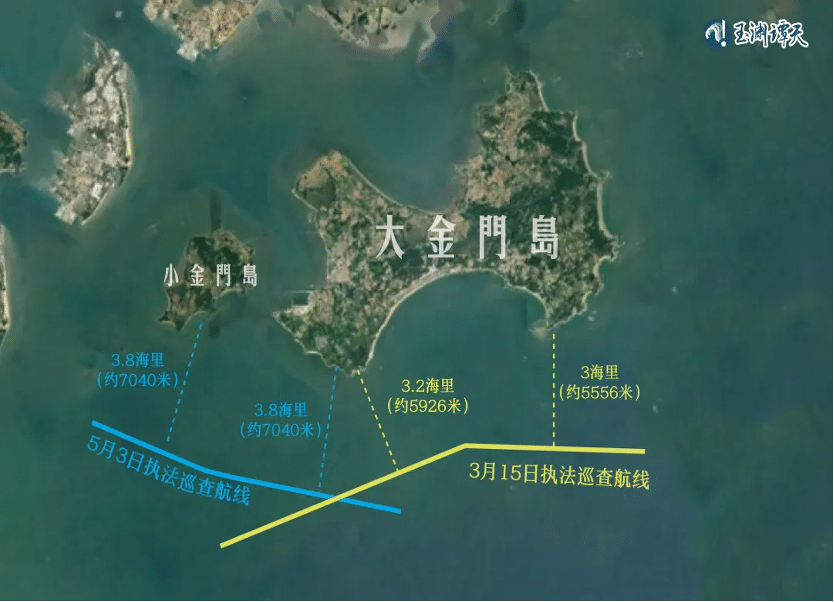
Figure 2. This map depicts the Chinese Coast Guard’s inspection route around Kinmen (大金門島) and Little Kinmen Island (小金門島) on March 15 and May 3, 2024. The yellow line depicts the route taken by the Chinese Coast Guard on March 5, which placed it 3.2 nautical miles (approximately 5926 meters) and 3 nautical miles (approximately 5556 meters) away from Kinmen County. The blue line depicts the route taken by the Chinese Coast Guard on May 3, which placed it 3.8 nautical miles (approximately 7040 meters) away from Kinmen County.[xxv]
This expansion is closely tied to the implementation and promotion of the Kinmen Model in Chinese media, which is characterized by the assertion of the PRC’s sovereignty and jurisdictional rights, the emphasis on protecting the livelihoods of Chinese fishermen, the gradual expansion and normalization of maritime control, the integration of civilian and security dimensions, and the framing of these actions as a counter-response to moves by the Taiwan authorities. Military exercises conducted by the PLA in the Taiwan Strait and surrounding areas—sometimes in coordination with Chinese maritime law enforcement—are incorporated into this narrative, serving as a deterrent to Taiwan’s independence efforts.
Chinese media coverage consistently emphasizes several key themes: the legitimacy of China’s actions, the assertion of sovereignty and jurisdiction, the presentation of the Kinmen Model as a viable solution, the framing of the issue within the broader context of cross-strait unification, and the portrayal of Taiwan’s Democratic Progressive Party as an obstacle to peace. The Kinmen Model represents an integrated strategy to assert PRC sovereignty, normalize control over previously restricted areas, and advance Chinese interests in the broader cross-strait relationship.
Raising an Issue
In the context of the Kinmen issue, Chinese media reports employ the “raising an issue” strand of securitization by emphasizing narratives that portray Taiwan’s actions as threats and stress the necessity of a Chinese response. This includes framing Taiwan’s military activities, political positions, and international engagements as potential challenges to regional stability and China’s sovereignty. Several media reports specifically highlight Taiwan’s military buildup as a significant concern. For instance, Taiwan’s increased defense spending and procurement of drones are depicted as moves toward militarization and, eventually, a declaration of independence from the PRC. Chinese media frame these actions as the DPP authorities “going further down the path of militarism” and “pushing Taiwan towards a dangerous precipice of war,” effectively raising the issue of a growing military threat from Taiwan.
Moreover, Taiwan’s political orientation and its interactions with other countries are also presented as security concerns. The media depict Taiwan’s pursuit of “independence” and its diplomatic efforts as provocative actions that undermine cross-strait relations and regional stability. President Lai Ching-te’s stance on independence and his call for “two-country dialogue” with the mainland are framed as escalatory, necessitating a strong response from China. These narratives serve to amplify the perceived threat from Taiwan, capture the attention of both the Chinese public and policymakers, and create a sense of urgency that may justify subsequent action.
Legitimizing Future Acts
Chinese media sources actively engage in the “legitimizing future actions” strand of securitization by framing potential actions against Taiwan as necessary and justifiable responses to perceived threats. This involves constructing narratives that depict future measures, such as an increased military and Coast Guard presence around Kinmen, and the expansion of the Kinmen Model to encompass all of Kinmen, Matsu, and the Taiwan Strait, as essential for protecting China’s interests and preventing Taiwanese secession. These reports legitimize future actions by emphasizing the need to counter Taiwan’s current behavior. In particular, the expansion of Coast Guard patrols and law enforcement activities around Kinmen is portrayed as a justified response to Taiwan’s perceived mishandling of maritime incidents, its failure to protect Chinese fishermen, and its mismanagement of rescue efforts. In this way, China’s actions are presented not as aggressive or escalatory, but as necessary measures to ensure safety, preserve lives, and maintain order in the region.
Deterrence
The Chinese media sources covered in this paper actively employ the deterrence strand of securitization to dissuade Taiwan from pursuing actions that China perceives as threatening, such as seeking independence or strengthening military ties with other countries. This is achieved through the prominent display of PRC military capabilities and the articulation of the potential consequences of defying Beijing’s warnings.
Central to this strategy is the emphasis on PLA military exercises. These drills are not portrayed as routine activities but as demonstrations of China’s power and its readiness to use force against a Taiwanese government that seeks independence. For instance, the Joint Sword-2024A exercises were explicitly described as a “powerful deterrent against separatist forces in Taiwan seeking independence and a serious warning against external forces interfering and provoking”.[xxvi] Media coverage of these exercises often includes details about the forces involved, the scope of operations, and their proximity to Taiwan, thereby amplifying the sense of threat and reinforcing the credibility of China’s deterrence.
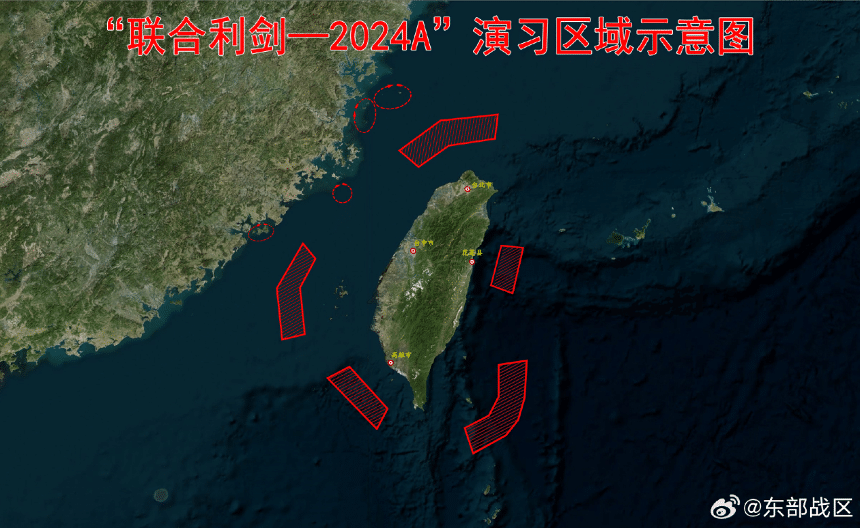
Figure 3. “Schematic diagram of the ‘Joint Sword-2024A’” exercise area.” This schematic depicts the areas in which the Chinese PLA conducted its joint exercises from May 23-24, 2024.[xxvii]
Additionally, the media employs strong rhetoric to reinforce the deterrence message. Statements from military officials and experts warn Taiwan against underestimating China’s resolve and capabilities, stressing that any attempts at independence are “doomed” or that “those who commit injustices will surely perish”.[xxviii] The language used is often forceful and unequivocal, leaving little room for ambiguity about China’s likely response to a sufficiently provocative action by Taiwan. In this way, Chinese media constructs a narrative in which the threat of military action is always present, aimed at influencing Taiwan’s decision-making and preventing it from crossing what China defines as its red lines.
Justifying Past Acts
Both the justification of past acts and the legitimization of future acts in Chinese media rely on the construction of a security threat, in which the core argument centers on a threat to a referent object such as national sovereignty, regional stability, or the well-being of the Chinese people. These two strands of securitization are fundamentally concerned with legitimacy, as the media aims to present actions—whether past or future—as justified and necessary, while countering potential criticism. This involves a combination of assertions and narrative construction, where the media affirms the existence of threats, the necessity of certain actions, and the justifiability of China’s stance in order to shape public opinion. However, a key difference between the two lies in their temporal focus.
When justifying past acts, the action is a fait accompli, and the media’s role is to provide a rationale that renders it acceptable. In contrast, legitimizing future acts concerns actions that have not yet occurred, with the media working to generate acceptance or support in advance. As such, justifying past acts tends to involve more explanatory and defensive rhetoric, including detailed accounts of events, the decision-making process, and the constraints under which controversial decisions were made.
In the sources selected for this analysis, Chinese media frames past actions as necessary and reasonable responses to perceived security threats. For example, increased Coast Guard patrols and maritime activity following the February 14 collision incident are justified as a required response to Taiwan’s alleged lack of cooperation and transparency during the investigation. The media emphasizes the PRC’s obligation to protect the safety of Chinese fishermen, casting these actions as legitimate efforts to uphold national interests and seek justice for the victims.[xxix] By carefully constructing narratives that link past actions to immediate security concerns, Chinese media seeks to legitimize these actions both domestically and internationally, while reinforcing China’s growing authority in the region.
Control
The control strand of securitization, as it relates to media, is fundamentally tied to achieving obedience to the directives of the securitizing actor.[xxx] In service of this goal, media can be expected to emphasize the authority of the securitizing actor—highlighting their position, power, or legitimacy to issue directives. Building on this, the media will likely promote compliance with these directives by explaining required or prohibited actions and stressing the importance of adherence. To reinforce this message, dissenting voices or alternative viewpoints may be downplayed or omitted, creating an impression of consensus or the futility of resistance. The framing of security threats often underscores the necessity of control, suggesting that only strict adherence to state directives can effectively address the issue.
In the context of the Kinmen issue, Chinese media invoke the control strand of securitization by using security narratives to assert authority, enforce compliance, and shape discourse in ways that support China’s objectives. A common theme across all PRC sources covering the Kinmen Model is China’s growing military dominance in the region and the framing of its actions as compelling adherence to Beijing’s directives. A key element of this is the portrayal of China’s increased maritime activities as a demonstration of its strengthened control over the waters surrounding Kinmen. Media reports emphasize the normalization and expansion of enforcement efforts, rejecting the idea that Taiwan can “restrict” these waters to Chinese vessels, and instead suggesting that China is establishing continuous jurisdiction.[xxxi] For example, coverage highlights the shift toward “24-hour” law enforcement and the extension of patrol zones, indicating that China’s presence is becoming inescapable. The media frequently frames these actions as measures to counter or constrain Taiwan’s activities. Narratives portray Taiwan’s Coast Guard as deterred or unable to respond effectively to China’s assertive enforcement, thereby undermining Taiwan’s authority and reinforcing China’s dominance in the maritime domain. These portrayals suggest that China’s actions are the primary driver of operational dynamics in the struggle for control over Kinmen.
Furthermore, the use of legal and regulatory language also plays a role in asserting control. By framing its actions within the context of maritime law and regulations, China positions itself as the legitimate enforcer in the region. This legal framing, combined with the demonstration of actual control, reinforces the idea that China’s actions are not only justifiable but also authoritative. Perhaps most concerning to the author is how Chinese media consistently portray Kinmen fishermen as part of the broader Chinese community. By referring to Kinmen fishermen as “Chinese fishermen,” the media reinforces not only China’s claim over the waters near Kinmen but also its claim over the lives of Taiwanese citizens.[xxxii] Framing Kinmen fishermen as part of the Chinese community helps to promote the idea of cross-strait integration, made easier by emphasizing that the people of Kinmen share a common identity and interest with those in neighboring Fujian Province.
| Strand of Securitization | Description | Example from the Sources |
| Raising an Issue | Aims to bring a specific concern to the forefront of political or public attention. | Media emphasizing the threat of Taiwan’s military activities. |
| Legitimizing Future Acts | Involves justifying potential actions by framing them as necessary responses to a security threat. | Justifying increased patrols as necessary to protect fishermen and maintain stability. |
| Deterrence | Seeks to discourage certain actions by signaling the potential consequences. | Media showcasing PRC military exercises to deter Taiwanese intervention. |
| Justifying Past Acts | The act of framing past actions as reasonable or essential, often to maintain the status quo or political legitimacy. | Portraying patrols as a legitimate response to the February 14th incident. |
| Control | Exerting influence or dominance over a situation or group through security-related rhetoric. | Asserting China’s control over the waters near Kinmen through increased patrols. |
Table 2. Strands of securitization in PRC media narratives on Taiwan and Kinmen.
Conclusion
The analysis of the five strands of securitization within Chinese media reveals a deliberate strategy employed by the PRC to challenge Taiwan’s control over Kinmen County. This strategy seeks to legitimize PRC actions, exert control, and shape the narrative surrounding cross-strait relations. The findings of this research support the argument for a distinct fifth period in Kinmen’s modern history. While the fourth period was characterized by increased cross-strait interaction and economic exchange through the Mini-Three-Links, the current era is fundamentally differentiated by China’s assertive securitization of Kinmen and its newly justified gray zone tactics. This period is marked by framing Taiwan’s actions as existential threats, the normalization of Chinese maritime control, and an overt challenge to Taiwan’s sovereignty in the region.
This securitization has broader implications beyond the Kinmen issue. The Kinmen Model serves as a case study for understanding the evolving nature of gray zone warfare, where coercion and control are exerted through non-traditional, non-military means. It also highlights the critical role of media in shaping perceptions, constructing threats, and legitimizing political actions in international conflicts. The PRC’s securitization and gray zone activities challenge the principle of territorial integrity and the existing status quo in the Taiwan Strait, with potential ramifications for other regions facing similar geopolitical tensions.
The Chinese media’s securitization strategy surrounding the Kinmen Model offers significant insights into modern irregular warfare frameworks, particularly within the Indo-Pacific. PRC actions around Kinmen demonstrate how gray zone tactics can operate below the threshold of traditional armed conflict while still advancing strategic objectives. This approach—marked by assertive and coercive activities—illustrates a shift from conventional military confrontation to indirect control. The contested Kinmen Model exemplifies a sophisticated blend of economic integration, cultural exchange, and securitized narratives to advance PRC territorial claims and reshape regional dynamics without triggering full-scale war. Such a model poses challenges for traditional deterrence strategies, which often focus on preventing conventional military aggression. Actions like the PRC’s deployment of the Coast Guard and the normalization of maritime patrols in previously restricted waters are difficult to counter through traditional military means alone. This reality necessitates a re-evaluation of deterrence frameworks, including approaches that deny the strategic benefits of gray zone actions or impose costs on aggressors through non-military instruments.
This research underscores the importance of narrative competition and pre-conflict shaping operations. Chinese media actively constructs narratives that legitimize PRC actions while portraying Taiwan’s responses as escalatory or destabilizing. By framing Taiwan’s control over Kinmen as a “security crisis,” Beijing seeks to justify its heightened presence and shift the regional narrative. This underscores the need for other Indo-Pacific actors to build robust counter-narratives and proactively shape the information environment to prevent the normalization of coercive behavior and preserve regional stability. The Kinmen Model deepens our understanding of how states can strategically employ information and non-military tools within the evolving landscape of irregular warfare.
It is important to acknowledge that this study focuses primarily on Chinese media sources. While these sources provide valuable insights into the PRC’s securitization strategy, incorporating alternative perspectives would offer a more comprehensive view of the Kinmen issue. Taiwanese interpretations of the Kinmen Model and international assessments of PRC actions would provide valuable counter-narratives and a more nuanced understanding of cross-strait dynamics. This analysis is also limited by its focus on a specific selection of Chinese-language media reports within a defined timeframe. Although the sources represent both state-run and privately owned media in China, a broader sample and longitudinal analysis could further enrich the findings. Despite these limitations, this study contributes to a deeper understanding of how the PRC uses securitization in the context of Kinmen and its broader implications for regional and international security.
[i] Tseng, Y. J., and S. Y. Chen. “Conservation and Development of Military Sites on Kinmen Island.” WIT Transactions on The Built Environment 143 (2014): 307-19.
[ii] CQCB. ““金门模式”,也可以适用于整个台湾海峡” (“Kinmen Model” Can Also be Applied to the Entire Taiwan Strait). 上游新闻 (Chongqing), May 12, 2024. Accessed April 10, 2025. https://www.cqcb.com/shishijingwei/2024-05-12/5566962_pc.html.https://www.mac.gov.tw/en/News_Content.aspx?n=AEC54CE1BB842CD0&sms=7C0CA8982E163402&s=E0EB95D7DBB072B0.
[iii] United States Department of State. “The Taiwan Strait Crises: 1954-55 and 1958.” Office of the Historian, United States Department of State. Accessed April 10, 2025. https://history.state.gov/milestones/1953-1960/taiwan-strait-crises.
[iv] Tseng, Y. J., and S. Y. Chen. “Conservation and Development of Military Sites on Kinmen Island.” WIT Transactions on The Built Environment 143 (2014): 307-19.
[v] Chang, Li-Hui. “Remapping the Island: The Relationships between Tourism and Conflict Borders of the Kinmen-Xiamen Border.” Journal of China Tourism Research 10 (2014): 363-77.
[vi] Tseng, Y. J., and S. Y. Chen. “Conservation and Development of Military Sites on Kinmen Island.” WIT Transactions on The Built Environment 143 (2014): 307-19.
[vii] Mainland Affairs Council. “Overview of the Provisional Implementation of ‘Mini-Three-Links’ between the Offshore Islands of Kinmen & Matsu and Mainland China.” December 18, 2000.
[viii] Chang, Li-Hui. “Remapping the Island: The Relationships between Tourism and Conflict Borders of the Kinmen-Xiamen Border.” Journal of China Tourism Research 10 (2014): 363-77.
[ix] Mainland Affairs Council. “Overview of the Provisional Implementation of ‘Mini-Three-Links’ between the Offshore Islands of Kinmen & Matsu and Mainland China.” December 18, 2000.
[x] Asia Maritime Transparency Initiative. “A New Normal for the China Coast Guard at Kinmen and Matsu. December 6, 2024. https://amti.csis.org/a-new-normal-for-the-china-coast-guard-at-kinmen-and-matsu/.
[xi] Nyman, Jonna. “Securitization,” in Security Studies: An Introduction, 4th ed., edited by Paul D. Williams and Matt McDonald, London: Routledge, 2023.
[xii] Nyman 2023.
[xiii] Nyman 2023.
[xiv] Campbell, David. Writing Security: United States Foreign Policy and the Politics of Identity, Revised Edition, Minneapolis: University of Minnesota Press, 1998.
[xv] Nyman 2023.
[xvi] Vuori, Juha A. “Illocutionary Logic and Strands of Securitization: Applying the Theory of Securitization to the Study of Non-Democratic Political Orders.” European Journal of International Relations 14 (2008): 65-99.
[xvii] Holm, Ulla. “Violence in Algeria: A Question of Securitization of State-Regime, Nation and Islam.” Alternatives: Turkish Journal of International Relations, vol. 2, no. 2 (Summer 2003).
[xviii] Breslin, Shaun. “Debating Human Security in China: Towards Discursive Power?” Journal of Contemporary Asia, (2014): 1-23.
[xix] Ghiselli, Andrea. “The Chinese Government, the Idea of Security, and Foreign Policy.” In Protecting China’s Interests Overseas: Securitization and Foreign Policy, 1-30. Oxford University Press, 2021.
[xx] Ghiselli, Andrea. “The Chinese Government, the Idea of Security, and Foreign Policy.” In Protecting China’s Interests Overseas: Securitization and Foreign Policy, 1-30. Oxford University Press, 2021.
[xxi] Ghiselli, Andrea. “The Chinese Government, the Idea of Security, and Foreign Policy.” In Protecting China’s Interests Overseas: Securitization and Foreign Policy, 1-30. Oxford University Press, 2021.
[xxii] Maizland, Lindsay, and Clara Fong. “Hong Kong’s Freedoms: What China Promised and How It’s Cracking Down.” Foreign Affairs. 2024. https://www.cfr.org/backgrounder/hong-kong-freedoms-democracy-protests-china-crackdown.
[xxiii] Vuori, Juha A. “How to Do Security with Words: A Grammar of Securitisation in the People’s Republic of China.” PhD diss., University of Turku, 2011.
[xxiv] Vuori, Juha A. “Illocutionary Logic and Strands of Securitization: Applying the Theory of Securitization to the Study of Non-Democratic Political Orders.” European Journal of International Relations 14 (2008): 65-99.
[xxv] CQCB. ““金门模式”,也可以适用于整个台湾海峡” (“Kinmen Model” Can Also be Applied to the Entire Taiwan Strait). 上游新闻 (Chongqing), May 12, 2024. Accessed April 10, 2025. https://www.cqcb.com/shishijingwei/2024-05-12/5566962_pc.html.
https://www.mac.gov.tw/en/News_Content.aspx?n=AEC54CE1BB842CD0&sms=7C0CA8982E163402&s=E0EB95D7DBB072B0.
[xxvi] 荀建国. “解放军围岛慑压两天,台湾岛内怎么说?丨舆情观察” (PLA Encirclement of the Island for Two Days, What Does Taiwan Say? | Public Opinion Observation). 网易号. May 24, 2024. https://m.163.com/dy/article/J2VT8EOP0514FGV8.html.
[xxvii] 王怡. “信息量极大!知情人士详细解读中国海警台岛外岛执法行动” (Huge Amount of Information! Insiders Provide Detailed Analysis of Chinese Coast Guard’s Law Enforcement Actions around Taiwan’s Offshore Islands). 环球时报-环球网 (Global Times, Hanqiu). May 23, 2024. Accessed April 10, 2025. https://mil.huanqiu.com/article/4HuLEexN8AC.
[xxviii] 大公報. “福建海警金门附近海域常态化巡查 强化管控力度” (Fujian Coast Guard Conducts Regular Patrols Near Kinmen, Strengthening Control). 大公网 (Takungpao). September 27, 2024. Accessed April 10, 2025. https://www.takungpao.com/news/232110/2024/0927/1015019.html.
[xxix] Zhu Suiyi. “隔海观澜/大陆扩大`金门模式”保障渔民权益\朱穗怡” (Overseas Observing Kinmen, Mainland Expands “Kinmen Model” to Protect Fishermen’s Rights). 大公報 (Ta Kung Pao). May 27, 2024. Accessed April 2, 2025. https://www.takungpao.com/news/232110/2024/0528/975717.html.
[xxx] Vuori, Juha A. “Illocutionary Logic and Strands of Securitization: Applying the Theory of Securitization to the Study of Non-Democratic Political Orders.” European Journal of International Relations 14 (2008): 65-99.
[xxxi] 杨威. “金门模式”再延伸!中国海警开启执法新模式” (“Kinmen Model” Extended! Chinese Coast Guard Launches New Enforcement Mode). 荆楚网, (Jingchu Net), CNHubei.com. June 26, 2024. Accessed April 10, 2024. http://news.cnhubei.com/content/2024-06/26/content_18095990.html.
[xxxii] 大公報. “福建海警金门附近海域常态化巡查 强化管控力度” (Fujian Coast Guard Conducts Regular Patrols Near Kinmen, Strengthening Control). 大公网 (Takungpao). September 27, 2024. Accessed April 10, 2025. https://www.takungpao.com/news/232110/2024/0927/1015019.html.
CONTACT Ian Murphy | iansergeimurphy@gmail.com
The views expressed in this article are solely those of the author(s) and do not necessarily reflect the views, policy, or position of SecuriFense.
© 2025 Arizona Board of Regents / Arizona State University