Richard D. Newton, Irregular Warfare Initiative, Angel Fire, New Mexico, United States
Introduction
Conventional wisdom holds that special air operations began with the British special duties squadrons of the Second World War. Nearly three decades earlier, however—when military aviation was still in its infancy—the predecessors of those 1940s units were already developing unique tactics and adapting hand-me-down aircraft in an effort to exploit the emerging advantages of airpower for special operations.[1] Few have heard of the First World War’s special-duties airmen; their work was deliberately kept secret at the time, and their contributions did little to advance the case for an independent air service alongside armies and navies.
In 1941, the Royal Air Force (RAF) formed its first special-duties squadron, 138 Squadron, and a year later reactivated 161 Squadron at Newmarket as a second. Additional RAF squadrons followed in the Mediterranean and China-Burma-India theatres. In 1943, the United States added the 492nd Bombardment Group’s “Carpetbagger” squadrons to support special operations in Europe, and in 1944, created the 1st Air Commando Group to support Brigadier Orde Wingate’s Second Chindit Operation in Burma. It is no exaggeration to say that what special operations airmen in these storied units accomplished was remarkable—adapting equipment and developing procedures for long-range, low-level, night operations deep into enemy airspace, all without the night-vision and electronic-warfare capabilities that define modern special air operations. Their achievements continue to inspire special operations airmen in the United States and Europe today.[2]
This article aims to show that, twenty-five years before the RAF and U.S. Army Air Forces formed their special-duties squadrons, British, French, and German airmen with a special operations mindset—marked by courage, flexibility, and the willingness to see opportunity where others saw obstacles—were already confronting and overcoming the challenges before them. In doing so, they planted the seeds of the special air operations ethos. These early pioneers ignored bureaucratic constraints and circumvented the artificial limits of conventional thinking to unleash the full potential of their crews and their aircraft. Using unconventional tactics and inventive adaptations of what were often obsolete aircraft,[3] special operations airmen developed the earliest tactics and procedures for inserting, resupplying, and extracting agents who were collecting intelligence and conducting sabotage behind enemy lines. Special air operations did not begin in the United Kingdom in 1941, but rather had their roots on the Western Front in 1914.
Special Operations Mindset
Then, as now, special operations airmen often did not conform to conventional air force norms. While the popular myth of aviation casts airmen as heroic “knights of the air”—dashing, bold, and pursuing glory in individual combat—the reality is that conventional airpower’s strength lies in discipline and mass: multi-aircraft fighter sweeps, bombers maintaining defensive formations, and long-range fighters flying bomber escort missions. First World War airmen quickly learned that teamwork, not individual heroics, wins conventional air battles. Those who did not fit these norms—mavericks in both attitude and call sign—were typically marginalized by conventional air forces, a pattern that persists today. Yet such outsiders have long thrived in special air operations, where courage, flexibility, and unconventional thinking are valued precisely because they yield innovative solutions to complex tactical problems. The most successful special operations airmen balance that unconventional spirit with disciplined preparation, commitment to the mission, and a healthy respect for the skills of their crews.
In the evolution of special air operations from the Second World War special-duties squadrons, modern special air operations typically involve single aircraft flying at night and at low level to provide the air mobility necessary to insert teams and supplies deep behind enemy lines, and then landing specialized aircraft in remote and austere locations to retrieve those teams and other high-value cargo. During the Second World War, excellence in these primary missions often led special-duties airmen to provide training, leadership, and influence for other, non-special-duties squadrons tasked with unconventional or strategically sensitive missions—thus imparting the special operations mindset to select units of the conventional force. For example, Group Captain P. C. “Pick” Pickard, who had flown Lysanders with 138 Squadron and later commanded 161 Squadron, was given command of 140 Wing in 1943. Guy Gibson claimed to have sought out Pickard’s counsel during the planning for Operation Chastise, the RAF’s Dambusters Raid.[4] Pickard instilled a sense of dogged commitment to excellence and courage among his aircrews. In early 1944, he trained and led a wing of three Mosquito squadrons on Operation Jericho, the mission to bomb the prison at Amiens intended to free members of the French Resistance. Using a scale model of the prison, Pickard’s airmen planned and practiced their attack profiles until they knew them by heart. Pickard was shot down and killed during Operation Jericho, but the wing he trained, led, and influenced continued his legacy by flying other successful special operations, such as the October 1944 raid to destroy Gestapo headquarters in Aarhus, Denmark, and Operation Carthage to destroy Gestapo headquarters in Copenhagen in March 1945.
Special Air Operations During the Great War
When the First World War began, it had only been five years since Orville and Wilbur Wright sold the first Wright Military Flyer—a two-seat observation aircraft—to the U.S. Army. At the start of the Great War, every major European power was using airplanes to extend their armies’ ability to see farther. Aerial reconnaissance and surveillance soon evolved into bombing troops and assembly areas from the air, and aerial fighting developed as commanders sought to deny their adversaries the ability to see and to bomb. The state of aviation technology early in the war limited nearly all flying to daylight. It took airmen with exceptional flying skills, courage, and willpower to embrace the extreme risks (at the time) inherent in nighttime air operations.
The British
The earliest British attempt to insert an agent behind enemy lines by aircraft appears to have occurred in September 1915, shortly before the Battle of Loos. In August, Brigadier-General H. M. Trenchard, then commanding the Royal Flying Corps (RFC) in France, asked his wing commanders to find a way to insert an agent near Courtrai. He noted, “The French have already done this sort of thing twenty-eight times—twenty-seven times successfully.”[5] The pilot chosen, Captain T. W. Mulcahy-Morgan of No. 6 Squadron, had earned a reputation for skillful flying, coolness under stress, and resourcefulness. He had force-landed multiple times without breaking the airplane, made quick repairs to his machine, and taken off again.
Just before dawn on 13 September, in poor light, Mulcahy-Morgan crashed his BE-2c into a tree while delivering a Belgian agent into a landing field that was too small and too rough. One of the wings broke off, and the agent broke both legs and suffered internal injuries. The pilot broke his jaw, but the pigeons survived. The Germans captured both the pilot and the agent. Two years later, Mulcahy-Morgan escaped and made his way back to England.[6] The lesson taken from that episode was that outstanding flying skills, while essential for special air operations, needed to be complemented by careful preparation and mission-specific training.
Lieutenant J. W. “Jack” Woodhouse was assigned to No. 4 Squadron, flying BE-2c aircraft on reconnaissance, artillery spotting, and bombing sorties. When approached by his commanding officer about attempting the mission, Woodhouse agreed that it could be done with proper preparation and training. The squadron’s BE-2c aircraft were the perfect choice for the job at the time because of their inherently stable flight characteristics and low landing speed—especially valuable when landing on unsurveyed open fields at night using only the moon for illumination.
In the weeks before this first mission, Woodhouse flew a series of reconnaissance sorties in the region where the clandestine landing was planned. To conceal the intent of his reconnaissances, his flights were often conducted as part of other squadron formations on bombing missions. The survey flights were typically flown at dusk to simulate the conditions he expected to encounter and to allow Woodhouse to memorize key landmarks, especially those that would stand out in bad weather and low light.
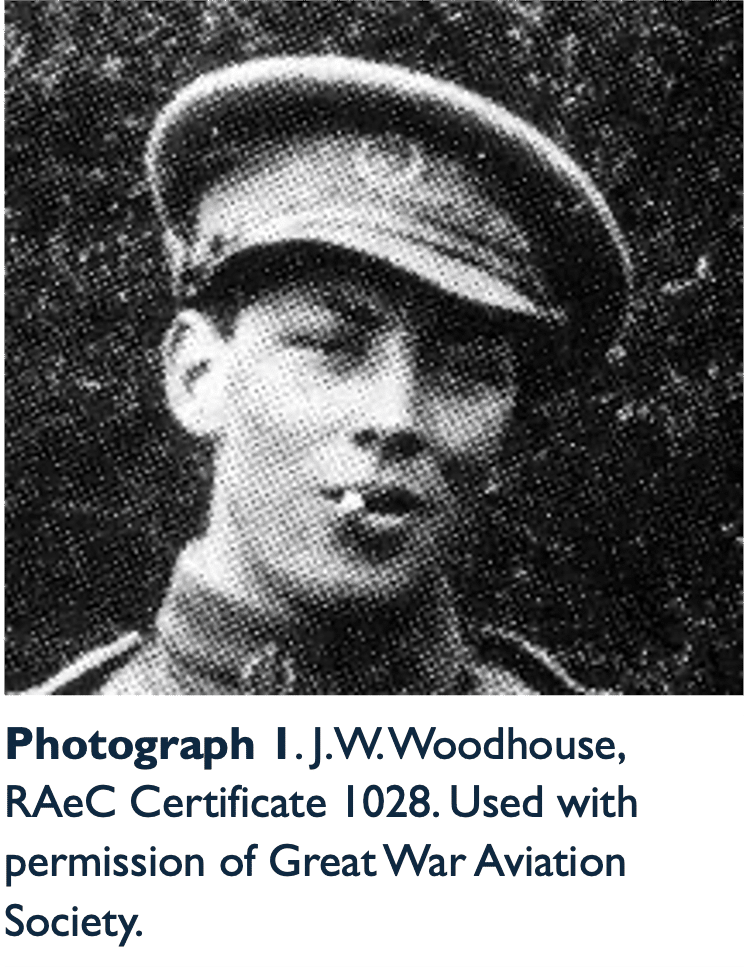
On 28 September, Woodhouse and the French agent took off in a BE-2c that had had its guns and all unnecessary equipment removed. This lightened the airframe to give it better climbing performance. The fuel tanks were also only half full to save weight. The agent and two baskets of homing pigeons were stuffed into the front cockpit of the biplane. Climbing to 7,000 feet, Woodhouse circled over friendly territory until dusk. Then, with the engine throttled back to reduce the noise signature, he began a long, slow descent toward the landing site on the German side of the trenches. At about 1,000 feet, they heard rifle fire. Woodhouse opened the throttle and climbed out of danger.
After discussing the situation with the agent, the pilot chose an alternate landing site south of Cambrai. Arriving overhead, Woodhouse shut down the engine and silently glided to a landing. After wishing the agent good luck, he was able to restart his engine, take off, and fly safely back to his aerodrome in the dark. While crossing the trenches south of Albert, he was shot at again—without knowing whether it was the Germans or the British. Over the next few weeks, Woodhouse flew additional sorties, landing multiple times behind German lines to bring the French agent supplies, money, and additional homing pigeons.[7]
In 1916, Woodhouse—now a captain—returned to France after a stint in a night defense squadron in England and was tasked with forming a special duties flight in No. 9 Wing. Their mission was to drop agents behind German lines using “Guardian Angel” parachutes developed by British engineer R. E. Calthrop.[8] It should be remembered that at this stage of the war very few pilots wore parachutes because of their bulk and unreliability. This was not true for observation balloon crews; those airmen regularly wore parachutes so they could escape when enemy fighters attacked their hydrogen-filled balloons with incendiary ammunition.[9] Woodhouse’s special duties flight flew BE-12a aircraft, a single-seat version of the BE-2c, with a long-range fuel tank in place of the forward cockpit. The agent would lie flat on the lower wing. The parachute was attached to the underside of the airplane, and the agent’s harness was linked to the parachute. When the agent jumped, his weight pulled the parachute from its case, where it opened and carried him safely to the ground. In May 1917, the special duties flight inserted three agents by landing, and then flew three to four special-air-mission sorties each in July and August, though with mixed success.[10] In between these missions, the flight also conducted nighttime bombing of sensitive targets.[11]
In early 1916, as requests for more agent insertions increased, Captain Guy L. Cruikshank was tasked with forming a special duties flight in No. 27 Squadron, then commanded by Major A. E. Borton. Using modified BE-2c aircraft, agents were strapped to the lower wing and shielded from the wind blast by a strip of plywood. Adapting Woodhouse’s nighttime experiences, 27 Squadron preferred early-morning insertions, taking off before dawn and using morning mist to conceal the landings. When one of 27 Squadron’s special duties sorties failed to return, Cruikshank suspected a double agent. Flying the next sortie himself, he shot the deceitful agent when the man turned to kill him. Cruikshank was wounded in the arm during the encounter but managed to fly the aircraft home.[12] He was killed that September while serving as a flight commander with No. 70 Squadron.
No. 58 Squadron moved to France in January 1918, flying obsolete FE-2b pushers in a night-bombing role. The squadron’s expertise in night operations made it well suited for stealthy agent-dropping missions. Flying from Fauquembergues, about 20 km south of St. Omer, the squadron’s I-Flight (Intelligence Flight) often flew 50 miles or more behind German lines to land and insert, extract, or resupply intelligence agents. As in other special duties resupply missions, the cargo they delivered included food, money, and homing pigeons.[13]
To the south, in July 1916, the RFC’s No. 17 Squadron moved from Egypt to support operations in Salonika, Greece. That December, BE-2c pilot Lieutenant W. S. Scott used darkness and low mist to conceal his landing while inserting an agent near the German aerodrome at Drama. Three weeks later, in January 1917, Lieutenant Scott successfully flew a second clandestine mission to insert another Greek agent.[14]
On the Italian front, British pilots worked with the Italians to develop alternative techniques for inserting agents by parachute. The Italians had developed a parachute that differed from the British “Guardian Angel” model and overcame many of the challenges associated with reliability, tangling, and drift. Instead of riding on the wing of a single-engine fighter-bomber, the agent was dropped from a twin-engine bomber via a trap door in the floor. On 9 August 1918, Captain William Barker, a Canadian, and Captain William Wedgwood Benn of No. 139 Squadron took off from Villaverla to insert an Italian agent into Vittorio in Austrian-held territory. Following a pre-planned path to avoid enemy searchlights and flying low to minimize noise exposure, the crew dropped the agent and returned home. They had no idea whether he survived. Weeks later, they were informed that the agent had fallen through the trap door, the parachute had inflated, and it had worked “as advertised.” The landing was hard but successful. Later flights airdropped parcels of food and homing pigeons to support him and for two months he passed information on Austrian troop movements and defenses.[15]
The RFC was not the only British air service to attempt special duties flights. In 1916, Trenchard asked the Royal Naval Air Service (RNAS) to provide an airship to insert, extract, and resupply enemy agents behind German lines at night.[16] The plan was to modify a Submarine Scout (SS) lighter-than-air, non-rigid airship, a blimp, painted flat black for invisibility at night and with the engine silenced to reduce noise signature. The SS airships used a wingless Armstrong Whitworth F.K.4, similar to a BE-2c, fuselage for a gondola. The plan was to have the two-seat airship silently drift over German territory to insert and support agents.[17]
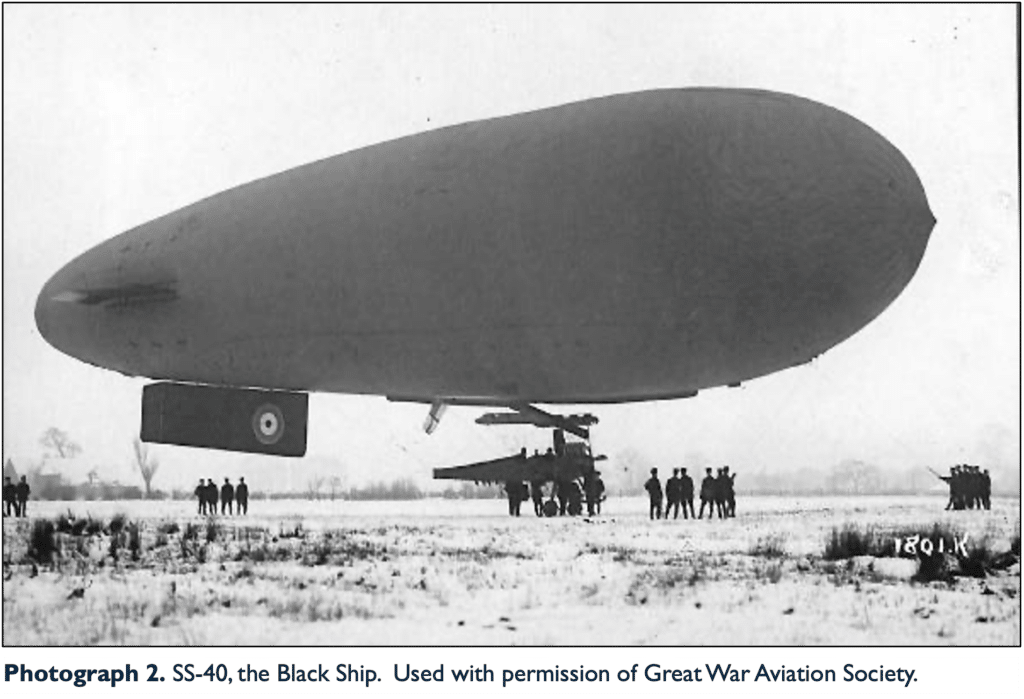
In June, the RNAS crew successfully tested SS-40 in front of senior officers from the War Office, and on 2 July the “Black Ship,” her crew, supplies, and equipment arrived in Boubers-sur-Canche, France. This was Day Two of the Battle of the Somme. The next day, the two pilots, Flight Sub-Lieutenants Billy Chambers and Victor Goddard, reported to Major-General Trenchard for duty. After learning that they needed to be above 10,000 feet when crossing friendly lines to avoid being shot at—and that they also required the ability to fly for more than four hours—the pilots concluded that their airship needed modifications. Goddard flew SS-40 back to England, where Royal Navy engineers added an extra gore to the gas bag, increasing the hydrogen capacity to 80,000 cubic feet—more than enough to climb above 10,000 feet.
Over the summer and into the fall, SS-40’s crew practiced extensively for their mission by conducting night reconnaissances over German lines. They were not allowed to fly on moonlit nights because they did not want German searchlights to locate the Black Ship. As a result, what the crew could actually see and report was negligible. Landing the blimp without a ground crew, however, proved more difficult than anticipated, and no air landings behind German lines were attempted. In August, RFC Lieutenant C. R. Robbins and a basket of homing pigeons safely parachuted from SS-40. According to Goddard, French and Belgian agents were reluctant to fly in the Black Ship, and thus the RNAS crew never had the opportunity to use their training and preparations to land agents behind enemy lines.[18] In October, SS-40 and her crew returned to England and were assigned to other duties.
The French
Trenchard was correct in September 1915 when he told the assembled wing commanders that the French had been successfully inserting, extracting, and resupplying agents behind enemy lines for months. As early as November 1914, Lieutenant Armand Pinsard of No. 23 Squadron had demonstrated the ability to insert an agent behind German lines by air.[19] By 1915, French customs officers—who before the war had patrolled and controlled the border—were recruited to serve as agents monitoring German troop movements in their former departments. The agents were taught to estimate unit size and the composition of support trains, care for the pigeons that would carry messages back to friendly lines, and help pilots turn the aircraft into the wind and start the propeller.[20]
The agents were “armed” with a basket of pigeons, a load of food and supplies, and one or two waterproof boxes containing explosives, detonators, fuses, and tools for sabotaging railways, bridges, and canal locks. With such a load, exiting a two-seat airplane that was not designed for passenger or cargo operations was not easy. Typically, the pilot would land and shut down the engine, then help the agent move his gear into a hiding place. Once that was done, the pilot and the agent would reposition the aircraft for takeoff, and the agent would then “swing” the propeller to restart the engine.
Through the spring and summer of 1915, French pilots René Bodin, William Hostein, and Jean Navarre of No. 12 Squadron, Jules Védrines of No. 3 Squadron, and others flew dozens of successful special air missions into occupied France.[21] Bodin had received his pilot’s license only in January 1915 and had not yet established himself as a strong pilot in the squadron after hitting a pylon during a turn and making a poor landing in a damaged aircraft. He begged his commander to allow him to fly one of the special missions to insert an agent in Champagne. That successful operation redeemed his reputation, and he continued flying special missions thereafter.[22]
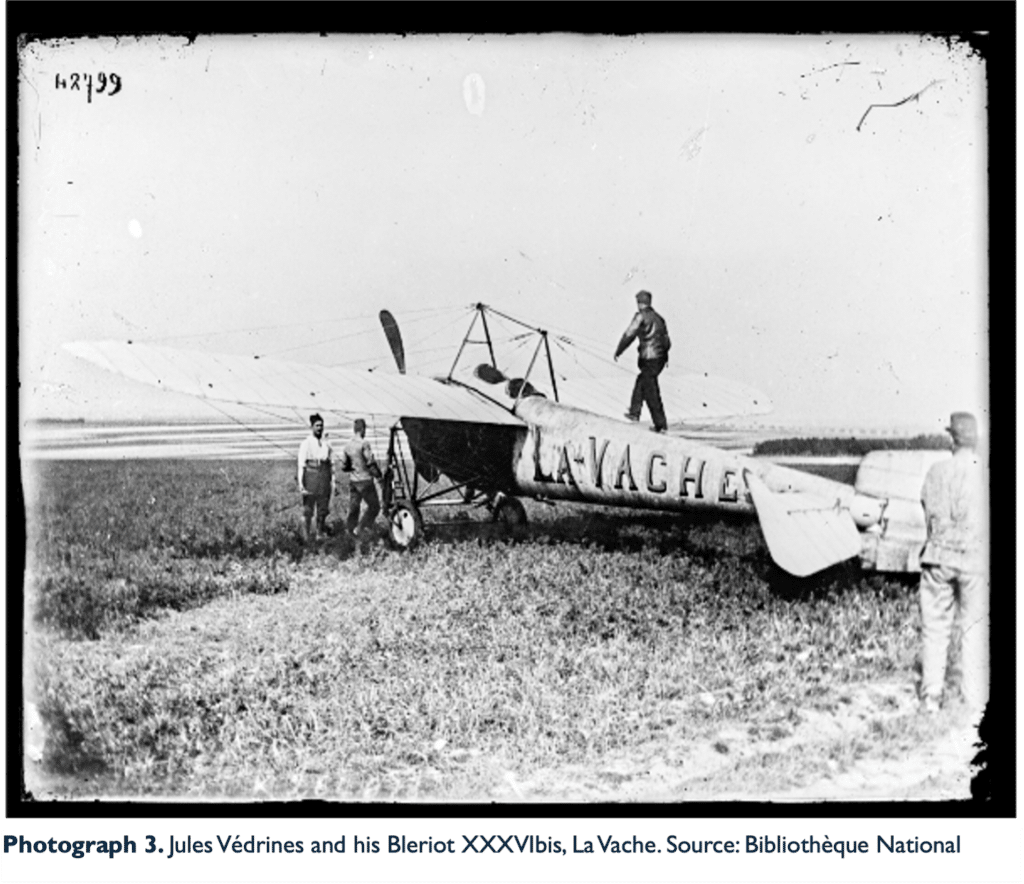
When the war broke out, Védrines was already an accomplished aviator, having won the 1911 Paris-to-Madrid race and becoming the first pilot to exceed 100 mph in 1912. In 1913, he became the first pilot to fly overland from France to Egypt. When France issued its call for volunteers, Védrines was among the first to join the Aviation Militaire. At 33 years old, he was considered too old for front-line service. Undeterred, his expertise in night flying, outstanding navigational skills, and disdain for aerial combat led him to become France’s premier special duties pilot.[23] The Blériot aircraft company delivered two experimental Type XXXVIbis monoplanes to the Aviation Militaire in the fall of 1914; one was assigned to Védrines.
The Blériot XXXVIbis was a rather ungainly two-seat airplane with a bulbous forward fuselage housing a Gnome rotary engine, tapering toward the empennage. One unique feature of the XXXVIbis was the 3 mm armor plating protecting the cockpits and engine. A second peculiarity was the set of doors on the fuselage under each wing that, when opened in flight, allowed the observer to fire a machine gun at targets on the ground. While not originally designed for special air operations, these doors significantly eased the challenge of unloading an agent and his cargo—especially when time on the ground was limited.
Beginning in March 1915, Védrines flew seven night insertions of agents, though in a Morane Parasol rather than La Vache.[24] According to his obituary, in early 1918 he landed near a bridge crossing the Saar River, dismounted, placed explosives to destroy the bridge, and successfully flew away after lighting the fuse.[25]
In June, Védrines taught Georges Guynemer how to fly special air operations. The trick, according to Védrines, was to “quell the desire to turn tail and run.” The tactic was to fly to the landing area at normal altitudes while looking for a secluded place to land, preferably near a wood to conceal the aircraft and give the agent a place to take cover. On 23 September, Guynemer flew one of twelve coordinated sorties to insert eleven agents in the Champagne region. All twelve aircraft returned safely to base. Guynemer, however, swore he would never fly special missions again, calling them “a filthy job.”[26]
Védrines, while not an ace in the traditional sense of shooting down five enemy aircraft, became known as the “ace of special missions,” having flown more such operations than any other French pilot. After the war, he remarked: “Our work, as aviators, was very pale in comparison to theirs [the customs officers/agents] and the amount of courage and willpower they had to display to succeed…. The customs officers were marvelous and often gave us examples of heroism and stoicism that can never be overemphasized.”[27]
The value of these special air missions was highlighted by General Joseph Joffre, the commander-in-chief of French armies on the Western Front between 1914 and 1916. In September 1915, General Joffre decided to launch a grand offensive in the Champagne region. On 16 September he directed General Jonchery to support the infiltration of saboteurs by air behind German lines to disrupt German resupply and reinforcement. Between 23 and 25 September, twelve special air missions were flown to achieve Joffre’s objectives. Of the twelve, eight were successful. Despite the success of the special operations, Joffre’s Champagne Offensive failed.
Farther south, the French also flew a small number of special air operations on the Salonika front. In 1916, Sous-Lieutenant (Second Lieutenant) Cornemont was assigned to Escadrille 391 at Topsin. He volunteered to fly a special mission to insert a Serbian agent with homing pigeons 300 miles behind Bulgarian lines at night. After weeks of planning and preparation, Cornemont flew the mission using only a compass and altimeter for instruments and navigating by flickering village lights and moonlit reflections on roads, rivers, and lakes. The mission was a complete success.[28]
The Germans
The Germans also conducted special air operations during the First World War, but they appear to have confined their efforts to the Eastern Front and Palestine. In early October 1916, Oberleutnant (First Lieutenant) Maximilian von Cossel was inserted by air behind Russian lines with a rucksack full of explosives. Flying a Roland Walfisch, the pilot, Vice Sergeant-Major Rudolf Windisch, made a night landing in a clearing about 50 miles behind the front. While on the ground, von Cossel destroyed several sections of the Rovno–Brody railway line to disrupt the Russians’ planned offensive. The next night, Windisch flew a second mission to retrieve von Cossel from their preplanned extraction point.[29]
In April and May 1917, Oberleutnants Gerhard Felmy of Flieger-Abteilung (Squadron) 300 and Richard Falke flew from their aerodrome at Ramleh to Bir Salmana in northern Sinai to destroy British water pipelines supplying Allenby’s troops, the telegraph lines he needed for communications, and the reservoirs the British had constructed to ensure a continuous water supply. While pipelines and telegraph lines were easily repaired, a successful attack on the reservoirs could have halted the British advance into Palestine.[30] During their reconnaissance sorties over Allenby’s forces, Felmy and Falke noticed that the railway line and accompanying water pipeline crossing the Sinai were protected by blockhouses spaced about twelve miles apart. They reasoned that if they could find a spot midway between blockhouses where the pipeline and railway lay close together—and where a landing area allowed takeoff in any direction—they could effectively disrupt British logistics.
They identified three suitable sites and decided to make their final choice on the day of the mission, depending on rail traffic, roving patrols, or passing caravans that might compromise them. At 07:00 on 19 April they took off toward the target area. They avoided the first location because of British activity. At the second, seeing no sign of human presence, they decided to land. Hearing a train in the distance, they estimated they had half an hour to place their charges. It took twenty-five minutes to emplace explosives under the railway, pipeline, and telegraph poles. Using cigars to light the fuses, they sprinted back to their aircraft. After the explosions, they discovered that the railway charges had failed to detonate and the pipeline was undamaged. Their spirits sank.
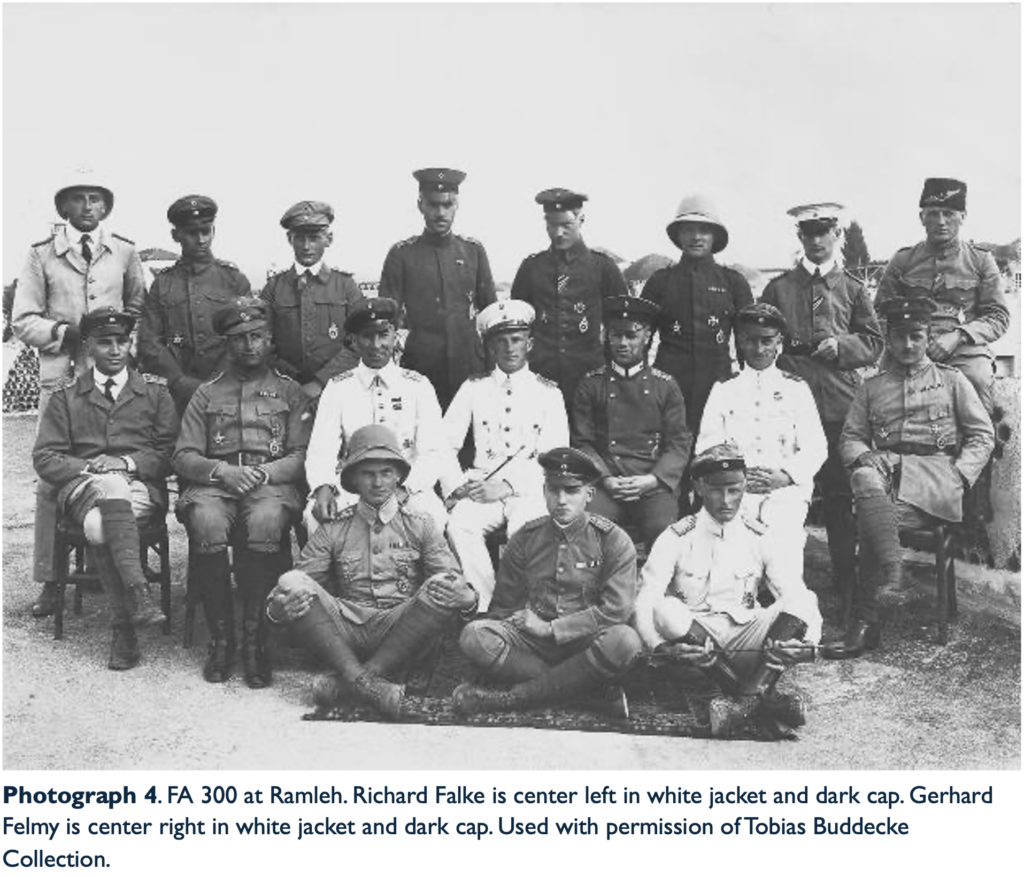
With no British patrols in sight, they decided to try again, using the unexploded railway charges. They moved the explosives to the pipeline and detonated them, assuming that loss of water would have a greater impact on British operations than a severed rail line. This time the charges worked. The two airmen raced for their aircraft as a newly arrived trainload of soldiers chased them.[31]
On 24 May, Felmy and Falke attempted to repeat their earlier success and volunteered for another special air operation. Landing near Kantara on the eastern bank of the Suez Canal, their goal was to cut the vital railway line from Cairo and the nearby water pipeline. It took just seven minutes to emplace charges on the railway and telegraph poles and set the fuses. As they were working on the pipeline charges, however, they were discovered by a British patrol. After hurriedly setting the last charges, they ran for their aircraft as bullets whizzed past. Felmy began to taxi while Falke turned his Maxim gun on the patrol. As they lifted off, they heard three explosions. Looking back, Felmy and Falke saw that they had successfully blown up the railway line, cut the pipeline, and toppled the telegraph lines.[32] This was the last German special air operation of the campaign.[33]
Parachuting—A Different Way to Insert Agents
Everard Calthrop was a British railway engineer who was good friends with Charles Rolls, an aviation pioneer and co-founder of Rolls-Royce. After Calthrop witnessed Rolls’s death in an aviation accident in 1910, he explored ways of using parachutes to save pilots’ lives. He patented his first parachute in 1913. In 1915, the Royal Aircraft Factory at Farnborough successfully tested Calthrop’s parachute, the Guardian Angel, but the Royal Flying Corps refused to issue parachutes to pilots. Calthrop was pressured to keep silent about the tests. In 1917, however, he broke his silence and described the successful trials in several aeronautical journals. Still, British pilots were not allowed to fly with parachutes, even if self-funded. According to an unpublished report, the Air Board believed that a parachute “might impair the fighting spirit of pilots and cause them to abandon machines which might otherwise be capable of returning to base for repair.”[34] They did, however, agree to explore the use of parachutes for dropping agents behind enemy lines.[35]
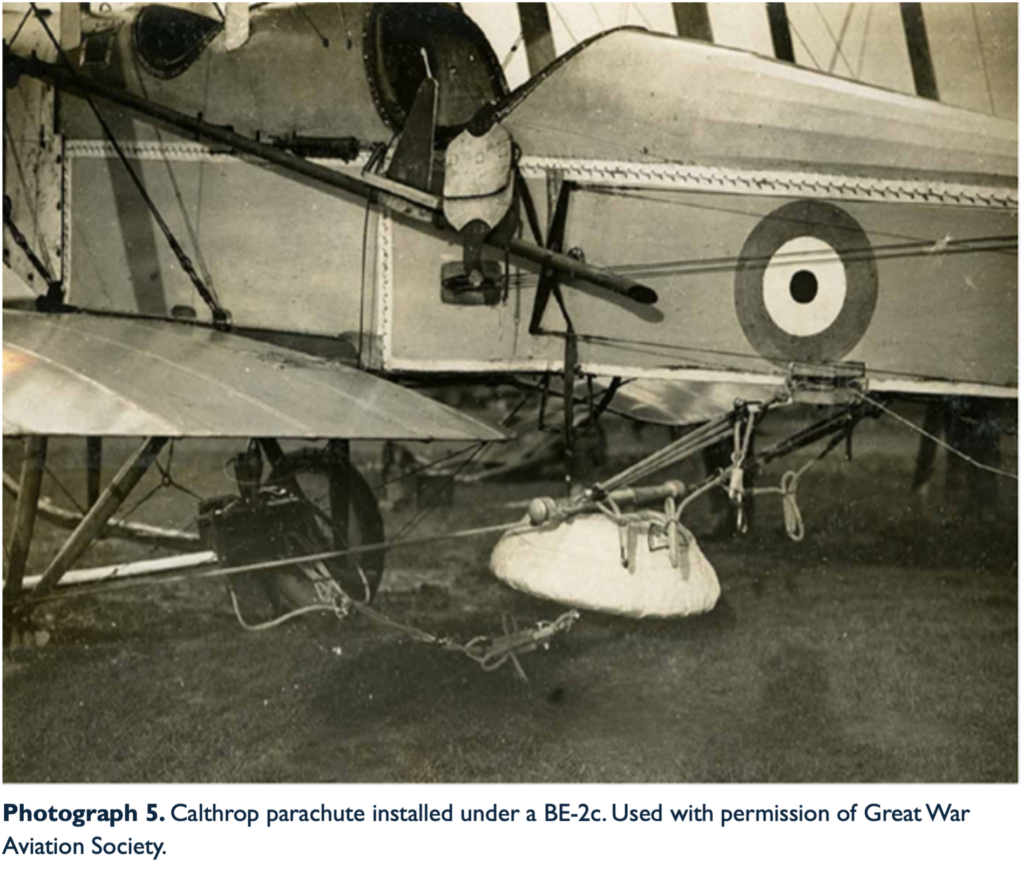
Major-General Trenchard, in 1917 commanding the RFC in France, requested twenty Calthrop parachutes for testing by his pilots. The Air Board refused his request. Later, when he requested the same twenty parachutes for dropping enemy agents behind the lines, the parachutes were furnished. That said, there is no evidence that Trenchard sponsored clandestine trials with his pilots behind the Air Board’s back. By September 1918, the newly created Royal Air Force relented and ordered all single- and two-seat aircraft to be fitted with parachutes.[36] Unfortunately for aircrews, the Armistice was signed before testing, adaptation, and logistical procedures were complete.
During the fall of 1918, Trenchard remained open to parachuting agents into German rear areas, preferring this to night landings. In a series of letters with George S. Clive, Head of the British Mission to French Army Headquarters, Trenchard noted that since the war began, “dropping by parachute from an airplane has become comparatively safe, whereas landing on unknown ground at night is no better than it was four years ago.” He estimated that a night landing behind the lines carried an 80 percent chance of injury or capture, while a parachute landing had a 60 percent chance of success.[37]
In October, Trenchard agreed to attempt parachuting an agent from an airplane, provided he could get a suitably equipped DH-4 or DH-9 and three parachutes before the upcoming November moon cycle. The Air Ministry agreed to send a DH-4 with Major Orde Lees to demonstrate parachuting from an aircraft, while the DH-9 was modified to accept the Calthrop parachute for the agent and a Mears parachute for the pilot. The Mears parachute was a compact system that could be rolled and worn across the shoulders.[38] Both parachutes used a static line for deployment. The earliest the Air Ministry could deliver the aircraft, parachutes, and Major Orde Lees—who had worked closely with Calthrop—was 20 November. On 10 November, with the Armistice all but signed, Trenchard cabled Clive: “Owing to change in situation, I propose to stop all arrangements with regard to special work….”[39]
Conclusion
Special operations airmen during the Great War established the mindset that continues to define special air operations over a century later: unconventionality, creativity, courage, and flexibility. Flying fragile, sometimes unreliable, and often outdated airplanes, colorful characters such as Jules Védrines, Georges Guynemer, Jack Woodhouse, Hellmuth Felmy, and their special operations brethren flew missions that were considered too dangerous for otherwise competent pilots in their squadrons. Unlike other night missions during the First World War, the special operations airmen overcame the physical, technical, and moral challenges of night air operations into hostile territory to successfully insert, resupply, and extract intelligence agents and saboteurs. It was their ability to successfully do what was considered too dangerous or too difficult for normal pilots that made these airmen “special.”
Equally important to their success, though, was that they were supported by commanders who recognized the potential contributions air power could make to intelligence gathering and sabotage operations. Together, these early special operations airmen and their commanders created a legacy that is older than most air power historians and practitioners realize. The Great War special operations airmen on both sides developed and refined training programs and unconventional tactics to overcome the very real limitations of First World War equipment, primarily related to night flying and navigation. More importantly, though, they created the mindset, the ethos, of a special operations airman that survives to this day.
This mindset for addressing and overcoming complex aviation challenges—despite technical limitations of equipment and administrative constraints imposed by risk-averse leaders—was first forged during the Great War, but it retains an important place in today’s special operations kit bag. Seeing possibilities where conventional airmen see only obstacles now defines what it means to be a special operations airman. The pantheon of “special” airmen that popularly includes Hugh Verity, Jim Wallwork, Guy Gibson, Jimmy Doolittle, Phil Cochran, Herb Kalen, and Jim Kyle—all of whom embraced the special air operations mindset—should rightly include Woodhouse, Cruikshank, Védrines, Bodin, Gerhard Felmy, and Falke. Up to today, and into future generations, special operations airmen have continued to evolve tactics, training, and equipment to meet changes in the character of air warfare, while maintaining a mindset that values courage, unconventionality, creativity, and flexibility, ensuring that the aircraft they employ are used in ways completely unexpected by the adversary.
[1] America’s late entry into the First World War, in 1917, and the unprepared state of its military aviation, means they are not part of this story.
[2] Case studies such as the Germans’ special air operation at Ft Eben Emael, the British Dambusters raid, and the Doolittle Raiders’ attack on Tokyo are still taught on both sides of the Atlantic.
[3] During the First World War aeronautical technology was transforming at a breakneck pace, sometimes changing tactics and capabilities within months. https://airandspace.si.edu/explore/stories/world-war-i-laboratory-air. The older, less maneuverable aircraft were often good enough for special air operations.
[4] Guy Gibson, Enemy Coast Ahead, (London: RAF Museum, 1986), p. 222.
[5] Ralph Barker, A Brief History of the Royal Flying Corps in World War I, (London: Robinson, 2002), p. 128.
[6] Barker, pp. 129 – 30.
[7] J.W. Woodhouse, Cross & Cockade, vol. 2, no. 2, (Winter 1971), pp. 60 – 61.
[8] TNA AIR 1/2215/209/30/11, War Diary of 9 Wing, RFC, 3 Aug 1917.
[9] Paul R. Hare, “Did the RFC Refuse to Let Pilots Use Parachutes During WWI?,” Great War Aviation Society, October 17, 2023, accessed at https://greatwaraviation.org/did-the-rfc-refuse-to-let-pilots-use-parachutes-during-ww1/.
[10] E.R. Hooton, War Over the Trenches: Air Power and the Western Front Campaigns, 1916 – 1918, (Hersham, UK: Midland, 2010), p. 75.
[11] Woodhouse, pp. 61 – 62.
[12] Ralph Barker, A Brief History of the Royal Flying Corps in World War I, (London: Robinson, 2002), p.134.
[13] “Secret Agents and Special Duties,” Great War Forum, https://www.greatwarforum.org/topic/224852-secret-agents-and-special-duties/.
[14] H.A. Jones, The War in the Air: The Part Played in the Great War by the Royal Air Force, vol. 5, (Oxford: Clarendon, 1935), p. 342.
[15] William Wedgewood-Benn, In the Side Shows, (London: Hodder and Stoughton, 1919), pp. 298 – 310.
[16] Victor Goddard, “The Black Ship,” Cross & Cockade, vol. 12, no. 4, (Winter 1981).
[17] A 1918 film showing the testing of Calthrop parachutes includes footage showing the configuration of the DH-4 fuselage with three cockpits and parachutists testing exits from SS blimps. Calthrop’s Patent “Safety Guardian Angel” Parachute Tests and Demonstrations (1918), British Film Institute, https://player.bfi.org.uk/free/film/ watch-er-calthrops-patent-safety-guardian-angel-parachute-tests-and-dem-1918-online.
[18] C.G. Jefford, Observers and Navigators, and other non-pilot aircrew in the RFC, RNAS, and RAF, (London: Grub Street, 2014), p. 80.
[19] Maud Jarry, “Les Missions Secrètes de la Première Guerre Mondial, » Le Fana de l’Aviation, no. 360, (Nov 1999), p. 13.
[20] Claude Pélerin, “1915 – Airmen and Customs Officers on Special Missions,” Histoire de la Douane, July 25, 2018, https://histoire-de-la-douane.org/1915-aviateurs-et-douaniers-en-missions-speciales/.
[21] Hooton, p. 74 ; Jarry, p. 14-15.
[22] Pèlerin.
[23] Maud, p. 21.
[24]“WWI: Behind Enemy Lines by Aircraft (I),” WarHistory.org, https://warhistory.org/@msw/article/wwi-behind-enemy-lines-by-aircraft-i.
[25] The Times, “The Death of Védrines,” (24 Apr 1919).
[26] Ian Sumner, Kings of the Air: French Aces and Airmen of the Great War, (Barnsley, UK: Pen & Sword, 2015), pp. 44 – 45.
[27] Pèlerin.
[28] Jacques Mortane, Special Missions of the Air, (London: The Aeroplane, 1919), p. 125; H.A. Jones, The War in the Air, vol. 5, (Oxford: Clarendon, 1922), pp. 74 – 75.
[29] Mortane, pp. 121 – 24.
[30] Mortane, p. 218. Mortane misspells the names the Germans who flew the missions in April and May 1917. Jones’s footnote mentions a third air attempt in August.
[31] Vig Lant, “Special Mission in Palestine,” Flying, (21 May 1938), pp. 8 – 9.
[32] Vig Lant, p. 27.
[33] Gerhard Felmy’s brother Hellmuth, the commander of FA 300, would later be associated with a Second World War special air operation, the Luftwaffe’s coup de main against the Belgian fort at Eben Emael in May 1940. Unfortunately, Hellmuth was fired in when two of his officers crash-landed their Bf-108 in neutral Belgium while carrying a copy of Fall Gelb, the German plan to invade France through the Low Countries.
[34] Quoted in Barker, p. 313. It was Sir David Henderson, Director-General of Military Aeronautics, and not Trenchard, who halted continued testing of parachutes for aeroplane crews.
[35] “Parachutes,” Spartacus Educational, http://www.spartacus.schoolnet.co.uk/FWWparachutes.htm.
[36] Barker, p. 317.
[37] TNA AIR 1/1997/204/273/245, Landing for Agent Over Line at Night, “Correspondence Between Major-General Sir H.M. Trenchard and G.S. Clive,” (Oct – Nov 1918). This source has been mistakenly attributed in other publications as a conversation between Trenchard and Maj-Gen Sir John Salmond. The signatures and salutations, though, are Clive’s.
[38] TNA MUN 8/20, Invention of Parachute and Quick Release Catch by Captain F.C. Mears, RAF, and Trials, 29 July 1918 – 24 April 1919; US Patent Office Document 1395723A, Parachute for Use With Aeroplanes, (1 Nov 1921).
[39] TNA AIR 1/1997/204/273/245, Landing for Agent Over Line at Night.
CONTACT Richard D. Newton | newtonrd@outlook.com
The views expressed in this article are solely those of the author(s) and do not necessarily reflect the views, policy, or position of the Irregular Warfare Initiative. © 2025 Arizona Board of Regents / Arizona State University