
Josh R. Aldred, U.S. Air Force, 325th Fighter Wing, Tyndall AFB, Florida, United States
Introduction
Failure to understand the local dynamics of conflict has been a consistent feature of American strategic planning, particularly in conflicts from Vietnam to Afghanistan and Iraq.[i] The primary reason local dynamics are commonly overlooked is that policymakers tend to adopt a macro-level view of the world rather than examining actor motivations at the subnational or local level.[ii] There are also common psychological biases that drive policymakers to initiate, sustain, or fail to terminate conflict. These include confirmation bias and the sunk-cost fallacy, which is rooted in human cognition as an evolutionary survival mechanism.[iii] Additional human tendencies, such as overconfidence and goal displacement, can lead to broken linkages between developed strategies and military operations.[iv] Finally, construal level theory suggests that people favor long-term desirability over short-term feasibility, creating blind spots in the planning process.[v]
The complexity of the battlefield reflects the diverse motivations of individual actors and the characteristics of the local environment. A deep understanding of local dynamics has traditionally been overlooked because mapping human behavior and social networks at the local level is labor-intensive and often dangerous.[vi] Because of these obstacles, the local dynamics of conflict represent one of the most difficult levels of conflict to understand. This assertion is supported by research on international peacekeeping efforts, which demonstrates that local-level buy-in is a key contributor to long-term success and stability.[vii] Stability and peace can only be achieved when the obstacles of collective action problems, local cleavages, and historical animosities are understood and addressed. Policymakers must understand the human terrain of a conflict at multiple scales (micro, meso, macro) and from opposing perspectives. A thorough understanding of human behavior will always be a challenge, but strategists can attempt to make progress through the study of historical cases and by training their minds to “go visiting” and imagine themselves as an opposing actor with unique motivations, interests, and perspectives.[viii] This paper examines the intricate nature of local dynamics and explains why understanding the local terrain is essential for military strategists. It then proposes a decision-support tool to guide strategists through a perspective-taking exercise and demonstrates its application through a historical case study of Sadr City before identifying opportunities for future research.
Understanding the Complexity of Localized Conflict: A Literature Review
Localized conflict in civil wars is typically not a binary interaction but rather a pattern of interactions among a multitude of actors with disparate motivations and interests.[ix] This complexity warrants further research. However, it has traditionally been overlooked because collecting objective data is difficult and because local cleavages and grievances are often overshadowed by the broader war narrative.[x] In many cases, actors take advantage of the power vacuum caused by supralocal conflict to compete for influence or settle interpersonal disputes that predate the larger war effort.[xi] It is common for strategists to lack an understanding of these local dynamics and the entanglements that arise from personal motivations and community-level micropolitics.[xii] Because of these unseen complexities, the constraints of time, and the ongoing difficulty of adequately framing a conflict for analysis, it has been customary to view war from a macro perspective without delving into the convoluted terrain of supralocal and micro-level conflict.[xiii] Patterns of interaction are, by nature, collections of behaviors derived from motivations that operate in tension among individuals, competing factions, and the national government.[xiv] Intrastate factions do not behave as unitary actors, and the probability of intrastate conflict is higher when more armed factions are involved in fighting.[xv] Finally, as in all conflict situations, actors leverage information to hide or reveal motivations and capabilities. This complicates the analysis of local conflict because individuals have incentives to misrepresent their motivations and maximize their positional advantage.[xvi] The dynamics of local conflict are further exacerbated by the common phenomena of alliance switching, fragmentation and cohesion, and the individual fighter’s preference to align with the faction that demonstrates an ability to establish control.
Alliance Switching, Fragmentation, and Control
A review of the literature frames localized conflict as dynamic, personal, and in a constant state of realignment. Switching sides is a widespread practice to gain access to resources, elevate political relevance, or alter the power structure between armed groups.[xvii] Research examining localized conflict case studies between 1989 and 2007 found that armed groups switched sides 25% of the time.[xviii] Patronage versus loyalty to the government is another key factor in local alliance selection.[xix] Alliance switching is inherently connected to ideational motivations, which link individual actions to interpretations of cultural norms, values, and beliefs.[xx] In turn, these individual interpretations are often viewed through the lenses of power and identity that are derived from communal relationships associated with race, language, religion, and social class. For the same reason, an individual’s decision to switch sides is often connected to motivations to maximize territorial or resource control for the benefit of the individual’s immediate family or social community.[xxi] Psychological motivations such as fear, greed, or self-interest may also drive alliance switching. These tendencies reflect evolutionary adaptations that promote survival.[xxii] Furthermore, an individual’s psychological fear of losing control of territory, resources, or personal security may inspire risk-seeking behavior due to the psychological bias known as prospect theory. Consequently, this may lead an individual to join an alliance to avert a personal loss.[xxiii] Side switching is more likely among splinter groups and within weaker states that have a lower gross domestic product per capita.[xxiv]
Fragmentation and types of infighting among armed groups in a conflict area can be displayed on a three-dimensional graph using characteristics of institutionalization, power distribution, and the number of fighting organizations.[xxv] Institutionalization is mapped on an axis defined by the strength of formal institutions in the conflict area. Power distribution is mapped on an axis defined by the concentration of power, ranging from highly concentrated to diffuse. The number of organizations is mapped on an axis ranging from few to many. The most fragmented scenario occurs when there are a high number of fighting organizations, power is dispersed, and there are weak formal institutions in place.[xxvi] In this case, there is a high probability of widespread infighting, with many armed groups attempting to dominate each other. The most stable scenario occurs when power is concentrated and supported by strong institutions.[xxvii] Figure 1 illustrates the fragmentation conditions among armed actors in Sadr City in 2008.
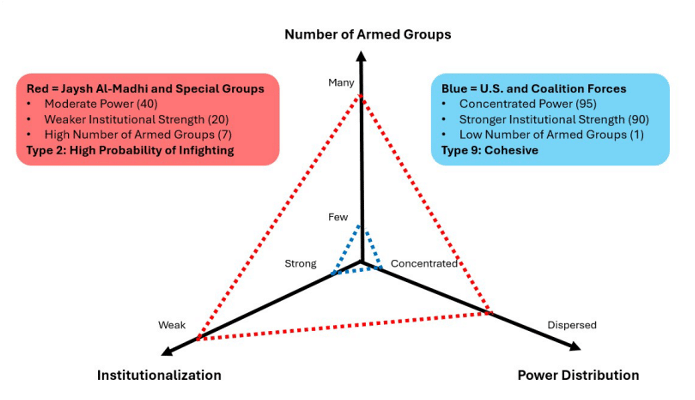
Figure 1. Analysis of fragmentation among armed actors in Sadr City in 2008.[xxviii]
Control operates through interactions among specific actors and broader social connections, resulting in both direct and diffuse arrangements of power.[xxix] Compulsory power (or brute force) is applied through direct means and can be defined as the ability of actor A to get actor B to do what actor B would otherwise not do.[xxx] Mechanisms of control in localized conflict often begin with brute force to conquer a locality, followed by selective violence against unaligned actors that consolidates control.[xxxi] The brute force actor reinforces control through the use of violence, and territorial control can be assessed by reported levels of violence, with higher levels generally indicating greater competition for control.[xxxii] Indiscriminate violence will occur in areas of low control, and acts of selective violence indicate areas of partial control.[xxxiii] Conversely, in areas securely controlled by one’s faction or the government, individuals can report malign actors without significant fear of repercussions, increasing the likelihood that those actors will be identified.[xxxiv]
The Positional Problem in Localized Conflict
In localized conflict, tactical military leaders often face two common challenges: (1) the identification problem (understanding friend versus foe), and (2) the positional problem (understanding how to position forces to protect them from local conflict).[xxxv] The positional problem includes considerations of alliance switching, how to fight the enemy, and how to posture forces to maximize military gains. Addressing the positional problem depends on accurately identifying friendly and enemy actors. This is typically the duty of senior national leaders, not of individual military leaders. However, because of their proximity and local knowledge, military leaders are often placed in positions where they must decide whom to support and whom to fight.[xxxvi] Military leaders in the wars in Iraq and Afghanistan, for instance, were deciding on political solutions without adequate training or experience.[xxxvii] Due to the lack of guidance or training, tactical leaders have often had to rely on personal instincts to assess local actors’ motivations and alliance posture.[xxxviii]
The positional problem can be broken into two key variables: discerning motives, especially among actors with a history of alliance-switching, and determining how to position forces while adjusting to dynamic changes in the local environment.[xxxix] A grave concern is that American counterinsurgency doctrine does not provide tools for discerning actor motivations or the potential for alliance-switching.[xl] Attempting to install a government in a conflict area can cause additional tensions due to supralocal, tribal, and family politics. Moreover, a lack of tools or training for tactical leaders can result in the selection of the wrong local ally (adverse selection).[xli] Therefore, tactical leaders need to be aware of common human biases and their own tendencies before selecting a local ally.[xlii]
Tactical military leaders require training in assessing political motivations and understanding the dynamics of local alliances.[xliii] Political motivations at the local level are often multipolar. Therefore, a tactical leader must be able to view the local political environment through multiple lenses.[xliv] It is important to understand that individual fighters may have different motivations or interests than their leaders.[xlv] Tensions between insurgents and the national government can be mistakenly viewed through a lens of Manichean moralism (us versus them, or good versus evil).[xlvi] A key takeaway is that both tactical leaders and strategists must recognize that local conflict is rarely Manichean. Instead, it reflects a complex mix of personal motivations, competing interests, and struggles for power that must be understood from the perspective of each actor to accurately interpret the human terrain of the battlefield.
Summary of the Literature
A summary of the published literature highlights that localized conflict is complex, dynamic, and nonlinear. The personal motivations of actors may lead to alliance switching, fragmentation, and patterns of interaction intended to improve their relative position or consolidate control. Due to these complexities and varying motivations, counterinsurgents (i.e., the U.S. military) may struggle to determine how best to position their forces in a localized conflict. Analysts must also avoid common errors by developing accurate causal chains that link actor motivations to observed behavior while accounting for effects on the population over time. Finally, a strategist should aim to address potential missing variables in the causal chain between an actor’s motivations and observed behavior. Accurately mapping motivations to actions is a crucial step that requires research, perspective-taking, and an understanding of the local environment.
Research Approach and Analysis
Every policy, strategy, plan, and mission statement is a causal statement, in which some action X leads to an outcome Y. Although we might assume these relationships to be linear, observed reality reveals them to be nonlinear due to the complex nature of the world. Therefore, it is essential to grasp both the causal links of conflict and the intricacies arising from interventions interacting with real-world systems. To understand the complex interplay of these causal links, motivations are mapped to patterns of interaction between two actors at a discrete moment in time. The resulting analysis identifies common patterns that can inform strategists about the best approach for posturing forces in future conflicts.
Developing a foundational understanding of causal logics, or the connections between independent and dependent variables in strategy development, is crucial. The political scientist Craig Parsons proposed four primary causal logics in his 2007 book How to Map Arguments in Political Science. Parsons’s four causal logics are: structural, institutional, ideational, and psychological.
The structural causal logic often characterizes decisions made because of physical constraints, resources, or materials. In other words, the actor detects a landscape that must be navigated to achieve the desired end state.[xlvii] Structural causal logics are typically attributed to “an obstacle course of resources and competitors.”[xlviii] Structural elements can be analyzed to assess the balance of power in an armed conflict. To substantiate a structural causal element, the strategist must be able to infer that the actor studied the environmental obstacles and deliberately chose the best course of action.[xlix] Geography is a good example of a structural causal element: the physical terrain provides an obstacle course that the strategist must navigate to achieve the objective.
Institutional causal logics are derived from local or national hierarchies or institutions that lead actors to a specific path of decision-making.[l] Stated differently, institutions impose rulesets on society that influence behavior and decision-making. A case in point is driving within the speed limit. An actor is unlikely to exceed the speed limit when there are strong institutional forces, such as the local police, that will encourage the actor to follow the law or face punishment. To substantiate an institutional claim, the strategist must be able to demonstrate that actions were formulated because of institutional rulesets and compliance.[li]
Ideational causal elements include decisions derived from practices, symbols, norms, grammars, models, beliefs, ideas, and identities that carry meaning about the world.[lii] Ideational claims start from ambiguity in the objective environment and must be challenged as they are mapped across the causal chain. This is primarily because ideational elements can be viewed through multiple lenses at different levels of society.[liii] A tradition or belief in one part of the country may be observed completely differently in another part of the country. Importantly, ideational causal claims explain a subset of institutions through which people interpret their world. To support an ideational causal claim, the strategist must be able to show that decisions or actions are derived from an actor’s interpretations, rather than from positioning caused by structural or institutional elements.[liv]
Finally, psychological causal elements are derived from hard-wired mental processes that may appear to make an actor seem irrational.[lv] These are often a result of common cognitive biases that have developed in humans to aid in survival. Psychological elements can also explain motivations for armed group alignments. For example, fighters may switch sides if they sense an alliance change will reduce their odds of losing. This can be attributed to the bias of prospect theory, which asserts that the pain of losing is psychologically twice as painful as the pleasure of gaining. In other words, a fighter may take more risks to avert a loss, while avoiding risk for potential gains. The psychological fear of losing drives fighters to seek high-certainty options to win, even if the potential gains are small.[lvi]
Applying causal logic involves using a combination of causal elements to create a story or narrative that could explain patterns of interaction between actors. To successfully leverage these tools, it’s important to understand what motivates opposing actors and what causal links influenced their decision-making. This foundational understanding will align with each actor’s strategic elements of ends, ways, and means. The causal logics approach can equip the military professional to identify key trends and to propose an alternative force posture. The force posture recommendation (offense or defense) will answer the positional problem discussed previously. It will use causal logic analysis to infer the best course of action for the counterinsurgent (defined here as the U.S. military and coalition forces).
The proposed approach is applied to a historical case study as a plausibility probe to determine whether it can serve as a decision-support tool for future strategy development. The research approach is derived from a concept developed by Dr. Celestino Perez, Jr., to connect the causal logics explained previously with narratives, culminating in a pattern of interaction.[lvii] The analysis was modified and expanded from Dr. Perez’s approach by incorporating both actors (versus one), evaluating the military force posture of each actor (offensive or defensive), and using the effects on the population as the primary pattern of interaction. For this paper, the first actor is the counterinsurgent (notated in blue text), and the second actor is the insurgent (notated in red text). An illustration describing this approach is included in Figure 2 below.
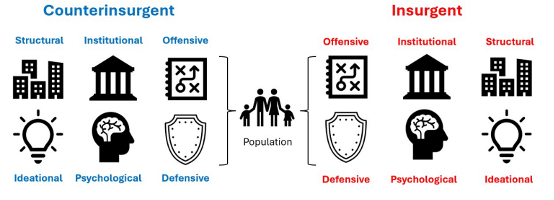
Figure 2. Illustration describing the research approach
The Sadr City case study examines the pattern of interactions between Jaysh al-Mahdi (JAM) militias and American military forces in Iraq during the spring of 2008. Previous research identifies the general population as the center of gravity for a counterinsurgency campaign.[lviii] Therefore, daily civilian casualties were selected as the primary outcome measure for evaluating force posture. Because tactical actions in Sadr City had broader strategic implications for coalition objectives in 2008, civilian casualties capture not only tactical effects but also their potential strategic implications.
Case Study Analysis: Jaysh Al-Mahdi vs. U.S. and Coalition Forces in 2008
This analysis examines the Sadr City neighborhood of Baghdad in 2008, when conflict between JAM and coalition forces intensified. The causal behaviors of both actors were evaluated daily using unclassified military reports and news articles sourced through an online search of the United States Army History and Education Center and the ProQuest database. The unclassified military reports provided narrative descriptions of key events and summarized the number of explosive hazards, enemy actions, and friendly fire in Sadr City daily. The news articles were sourced from a ProQuest search of news articles with keywords “Sadr City” or “al-Sadr” ranging from 1 March 2008 to 31 May 2008. The articles provided perspectives from JAM fighters, civilians in Sadr City, Iraqi government officials, and American service members through statements and interview responses. Overall, 32 unique sources were compiled, and the collected narratives were used to indicate daily motivational behaviors for coalition forces and JAM fighters.
In addition to mapping the causal behaviors of both actors, the positioning of military forces was also estimated for both actors using the same source materials. All behaviors and positions were coded using a binary system, with zero representing no behaviors and one representing observed behaviors. Physical attacks such as explosive hazards, enemy action, and airstrikes were coded as a structural behavioral element. The installation of physical barriers by the counterinsurgents (e.g., concrete walls on Phase Line Gold) was also considered a structural behavior, but through the lens of a defensive posture. Personal attacks or public statements meant to spur on or deter violence were coded as an ideational behavioral element. Institutional behavioral elements were commonly observed when providing basic services to the population or maintaining compliance with mutual agreements or ceasefires. Psychological behaviors included deliberate psychological operations such as the counterinsurgents’ use of pamphlets and radio broadcasts. Typical psychological behaviors observed by the insurgents included deliberate executions combined with elements of torture.
For positioning, any observed attack indicated an offensive position; this included enemy actions, friendly fire, and counterinsurgent air strikes. Offensive activities were indicated with a value of one. If minimal or no military activities were observed, the position was marked as defensive and assigned a value of zero. The insurgents were typically marked in an offensive position unless there were deliberate acts of restraint (e.g., ceasefire). This aligns with Mao’s insurgency principles: “the operations of a guerrilla unit should consist of offensive warfare. Whether its numbers be great or small, such a unit can nonetheless appear where it is not expected and, in its attacks, take advantage of the enemy’s lack of preparations.”[lix]
The process was repeated daily from 1 March 2008 to 31 May 2008. The full table includes three months of activities and notes to help explain the coding and references.[lx] After evaluating all the unclassified reports, news articles, and reports of civilian casualties, a database containing 1,012 observations was compiled for analysis. A seven-day sample of the causal logic analysis is shown in Table 1 below.
Table 1. Causal logic analysis of military actors in Sadr City, Iraq in 2008.
The full dataset of daily military positions and causal elements for both actors over the 92 days was further analyzed using qualitative comparative analysis (QCA). QCA is commonly used in international security studies because it offers distinct advantages for comparative research and enables the analysis of causal claims using Boolean logic and logistic regression.[lxi] In short, QCA helps identify causal pathways that lead to a specific outcome. In this case, the behavioral elements and military positions of both actors were evaluated to determine combinations of pathways that resulted in civilian casualties.
There were three clear phases of battle, as indicated by the numbers of civilian casualties and reported significant activities (SIGACTs) in Sadr City.[lxii] The first phase was pre-conflict, which ranged from 1 March to 24 March 2008. During this phase, the counterinsurgents complied with the ceasefire agreement and remained in a defensive posture. The second phase, intense conflict, began on 25 March and continued through the ceasefire, which began on 10 May 2008. During this phase, the insurgents were primarily in an offensive position, and the counterinsurgents alternated between offensive and defensive positioning. The final phase, post-conflict, began on 11 May. During this phase, the counterinsurgents were complying with the ceasefire and remained in a defensive position. The insurgents attempted to comply with the ceasefire and remained in a primarily defensive position, but there were several days of sporadic attacks because the insurgents did not have complete institutional control over all the special militia groups operating in Sadr City. Figure 3 illustrates the reported SIGACTs in Sadr City from 1 March to 31 May 2008.
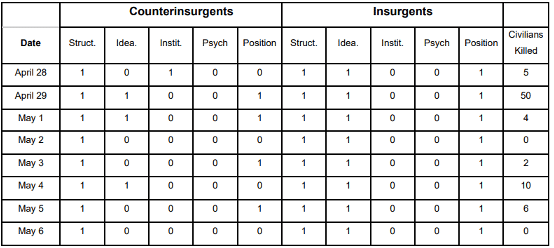
Figure 3. Reported SIGACTs in Sadr City from 1 March to 31 May 2008.
After partitioning the data into the three distinct periods, QCA was conducted separately for each period. The independent variables were the military positions and causal behaviors of both actors. The dependent variable was the reported number of civilian casualties. The QCA analysis was then used to construct minimized Boolean logic pathways for each period. The causal pathways indicate that each behavioral element and force posture is connected to the others through Boolean “AND” relationships that collectively produce the outcome of civilian casualties. When there are multiple rows, as is the case for the peak-conflict scenario, each row is related to the others through an “OR” relationship, resulting in five independent causal pathways. A summary of the analyses is shown in Table 2 below.
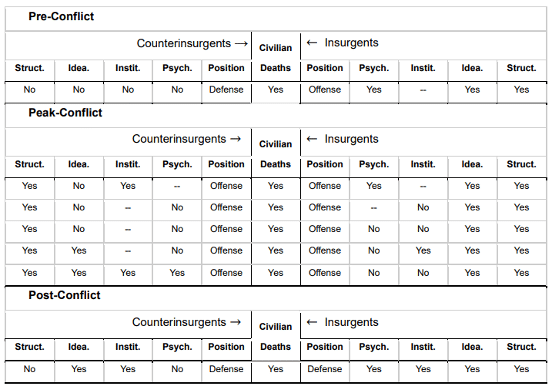
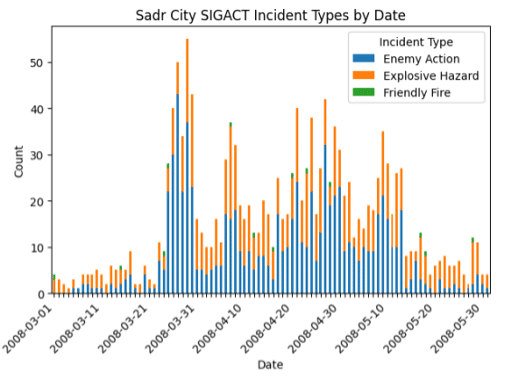
Table 2. Summary of minimal Boolean pathways for each condition.
The analysis shown in Table 2 aligns with the observed behaviors that led to civilian deaths. For example, in the pre-conflict phase, there were several civilian deaths resulting from targeted killings carried out by the insurgents, indicating structural, ideational, and psychological behavioral elements. During the peak-conflict phase, there was a mix of behaviors leading to civilian deaths; however, the highest numbers of daily casualties were related to air strikes conducted by the counterinsurgents, typically launched in response to personal attacks on coalition soldiers within Sadr City. In the post-conflict phase, the counterinsurgents relied heavily on informational and institutional processes to maintain the cease fire. Conversely, the insurgents conducted isolated and targeted attacks during the cease fire despite Al-Sadr’s efforts to control violence in Sadr City using institutional power.
The causal pathway analysis did not fully identify the optimal force posture for minimizing civilian casualties. Therefore, a logistic regression model was used to determine if there were indicators of whether an offensive or defensive position by both sides would lead to an outcome of civilian casualties. Using library functions in R and Python, a logistic probability equation was developed using the mean values of the behavioral causal elements while varying military posture (0 = defensive, 1 = offensive). The analysis was run for both actors to determine how each side of the conflict should posture forces to minimize civilian casualties. As shown in Figure 4, the logistic regression predicts that counterinsurgents should primarily position forces in a defensive posture to minimize civilian casualties. This finding is consistent with observed operational patterns, as offensive actions by the counterinsurgents typically involved airstrikes that produced higher civilian casualty counts because of collateral damage in Sadr City’s dense urban environment.
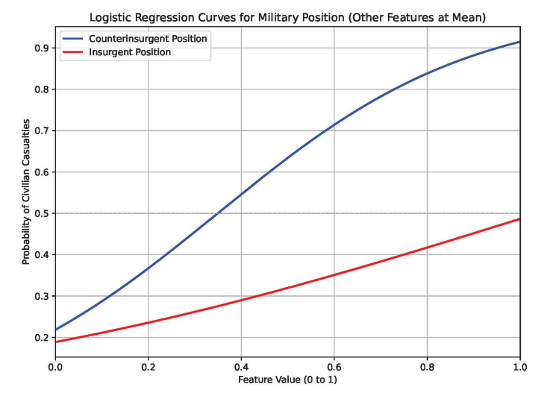
Figure 4. Probability of civilian casualties based on both actors’ military position.
Conversely, the insurgents could use an offensive posture and maintain a lower probability of civilian casualties. This finding is consistent with JAM’s use of civilians and the urban environment to conduct offensive operations. The insurgents also knew that counterinsurgent forces would limit responses to enemy attacks to protect the civilian population. These factors permitted JAM fighters to maintain an offensive posture throughout most of the conflict. This often resulted in the placement of explosive hazards or targeted killings when the counterinsurgents maintained a defensive position.
Analysis of the 2008 Interactions
This approach provides greater granularity regarding actor motivations and offers insights into how counterinsurgents should posture military forces in a dense urban environment. It also aims to address common analysis errors by breaking down actor motivations and discretizing time into daily segments. Analyzing individual slices of time is an intensive exercise, but it provides a rich dataset that can identify missing causal links. Moreover, this method demonstrates that levels of violence and territorial control are dynamic and closely linked to actor motivations and perceptions of an opponent’s behavior. Missing from this analysis are reliable indicators of insurgent fragmentation. A robust dataset of primary sources would be required to accurately map dynamic insurgent alignments.
Discussion and Opportunities for Future Research
The research approach presented here aims to address common analysis errors regarding the dynamic nature of localized conflict. Limitations of this research include missing primary sources from JAM fighters and Sadrist political leaders during the relevant periods. An effort was made to incorporate public statements by Muqtada al-Sadr into the analytical framework. The public comments made by Al-Sadr were followed by increased enemy activity later that day. This highlights that observed ideational behavior can predict military activity. Unfortunately, most of the sources used in this analysis were derived from unclassified American military reports or news articles authored by American media outlets. However, current open-source data aggregation tools that were not available in 2008 now present an opportunity to enhance the approach presented here to better capture the public statements, social media posts, and interview responses of non-American actors involved in localized conflict.
For example, the corpus of 32 sources used for this case study was further analyzed by three commercial large language models (LLMs) and paired with the definitions of behavioral causal logics described earlier. The LLMs were able to quickly summarize a large corpus of 178 pages and highlight patterns of causal logics and military posture. An approach for future case studies could include implementing LLMs with causal logic criteria along with commonly identified keywords. A test analysis from one LLM compiled frequently used words for each category of causal logics, as shown in Table 3 below. A future approach could use aggregated data sources (e.g., news articles, social media posts, etc.) and keywords to identify causal behaviors for both actors in real time. In turn, this could help decision makers quickly determine the best method to position their forces on the battlefield using causal pathways (as described previously in Table 2) and machine learning models (e.g., logistic regression as described previously).
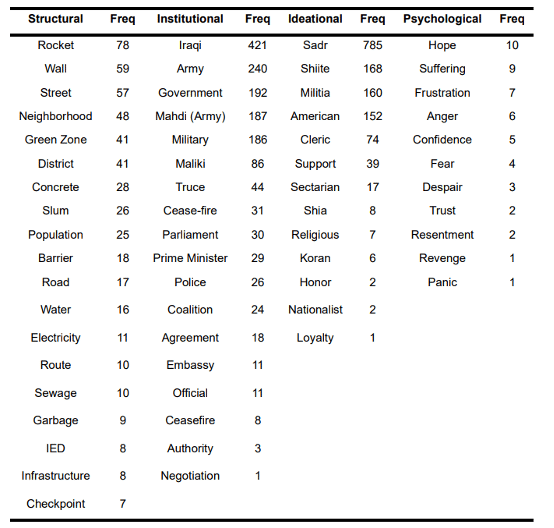
Table 3. Commonly identified words aligned to causal behaviors in the case study.[lxiii]
This approach is not perfect. A human still needs to be in the loop to connect context to behavior. However, it demonstrates that analysts can identify patterns more efficiently with the assistance of data aggregation, large language models, and machine learning.
This research also highlights the challenges of operating highly modern ground forces in an urban environment against a well-hidden and dug-in enemy force. The counterinsurgents continuously adjusted their force posture and counterattacks to minimize collateral damage against civilians. The adjustments were in line with contemporary counterinsurgency doctrine to provide security to the local population. What is less clear from the analysis is whether other tenets of counterinsurgency doctrine were effective in minimizing civilian casualties. Attempts were made by American forces to establish institutional processes for the purpose of providing basic services within Sadr City. The effects of these actions lagged beyond the scope of the selected dates. American forces also attempted to use ideational and psychological behaviors to shape the environment. It remains unclear whether these practices were as effective for counterinsurgents as they were for insurgents, whose efforts appeared to produce more immediate effects. These topics are worthy of future research on causal behaviors in localized conflict.
Another opportunity for future research is accurately determining alliance switching behavior and fragmentation at the local level. It was difficult to assess alliance switching for this case study due to a lack of primary source information. However, advances in information analysis through open-source collection and large language models present an opportunity to more deeply explore the motivations of local actors and their propensity to form alliances. Most importantly, a clearer perspective of local alliance dynamics will help inform leaders on the best approaches to position their forces or to exploit cleavages in support of military effects.
Conclusion
Conflict analysis is typically viewed through a macro-level lens and often overlooks the complex micro and supralocal elements that contribute to the larger war effort. In the convoluted environment of localized conflict, counterinsurgents face challenges with identifying the enemy and determining how to position their forces to maximize military gains. This often leads to tactical leaders making political decisions on the battlefield. This paper presents and analyzes decision-making tools that can assist military leaders at both the tactical and strategic levels.
The tools presented here can provide leaders with a better understanding of actor motivations, empowering those at the tactical level to better distinguish friend from foe, a distinction that shifts as actors determine whom to ally with to maximize their personal position. This improved understanding can lead to guidance on how to position forces to minimize harm to the local population.
The framework presented here is intended to help military strategists and tactical leaders address the positional problem using causal behavioral elements from a historical case study. The causal and positional data collected provide insights into pathways leading to civilian deaths and indicate how a counterinsurgent should position military forces in a dense and urban environment using observations of insurgent behavior.
The findings also demonstrate that strategists can gain a more granular understanding of localized conflict through a careful analysis of actor motivations and force posture. Advances in automation and artificial intelligence can support detailed analyses of causal behaviors. By increasing both the amount of data collected and the speed at which it is processed, these tools can inform strategic and tactical leaders as they determine how best to position forces during conflict, while augmenting rather than replacing human judgment. Paired with real-time data and machine learning, these analytical tools can provide senior leaders with a valuable feedback loop for assessing the strategic environment. Collectively, they have the potential to compress the analysis cycle by enabling the rapid collection and interpretation of detailed data on local dynamics. In conclusion, strategists and tactical leaders can gain valuable insight into insurgent behavior by analyzing causal logics on both sides of a local conflict. The analysis of causal logics can also provide information on the best method to position forces in a combat zone to minimize casualties and protect the local population. This type of analysis is not easy, especially when considering the complexities and fluid nature of localized conflict. Therefore, the counterinsurgent must deliberately attempt to gain perspective on the motivations of all actors in a conflict to conduct a causal logic analysis. Historically, this has been challenging due to a lack of local knowledge and gaps in collected intelligence. However, the decision support tools described here, combined with new machine learning applications, have the potential to quickly aggregate and analyze causal elements. Tactical leaders can use these tools to help make decisions on the battlefield and provide feedback mechanisms to strategists overseeing the larger war effort. Most crucially, these insights can help future counterinsurgents act more quickly to protect the local population and to ultimately establish the conditions necessary to secure a peacefu
Endnotes
[i] M. C. Mason, “COIN Doctrine Is Wrong,” Parameters 51, no. 2 (2021): 22, https://doi.org/10.55540/0031-1723.3065.
[ii] Séverine Autesserre, “International Peacebuilding and Local Success: Assumptions and Effectiveness,” International Studies Review 19, no. 1 (2017): 5.
[iii] Craig Parsons, How to Map Arguments in Political Science (Oxford: Oxford University Press, 2007), 134.
[iv] Richard K. Betts, “Is Strategy an Illusion?” International Security 25, no. 2 (2000): 7.
[v] Aaron Rapport, “The Long and Short of It: Cognitive Constraints on Leaders’ Assessment of ‘Postwar’ Iraq,” International Security 37, no. 3 (Winter 2012/13): 140–41.
[vi] Stathis N. Kalyvas, “The Ontology of ‘Political Violence’: Action and Identity in Civil Wars,” Perspectives on Politics 1, no. 3 (2003): 480.
[vii] Autesserre, “International Peacebuilding,” 5.
[viii] Hannah Arendt Center, “Critical Thinking, Judgment, and Empathy,” Hannah Arendt Center for Politics and Humanities at Bard College, April 20, 2015, https://hac.bard.edu/amor-mundi/critical-thinking-judgment-and-empathy-2015-04-20; Joseph MacKay, The Counterinsurgent Imagination: A New Intellectual History (Cambridge: Cambridge University Press, 2023), 162.
[ix] Kalyvas, “The Ontology of ‘Political Violence,’” 475.
[x] Kalyvas, “The Ontology of ‘Political Violence,’” 476.
[xi] Kalyvas, “The Ontology of ‘Political Violence,’” 485.
[xii] William E. Connolly, The Fragility of Things: Self-Organizing Processes, Neoliberal Fantasies, and Democratic Activism (Durham, NC: Duke University Press, 2013), 401.
[xiii] Connolly, The Fragility of Things, 401.
[xiv] Kathleen Gallagher Cunningham, “Actor Fragmentation and Civil War Bargaining: How Internal Divisions Generate Civil Conflict,” American Journal of Political Science 57, no. 3 (2013): 662, https://www.jstor.org/stable/23496645.
[xv] Cunningham, “Actor Fragmentation and Civil War Bargaining,” 668.
[xvi] Cunningham, “Actor Fragmentation and Civil War Bargaining,” 662.
[xvii] Sabine Otto, “The Grass Is Always Greener? Armed Group Side Switching in Civil Wars,” Journal of Conflict Resolution 62, no. 7 (2018): 1462–63.
[xviii] Otto, “The Grass Is Always Greener,” 1462.
[xix] Celestino Perez, “The Positional Problem in Civil Wars,” Small Wars & Insurgencies, online version 31 December 2025, 30.
[xx] Parsons, How to Map Arguments, 12.
[xxi] Fotini Christia, Alliance Formation in Civil Wars (New York: Cambridge University Press, 2012), 11.
[xxii] Parsons, How to Map Arguments, 139.
[xxiii] Parsons, How to Map Arguments, 140.
[xxiv] Otto, “The Grass Is Always Greener,” 1472, 1481.
[xxv] Kristin M. Bakke, Kathleen Gallagher Cunningham, and Lee J. M. Seymour, “A Plague of Initials: Fragmentation, Cohesion, and Infighting in Civil Wars,” Perspectives on Politics 10, no. 2 (2012): 272.
[xxvi] Bakke, Cunningham, and Seymour, “A Plague of Initials,” 279.
[xxvii] Bakke, Cunningham, and Seymour, “A Plague of Initials,” 279.
[xxviii] Stephen Biddle, Nonstate Warfare: The Military Methods of Guerillas, Warlords, and Militias (Princeton, NJ: Princeton University Press, 2021), 163–68; Bakke, Cunningham, and Seymour, “A Plague of Initials,” 279.
[xxix] Michael Barnett and Raymond Duvall, “Power in International Politics,” International Organization 59, no. 1 (Winter 2005): 48.
[xxx] Barnett and Duvall, “Power in International Politics,” 49.
[xxxi] Stathis N. Kalyvas and Matthew Adam Kocher, “The Dynamics of Violence in Vietnam: An Analysis of the Hamlet Evaluation System (HES),” Journal of Peace Research 46, no. 3 (2009): 339, https://www.jstor.org/stable/25654409.
[xxxii] Kalyvas and Kocher, “The Dynamics of Violence in Vietnam,” 339.
[xxxiii] Kalyvas and Kocher, “The Dynamics of Violence in Vietnam,” 339.
[xxxiv] Kalyvas and Kocher, “The Dynamics of Violence in Vietnam,” 339.
[xxxv] Perez, “The Positional Problem,” 4.
[xxxvi] Perez, “The Positional Problem,” 17.
[xxxvii] Perez, “The Positional Problem,” 3.
[xxxviii] Perez, “The Positional Problem,” 11.
[xxxix] Perez, “The Positional Problem,” 9.
[xl] Perez, “The Positional Problem,” 10.
[xli] Perez, “The Positional Problem,” 27.
[xlii] Perez, “The Positional Problem,” 28.
[xliii] Perez, “The Positional Problem,” 33.
[xliv] Perez, “The Positional Problem,” 34.
[xlv] Perez, “The Positional Problem,” 35.
[xlvi] Perez, “The Positional Problem,” 5.
[xlvii] Parsons, How to Map Arguments, 62.
[xlviii] Parsons, How to Map Arguments, 17.
[xlix] Parsons, How to Map Arguments, 63.
[l] Parsons, How to Map Arguments, 12.
[li] Parsons, How to Map Arguments, 91.
[lii] Parsons, How to Map Arguments, 12.
[liii] Parsons, How to Map Arguments, 98.
[liv] Parsons, How to Map Arguments, 129.
[lv] Parsons, How to Map Arguments, 12.
[lvi] Parsons, How to Map Arguments, 19.
[lvii] Celestino Perez Jr., “Causal Literacy: Strategic Analysis” (unpublished article, March 5, 2025), 1–15.
[lviii] John A. Nagl, Learning to Eat Soup with a Knife: Counterinsurgency Lessons from Malaya and Vietnam (Chicago: University of Chicago Press, 2005), 25.
[lix] Mao Tse-Tung, Basic Tactics (New York: Frederick A. Praeger, 1966), 83.
[lx] Multi-National Corps–Iraq, Battle of Phase Line Gold in Sadr City, Iraq (Baghdad, Iraq: Department of Defense, 2008), 1–22; Andrew Shaver, Replication Data for: Disorganized Political Violence: A Demonstration Case of Temperature and Insurgency, V2 (Harvard Dataverse, 2022), https://doi.org/10.7910/DVN/JRYGFP; iCasualties.org, Operational Iraqi Freedom Dataset, accessed February 15, 2025, https://icasualties.org; Dan Senor and Roman Martinez, “Whatever Happened to Moqtada?,” Wall Street Journal, March 20, 2008, A19, ProQuest; Raheem Salman, “The Conflict in Iraq: Sadr’s Militia Flexes Its Muscles: Militia Keeps U.S., Iraqi Forces Out of Sadr City; Shiites Retain Their Grip on the Area. In Basra, a Clampdown Continues,” Los Angeles Times, March 27, 2008, A8; Sudarsan Raghavan, “19 Tense Hours in Sadr City Alongside the Mahdi Army,” Washington Post, March 28, 2008, A1, ProQuest; Sudarsan Raghavan, “On a Baghdad Street, Palpable Despair; Residents Embittered Politicians’ Choices,” Washington Post, March 31, 2008, A16, ProQuest; Sam Dagher, “Anger Follows the Fight with Sadr’s Militia,” The Christian Science Monitor, April 1, 2008, https://www.csmonitor.com/World/Middle-East/2008/0401/p06s02-wome.html; “U.S. Troops Killed as Fighting Reignites in Sadr City,” Morning Edition, April 7, 2008, Gale General OneFile, accessed February 14, 2025, https://link.gale.com/apps/doc/A177567491/ITOF?u=columbiau&sid=bookmark-ITOF&xid=28f48ee9; Ned Parker and Raheem Salman, “The World; Deadly Fighting Erupts in Baghdad; The Violence Paralyzes Sadr City and Kills Three U.S. Troops. Two Others Are Killed Elsewhere,” Los Angeles Times, April 7, 2008, A3; James Glanz and Stephen Farrell, “Iraqi Offensive Against Militia Is Raising Concerns on Stability,” New York Times, April 8, 2008, A1, ProQuest; Michael R. Gordon, “Hearing Intrudes in Sadr City, If Power Lasts,” New York Times, April 9, 2008, A13, ProQuest; Amit R. Paley, “Sadr City Fighting Leaves 10 Dead: Violence in Area Appears to Wane,” Washington Post, April 10, 2008, A1, ProQuest; Stephen Farrell, “In Sadr City, Leisurely Preparations for War,” The New York Times, April 11, 2008, sec. World, https://www.nytimes.com/2008/04/11/world/africa/11iht-11iraq.11888907.html; Institute for the Study of War, “Statement by Muqtada al-Sadr,” accessed February 20, 2025, https://www.understandingwar.org/arabic-news/statement-muqtada-al-sadr; Sholnn Freeman, “Iraqis, U.S. Intensify Actions in Sadr City,” Washington Post, April 13, 2008, A15, ProQuest; Michael R. Gordon, “Iraqi Soldiers Abandon Posts in Sadr City,” The Globe and Mail, April 16, 2008, A17, ProQuest; Michael R. Gordon, “U.S. Begins Erecting Wall in Sadr City,” The New York Times, April 18, 2008, sec. World, https://www.nytimes.com/2008/04/18/world/middleeast/18sadrcity.html; Alissa J. Rubin and Stephen Farrell, “Sadr City Fighters Lay Defenses Amid Latest Official Efforts at Calm,” The New York Times, April 19, 2008, sec. World, https://www.nytimes.com/2008/04/19/world/middleeast/19iraq.html; Michael R. Gordon, “Sadr City’s Daily Gun Battles Rage On, and Civilians Suffer,” The New York Times, April 21, 2008, https://www.nytimes.com/2008/04/21/world/africa/21iht21sadr.12175106.html; Michael R. Gordon, “In Sadr City, Basic Services Are Faltering: Delay Threatens Effort to Thwart Militias,” New York Times, April 22, 2008, A1, ProQuest; Michael R. Gordon, “Fighting Impedes Restoration of Basic Services in Sadr City Section of Baghdad,” The New York Times, April 22, 2008, https://www.nytimes.com/2008/04/22/world/africa/22ihtbaghdad.4.12236670.html; Alissa J. Rubin, “Sadr Tells Forces Not to Attack Iraqis,” The New York Times, April 24, 2008, https://www.nytimes.com/2008/04/24/world/middleeast/26iraq.html; Michael R. Gordon, “Amid Sadr City Chaos, American Medics Tend to Iraq’s Wounded,” New York Times, April 25, 2008, A1, ProQuest; Erica Goode, “Fighting in Sadr City Cuts Short Effort to Collect Trash,” New York Times, April 27, 2008, A14, ProQuest; Al Jazeera, “Many Killed in Sadr City Fighting,” accessed February 20, 2025, https://www.aljazeera.com/news/2008/4/28/many-killed-in-sadr-city-fighting; Amit R. Paley, “U.S. Role Deepens in Sadr City: Fierce Battle Against Shiite Militiamen Echoes First Years of War,” Washington Post, April 29, 2008, A1, ProQuest; Associated Press, “28 Militants Killed in Iraq by U.S. Troops,” Moose Jaw Times-Herald, April 30, 2008, online edition; Howard Lafranchi, “U.S. Death Toll Rises as It Digs In against Iraq’s Shiite Militias,” Christian Science Monitor, accessed February 24, 2025, https://www.csmonitor.com/World/Middle-East/2008/0501/p06s02-wome.html; Tareq Mahir, “Missiles Strike Sadr City, Damaging Hospital,” New York Times, May 4, 2008, A1, ProQuest; Bradley Brooks, “Humanitarian Woes Mounting in Sadr City: Food Shortage Gets Worse as Fighting Rages,” South Florida Sun-Sentinel, May 8, 2008, A16, ProQuest; “Deal Reached on Truce in Sadr City,” New York Times (Online), May 10, 2008, sec. World, ProQuest; Alissa J. Rubin, “Sadr City Truce: Will It Last?,” The New York Times, May 11, 2008, sec. World, https://www.nytimes.com/2008/05/11/world/africa/11ihtiraq.1.12765920.html; “Militants Withdraw from Streets of Sadr City,” The New York Times, May 11, 2008, sec. World, https://www.nytimes.com/2008/05/11/world/africa/11iht-iraq.4.12776709.html; Sudarsan Raghavan, “Delicate Deal Helps Decrease Violence in Baghdad’s Sadr City Enclave,” Washington Post, May 11, 2008, A14, ProQuest; Michael R. Gordon and Stephen Farrell, “In Sadr City, a Cease-Fire Is Put to the Test, and Fails,” The New York Times, May 12, 2008, https://www.nytimes.com/2008/05/12/world/middleeast/12sadr.html; Alexandra Zavis, “Iraqis Approach Sadr City Truce with Caution,” Newport News Daily Press, May 12, 2008, C1, ProQuest; “In Spite of Truce, War over Wall Goes On in Sadr City,” The New York Times, May 15, 2008, https://www.nytimes.com/2008/05/15/world/africa/15iht15wall.12900275.html; Ernesto Londono and Sudarsan Raghavan, “Iraqi Troops Welcomed in Sadr City: U.S. Absence Seems to Make Difference,” New York Times, May 21, 2008, A1, ProQuest; Amit R. Paley, “U.S. Deploys a Purpose-Driven Distinction: Reluctance to Identify Foes as Sadrists Reflects View of Iran and Fragility of Security Gains,” Washington Post, May 20, 2008, https://www.washingtonpost.com/archive/national/2008/05/21/us-deploys-a-purposedriven-distinction/2f64166e-78cf-4c24-ad9e-390c2087810f/; Damien McElroy, “US Is Excluded from Sadr City,” Daily Telegraph, May 24, 2008, 20, ProQuest; Stephen Farrell and Richard A. Oppel Jr., “Amid Calm in Sadr City, Officials and Cleric’s Backers Swap Charges of Weakness,” The New York Times, May 26, 2008, https://www.nytimes.com/2008/05/26/world/middleeast/26iraq.html; Tina Susman and Usama Redha, “Iraqis Losing Patience with Militiamen; Cleric Muqtada Sadr’s Group Has Helped and Protected Residents, but Recent Fighting Has Endangered Their Lives,” Los Angeles Times, May 27, 2008, https://www.latimes.com/archives/la-xpm-2008-may-27-fg-mahdi27-story.html.
[lxi] Andreas Kruck and Andrea Schneiker, eds., Researching Non-State Actors in International Security: Theory and Practice, 1st ed. (Routledge, 2017), 123; Adrian Dusa, QCA with R: A Comprehensive Resource (Springer International Publishing, 2019).
[lxii] Andrew Shaver, Replication Data for: Disorganized Political Violence: A Demonstration Case of Temperature and Insurgency, V2 (Harvard Dataverse, 2022), https://doi.org/10.7910/DVN/JRYGFP; iCasualties.org, Operational Iraqi Freedom Dataset, accessed February 15, 2025, https://icasualties.org.
[lxiii] Claude, response to “I am searching for specific words that meet the criteria of four behavioral causal logics as described in the pasted paragraphs. Can you provide common words found in the corpus that highlight either structural, ideational, institutional, or psychological causal logics?,” Anthropic, March 31, 2025.
CONTACT Josh Aldred, josh.aldred@us.af.mil
The views expressed in this article are solely those of the author(s) and do not necessarily reflect the views, policy, or position of the U.S. Air Force.
© 2026 Arizona Board of Regents/Arizona State University